preferred on

Key Takeaways
- Aztec Labs’ Graham Nelson told AlphaWire at Solana Breakpoint 2026 that data breaches fuel demand for private payments.
- The Tierra upgrade halved proof times in Aztec’s benchmark as Zk.money pursues private stablecoin payments.
- A proposed disclosure feature would let users give compliance reviewers one-time access to selected transactions.
Revolut confirmed a data breach, reported Sept. 12, after fraudulent information requests came from a government agency’s email domain. Gnosis Pay disclosed on Nov. 6 that a breach of its legacy card system had exposed customer information. It detected the intrusion on Nov. 3 and confirmed that customer funds were unaffected. Former user Lefteris Karapetsas wrote on X that the exposed data included his home address, card number, and linked wallet addresses.
At this point I really don't know what to say @gnosispay
– Full home, name and address details
– Card number
– All wallet addresses linked to the accountExtremely disappointed. You had already lost me as a user but you could have at least protected my data ….
Damn shame,… pic.twitter.com/e4yqNZquxJ
— Lefteris Karapetsas (@LefterisJP) November 6, 2026
Chainalysis counted 46 wrench attacks through late June 2026, up from 40 in the same period of 2025. Its Aug. 6 report calls an alleged 2024 sale of French crypto holder dossiers the likeliest culprit for France’s surge.
Aztec Labs relaunched Zk.money on Sept. 29 as a self-custodial wallet for private transfers on the Aztec Network. Speaking with Dr. Guneet Kaur, AlphaWire’s head of content strategy and media relations, on the sidelines of Solana Breakpoint 2026 in London on Nov. 16, Graham Nelson said data breaches fuel demand for private payments. Nelson leads go-to-market for Zk.money at Aztec Labs.
How breaches link identities to wallet activity
Nelson pointed to Revolut and Gnosis Pay as examples of why users might seek onchain privacy. The biggest risk, in his view, is that exposed personal data can link a person to their financial activity onchain.
Intruders who access centralized records at banks and fintechs can piece together a fuller profile of a customer, Nelson warned. “More banks, more fintechs, more crypto fintechs are gonna be exposed.” Each hack, he added, “does the marketing for us,” though he called the incidents “never nice to see.”
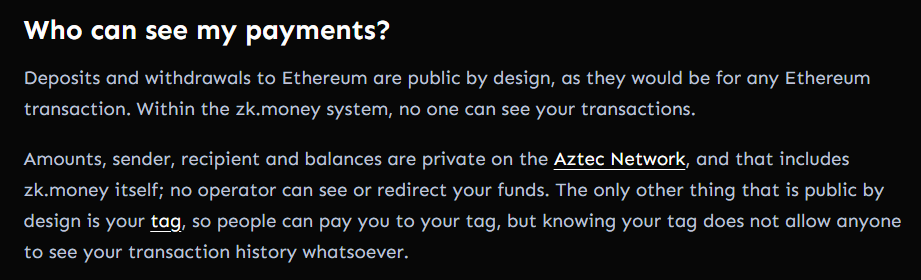
Nelson framed Zk.money as a response, arguing users alone can see their private transactions even after a data exposure. Zk.money’s FAQ draws a boundary around that protection. Ethereum deposits and withdrawals are public by design, while amounts, senders, recipients, and balances stay private on the Aztec Network.
Faster proofs and private stablecoin payments shape Zk.money’s neobank ambitions
Nelson cited compute cost as what keeps privacy from becoming a default, with delays of one to 10 minutes. The Aztec Foundation announced Tierra, the v6 network upgrade, on Nov. 3. It reported one-second client-side proofs on a native device, a 2x speedup from the previous version. The announcement gave no end-to-end settlement time for private transactions.
The foundation put Ethereum-to-Aztec message delivery at as low as 12 seconds, down from a two-minute average. Tierra also fixes the critical v5 vulnerability disclosed on Aug. 7. Nelson called the upgrade a big step toward more convenient zero-knowledge applications while acknowledging room for improvement.
Aztec Tierra is built on a stronger foundation.
Major security upgrades. Formal verification of core cryptographic components. A new AI-powered security testing harness.
Plus client-side proofs in as little as 1 second on native.
Powerful privacy. Serious infrastructure.
— Aztec (@aztecnetwork) November 3, 2026
Nelson answered “100%” when asked whether private stablecoin payments are the next big opportunity for zero-knowledge technology. Contractors and security auditors paid onchain, he argued, cannot have their salaries public and traceable back to an identity.
He described a future where Zk.money sits “on the edge of being a neobank” with bank-grade privacy. With Zk.money, users claim a tag such as “name.zk.money,” secured by a passkey, and share links to send or request funds. He also cited ZKPassport, an Aztec Labs product that lets users prove their age or nationality with a one-time proof.
User-consented disclosure for regulators
Nelson observed that regulators have grown comfortable with public blockchains because transactions are easy to trace end to end. He described Aztec as building toward letting users choose which transactions to share and which third party can see them. For a compliance check, a user would give the reviewer a one-time view, he explained.
Nelson rejected the backdoor label, noting that “a backdoor means that one person can access everything.” As of Nov. 17, Zk.money’s FAQ mentions neither viewing keys nor selective disclosure.
Zk.money’s wallet already runs a separate check when funds enter or leave. It screens deposit and withdrawal addresses against a sanctions policy through Predicate, with checks running offchain.
The EU’s Anti-Money Laundering regulation enters into force on July 10, 2027. Its Article 79 bars crypto-asset service providers from keeping accounts that allow anonymization or increased obfuscation of transactions. Recital 160 exempts self-hosted wallet providers without access to or control over the wallets.

Ethereum, Solana, and Near build rival privacy stacks
Nelson predicted every chain will have some kind of privacy stack. He cited Vitalik Buterin on Ethereum, Helius on Solana, and Near Intents.
Buterin listed short-term steps toward native privacy on Ethereum in a May 20 post on X, including account abstraction plus fork-choice enforced inclusion lists.
Helius launched Solana Privacy Rings on mainnet on Nov. 10, encrypting assets and amounts while leaving wallet addresses visible. The Solana Foundation lists auditor visibility and selective disclosure among planned Custom Rings features, which remain in audit.
Short-term things being done to shift Ethereum toward native privacy:
* AA + FOCIL (makes privacy protocol txs, among many other things, first-class with strong inclusion guarantees)
* Keyed nonces: https://t.co/BeTJvFhxiV
* Access-layer work (Kohaku, private reads…) https://t.co/MImWVYXBQv— vitalik.eth (@VitalikButerin) May 20, 2026
Near added Confidential Intents on Feb. 25, creating a restricted-visibility environment for cross-chain transactions. Nelson argued Aztec’s edge is five to six years of building the technology and learning its difficulties.
In 2027, Nelson wants more users to understand how public onchain activity can link financial data to their identities. He pointed to wrench attacks as a risk and noted that users are starting to adopt privacy apps.
Aztec Labs points to the first Zk.money as evidence of demand. That version attracted more than 75,000 unique wallets and recorded over $100 million in first-year volume.