preferred on


Points of Focus
- Binance’s $6.3-billion hack may have originated from a compromised engineer’s laptop, with no evidence of leaked private keys.
- About $3 billion in assets were frozen, while Binance pledged to cover all customer losses.
- Unauthorized transfers continued after Binance paused withdrawals, exposing a gap between withdrawal suspension and onchain authorization revocation.
Binance suffered a multichain hot-wallet breach on Oct. 29, potentially the largest crypto theft on record.
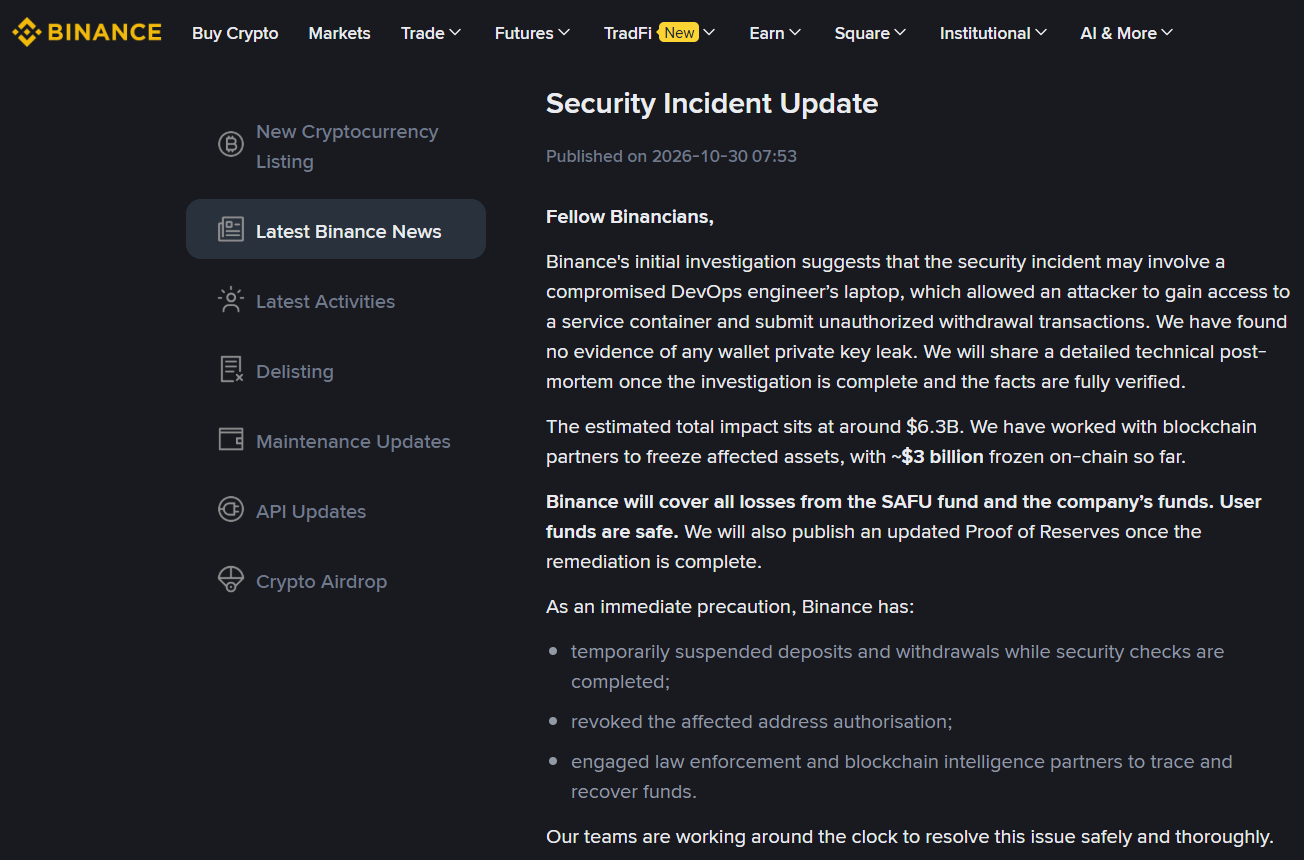
On Oct. 30, it said that an attacker may have breached a DevOps engineer’s laptop, reached a service container, and submitted unauthorized withdrawals. The exchange puts the total impact near $6.3 billion but found no evidence of leaked wallet private keys.
This is a developing story, and Binance has promised a technical post-mortem that it had not published as of Oct. 30.
What Binance has confirmed and what it has not
Binance said it temporarily suspended deposits and withdrawals, canceled an affected address authorization, and brought in law enforcement and analytics companies to track the funds. At 04:17 UTC, co-founder Yi He said Binance expects to begin resuming withdrawals within 48 hours, with deposits unaffected.
**Service Update**
Deposits remain unaffected and continue to operate as normal.
Our team is currently working on enhancements to the withdrawal service and related address controls. We expect to begin resume withdrawal services in the next 48 hours.
We will continue to share…
— Yi He (@heyibinance) October 30, 2026
The exchange committed to absorbing every loss through its emergency Secure Asset Fund for Users and corporate funds. It also promised an updated proof-of-reserves after remediation.
Binance’s statement doesn’t detail how the laptop was compromised, how the attacker entered the service container, or whether employee credentials were involved.
Binance reported about $3 billion frozen on Oct. 30. Bitquery and TRM Labs each counted about $2.7 billion frozen onchain, predominantly by Tether and Circle.
Tether froze more than 1.567B USDT related to a potential Binance exchange hack.
Protecting the industry and our partners is our main priority.
Stay safe everyone.
— Paolo Ardoino 🤖 (@paoloardoino) October 29, 2026
At 03:54 UTC on Oct. 30, Bitquery found the attacker still holding about $3.1 billion, mainly Ether (ETH) and Bitcoin (BTC), with none of it sent to exchanges or mixers.
How the attacker used Binance’s own signatures
TRM Labs traced $6.36 billion leaving Binance wallets on 10 chains on Oct. 29, all with valid signatures. Bitquery estimates Binance’s $6.3-billion impact at roughly four times the $1.5 billion stolen in the February 2025 Bybit hack, previously the largest crypto theft on record.
On Ethereum, Binance’s system signed 50 Ethereum Improvement Proposal (EIP) 7702 authorizations targeting its Binance 14 hot wallet. One matched the required nonce, letting the wallet execute attacker-controlled code.

Blockaid CEO Ido Ben-Natan reportedly said his preliminary assessment points to a compromise of Binance’s signing infrastructure rather than stolen private keys. He also raised the possibility of multiple compromised devices and movement through Binance’s network.
Bitquery notes that onchain records cannot identify who instructed Binance’s system to sign transactions, so the laptop account remains Binance’s preliminary finding.
Onchain transfers continued after Binance paused withdrawals
Bitquery’s timeline shows unauthorized Ethereum transfers until 23:56 UTC on Oct. 29, after Binance reportedly began suspending withdrawals on multiple networks around 22:33 UTC. The exchange canceled the malicious EIP-7702 authorization at 00:10 UTC on Oct. 30, nearly four hours after it took effect on Binance 14, one of Binance’s major Ethereum hot wallets.

Blockaid separately documented a 21:44 UTC sweep on Oct. 29 of more than $200 million in fresh deposits. The attacker needed no additional signature from Binance 14.
Pausing customer withdrawals does not revoke existing onchain permissions. Clearing this delegation required a new authorization pointing to the zero address, Blockaid explained.
Bitquery’s timeline does not establish when Binance isolated its internal systems or whether alerts were missed. Nor does it explain why revocation took until 00:10 UTC.