preferred on


Points of Focus
- 1inch and the Blockchain Association will host Groundwork in Washington, DC, on Oct. 16 to advance DeFi education.
- Universities are expanding DeFi courses, but gaps remain between theory and practical skills.
- Growing adoption of stablecoins and tokenization highlights the need for stronger, independent DeFi education.
On October 16, students, professors, policymakers, and DeFi builders will meet in Washington, DC, for Groundwork, an education-focused forum organized by 1inch and the Blockchain Association.
The event is part of 1inch Forward, an initiative launched in March that encourages US business and law schools to incorporate digital assets, blockchain, and decentralized finance into their curricula.
The initiative raises a broader question: how well do current programs prepare future finance professionals, lawyers, and regulators to assess the interactions among financial services, technology, custody, and governance in onchain systems? Moving financial activity onto software-based systems does not remove the need to understand those underlying functions.
Groundwork is in Washington DC on purpose.
The rules for this industry are being written here. The students who will spend their careers working under those rules are at universities across the city. Groundwork puts both in one room for an afternoon.
Co-hosted by 1inch Forward… pic.twitter.com/5fe8yBG4wN
— 1inch (@1inch) October 9, 2026
1inch Warns of Growing Gap Between DeFi Education and Real-World Skills
Orest Gavryliak, Chief Legal Officer at 1inch, told AlphaWire that DeFi remains a limited part of many university curricula, rather than suggesting that universities have ignored the sector entirely.
“We are increasingly seeing universities include DeFi in courses on innovation in finance, but it remains a niche subject, often an elective rather than a core module.”
This is relevant to the article’s central question. Familiarity with consensus mechanisms or token economics does not necessarily mean a student can evaluate wallet permissions, liquidity mechanisms, governance processes, or custody arrangements. Gavryliak describes what he sees as a practical gap:
“Students may learn blockchain theory, but not how wallets, liquidity, smart contracts, governance, and custody work in practice. As a result, much of the practical understanding of the ecosystem still comes from outside the classroom. However, with increasing regulatory clarity, curricula need updating. DeFi needs to be a more prominent part of the course structure, ensuring students keep pace with the technology and systems already being used by industry leaders.”
1inch has developed education initiatives in response to this concern. On March 18, the company and more than 20 DeFi organizations and advocacy groups issued an open letter encouraging US business and law schools to include more material on digital assets and DeFi. The company has also taken 1inch Forward to campuses, developed its DeFi Academy, and released ReDefine Money, an oral history based on interviews with DeFi founders.
DeFi Education at NYU, Stanford and MIT: What’s Still Missing?
The available examples suggest that some universities are already teaching aspects of decentralized finance. In spring 2026, NYU Stern offered Introduction to Decentralized Finance, covering topics including lending, automated market makers (AMMs), stablecoins, governance, regulation, and security risks. Stanford’s fall 2026 Blockchain Technologies syllabus includes topics such as wallets, Solidity, stablecoins, lending protocols, and decentralized exchanges. MIT’s graduate course Blockchain and the Design of Financial Systems examines distributed ledgers and smart contracts alongside economics, tokenized assets, and regulation.
These examples complicate broad claims that universities have not addressed DeFi. A more specific question is how widely this material is available, whether it is elective or required, and how well it prepares students in business and law programs to assess onchain financial systems. The examples cited here do not, by themselves, establish how representative these courses are of university curricula overall.
This difference also raises the question of what practical education should involve. The aim need not be to turn finance courses into trading laboratories. Coursework could instead examine real-world issues such as smart-contract failures, concentration of control, oracle dependencies, liquidity constraints, custody, and the difference between direct asset control and arrangements in which another party controls the assets.
These issues are relevant to both crypto markets and traditional financial institutions. They can be difficult to teach through text alone because technologies, platforms, and regulatory approaches continue to evolve. One approach is to combine foundational concepts with current case studies and opportunities to examine how these systems work in practice.
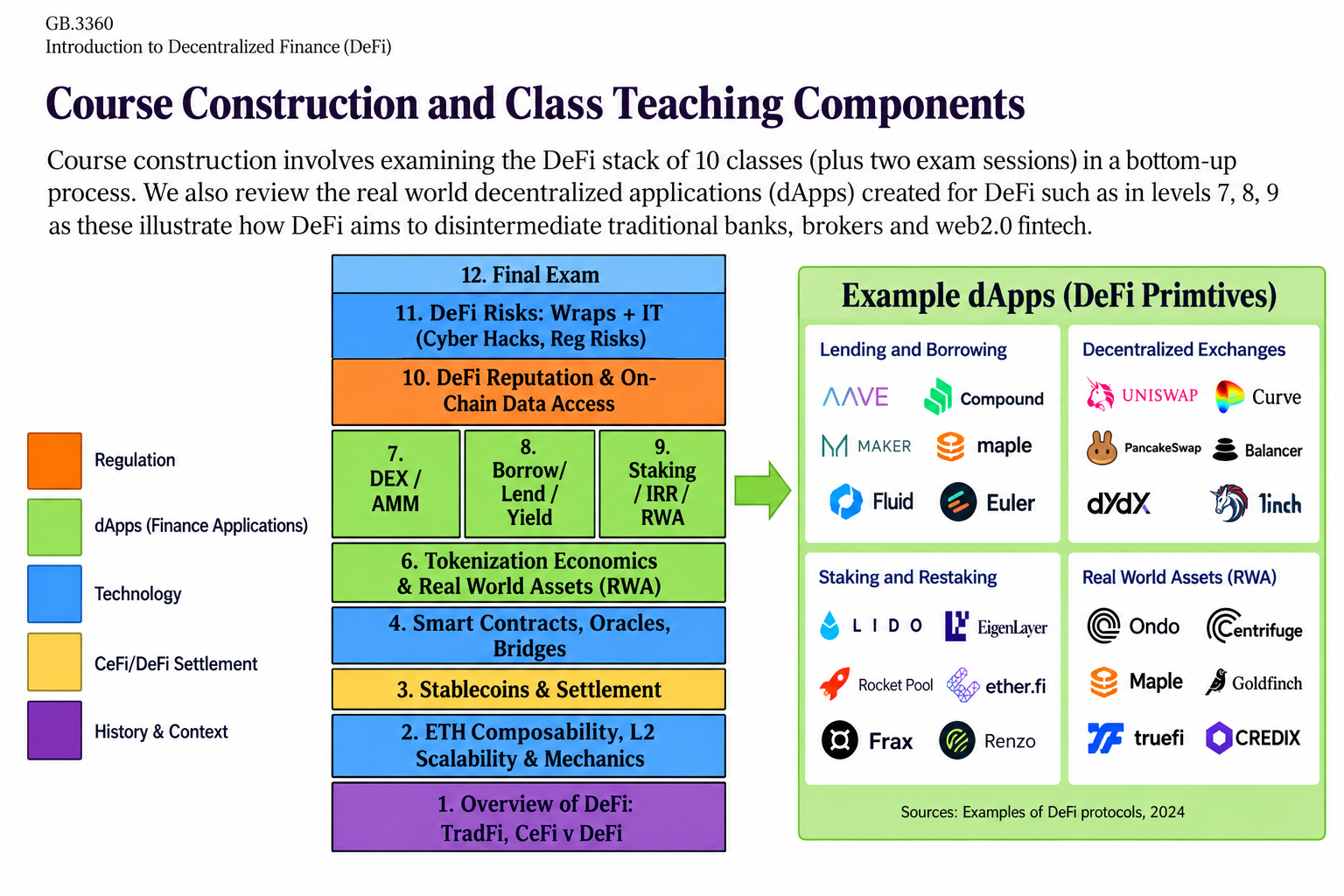
NYU Stern’s DeFi curriculum structure and examples of decentralized finance applications. Source: NYU Stern
Some traditional financial institutions are also exploring blockchain-based financial services. Morgan Stanley’s work on stablecoins, tokenized deposits, and DeFi applications; activity involving stablecoin payment rails at Coinbase and Citi; and USDC settlement tests involving Lloyds and Visa. These examples represent different types and stages of activity and should be verified against primary sources before publication. They do not establish that DeFi has achieved broad adoption, but they provide context for considering whether onchain finance should be addressed in relevant finance curricula.
How 1inch Groundwork Is Bridging the Gap Between DeFi Education and Industry
Groundwork is designed to bring students and academics into conversation with people developing, overseeing, and advising on digital-finance systems. Its October 16 agenda includes participants from Circle, Robinhood, Uniswap, Fireblocks, Digital Asset, and OpenZeppelin, alongside panels and roundtables on regulation, tokenized real-world assets, trust, careers, and AI.
Gavryliak argues that collaboration should extend beyond guest lectures:
“Through practical, ongoing collaboration: live DeFi systems in coursework, real case studies, and direct exposure to what careers in Web3 would look like across streams (engineering, law, policy, compliance, and product).”
“Hackathons and community events are especially valuable. They give students hands-on experience building with the technology and can also open doors to real opportunities; 1inch itself was born out of a hackathon”
This approach reflects 1inch’s education strategy, while also raising a question for universities: how can they draw on industry expertise while maintaining academic independence? Industry participants can contribute practical examples and technical knowledge, but they also have commercial interests. Curriculum design therefore needs room for independent assessment of the products, protocols, and policy positions being studied.
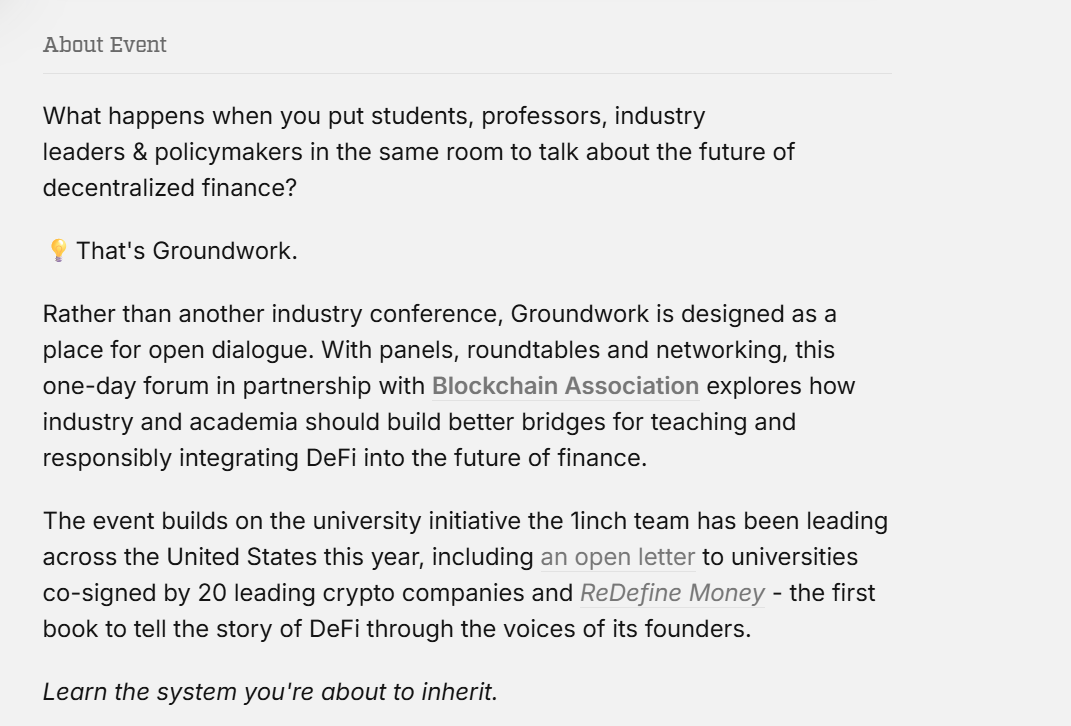
Groundwork explores the future of DeFi education and policy. Source: Luma
Why DeFi Education Must Address Crypto Regulation, Stablecoins and AI Payments
Academic independence is particularly relevant where regulatory questions intersect with protocol design. ESMA proposals concerning DeFi access, token classification, and provider responsibilities, as well as the US CLARITY Act debate about oversight, custody, market structure, and accountability. The current status and scope of each proposal should be verified against official documents. These topics illustrate why students may need to understand both the relevant legal framework and the technical details of who controls an interface, contract, asset, or transaction flow.
Similar questions arise in product design. AlphaWire has previously covered programmable payment systems that can make blockchain interactions less visible to end users. Coinbase’s x402 standard for software-based payments over HTTP, Cloudflare’s work involving x402 and AI-agent payments, and 1inch Business MCP, which provides agents with access to onchain data and execution infrastructure. Each example should be checked against current primary documentation before publication.
Gavryliak puts the required fluency plainly:
“They need to be bilingual in traditional and decentralized finance: understanding markets, custody and risk, as well as stablecoins, tokenization and smart contracts.”
The issue is not whether every business student should learn to write Solidity. A more practical question is whether future professionals who handle payments, develop rules, audit processes, or design financial products can evaluate onchain finance with the same care they apply to a balance sheet or a legal contract.
Groundwork alone cannot determine what universities should teach; curriculum decisions remain the responsibility of academic institutions. The event can, however, contribute to a discussion about how programs should respond as stablecoins, tokenized assets, automated agents, and decentralized protocols become relevant to parts of the financial sector. Whether a gap in practical knowledge exists, and how large it is, requires evidence about what students are taught and what they can demonstrate they understand.
The number of times DeFi appears in a syllabus is not, by itself, a measure of educational progress. More useful indicators could include whether students can explain how these systems work, identify their strengths and limitations, assess relevant risks, and apply that understanding to realistic financial, technical, and regulatory scenarios.
Disclaimer: AlphaWire is an official media partner of Groundwork, an event organized by 1inch in partnership with the Blockchain Association. This media partnership does not influence AlphaWire’s editorial independence. The views expressed by contributor(s) are their own and do not necessarily reflect those of AlphaWire.