preferred on


Points of Focus
- MoonPay’s Halsey Huth told AlphaWire that AI agents are changing how users interact with wallets, allowing financial transactions through natural-language instructions.
- MoonPay’s Sept. 23 North Capital acquisition agreement signals a shift toward integrating regulated brokerage infrastructure into crypto wallets rather than eliminating intermediaries.
- Huth emphasized that AI agents can initiate transactions without accessing private keys, but user approvals, oversight and financial protections remain essential.
A crypto wallet can now offer capabilities that would have seemed unusual a few years ago: holding a token linked to Apple stock (AAPL), transferring it onchain, and potentially accessing stock-linked products outside traditional market hours.
This raises an important question: When a wallet allows investors to hold and trade stock-linked tokens, what role remains for the traditional stockbroker?
The answer lies not just in the wallet, but in what sits behind the token.
In its September discussion of tokenized stocks, MoonPay highlighted an important difference. A token linked to Apple stock may represent an interest in an underlying security, a contractual claim, or a synthetic instrument. Although these products may reference the same ticker, the legal rights they provide can differ significantly.
Crypto wallets may become alternatives to traditional brokerage platforms, but they do not automatically eliminate the compliance, ownership, custody, and settlement functions associated with securities.
MoonPay’s Halsey Huth, Global Head of AI & Ecosystems, has also discussed how users may delegate financial tasks to AI agents rather than switch between applications to complete transactions. This could make wallets a more prominent financial interface. However, facilitating transactions does not eliminate the legal and regulatory obligations associated with securities trading.
Speaking to AlphaWire, Huth described how AI agents are changing users’ expectations of financial applications.
“We’re seeing people move more of their financial activity into the conversations they’re already having with AI. They might start by researching a market or putting together a strategy, but the next question is naturally, ‘Can you actually go and do this for me?’”
The shift suggests that the interface through which investors access financial services could become increasingly separate from the infrastructure executing their transactions.
Brokerage interface is already moving into wallets
A traditional brokerage account combines several functions in one application: identity verification, funding, trade execution, portfolio tracking, custody and access to market infrastructure.
Crypto wallets are gradually incorporating similar capabilities, moving beyond token storage to support payments, trading and other financial services.
AlphaWire’s coverage of Bitget Wallet reflects this evolution, as wallet providers expand their services to support a wider range of financial activities.
MoonPay’s PayBox offers another example, allowing users to initiate transactions through AI interfaces such as ChatGPT, Claude and Grok using natural language.
Speaking to AlphaWire, Huth explained how users can delegate financial tasks while retaining control over what an AI agent is authorized to do.
“You connect PayBox, set up your wallet and define what your agent is allowed to do. From there, you can describe an action in plain language, whether that’s swapping tokens, accessing a lending protocol or paying for a service.”
“The agent prepares the action, and PayBox applies the permissions and approval requirements you’ve established. You can require approval for each transaction or allow certain activities to happen automatically within defined limits.”
Such systems could reduce the need for users to navigate multiple applications, while permissions and approval mechanisms continue to govern transactions.
Tokenized stocks introduce a further dimension by bringing stock-linked products into blockchain-based financial applications.
Robinhood’s stock tokens provide an example of blockchain-based representations of stock-linked assets. However, the legal rights attached to a token depend on its structure and documentation. Onchain transferability does not automatically establish ownership of the underlying shares.
As wallets take on more brokerage-like capabilities, the distinction between the user-facing interface and the regulated infrastructure supporting securities transactions becomes increasingly important.

MoonPay’s expansion into regulated onchain capital markets. Source: MoonPay
Real question is what the token legally represents
This distinction is becoming central to the regulation of tokenized securities.
In its Jan. 28, 2026, statement, the US Securities and Exchange Commission (SEC) distinguished securities tokenized by or on behalf of their issuers from securities tokenized by unaffiliated third parties. The structures can differ in the rights they provide to holders.
That is why “tokenized Apple stock” is not a sufficiently precise description.
One structure may provide an interest in underlying securities, while another may create a contractual claim against the token issuer. The difference matters when dividends are distributed, voting rights are exercised, tokens are redeemed, or an intermediary fails.
Securitize’s tokenized US stocks illustrates how tokenization can be structured around securities entitlements rather than synthetic price exposure alone. The relevant question for investors is what legal rights the product actually confers.
Investors also need to understand who holds the underlying asset, whether it is segregated, how rights are passed through, and what happens if an intermediary becomes insolvent.
A wallet can prove that an address controls a token. It cannot, by itself, establish the full legal rights that token confers.
Regulation is letting stocks move onchain, but not without rules
The SEC’s Sept. 17, 2026, Innovation Exemption represents a development in the regulatory treatment of certain tokenized US equities. The exemption is conditional and applies only within its specified scope; it should not be described as blanket approval for all tokenized stocks or trading venues.
This matters because moving transactions onchain does not automatically remove securities-law obligations. The structure of the product, the participants involved, and the applicable regulatory requirements continue to determine how it can operate.
AlphaWire has also examined the exemption’s implications for tokenized-stock trading and emerging platforms, including the proposed OKX-ICE initiative.
A separate SEC staff statement concerning crypto-securities interfaces also highlights the regulatory questions that can arise when wallet software helps users assemble transactions. Moving the interface into a wallet does not, by itself, resolve those questions.
Onchain does not automatically mean intermediary-free.
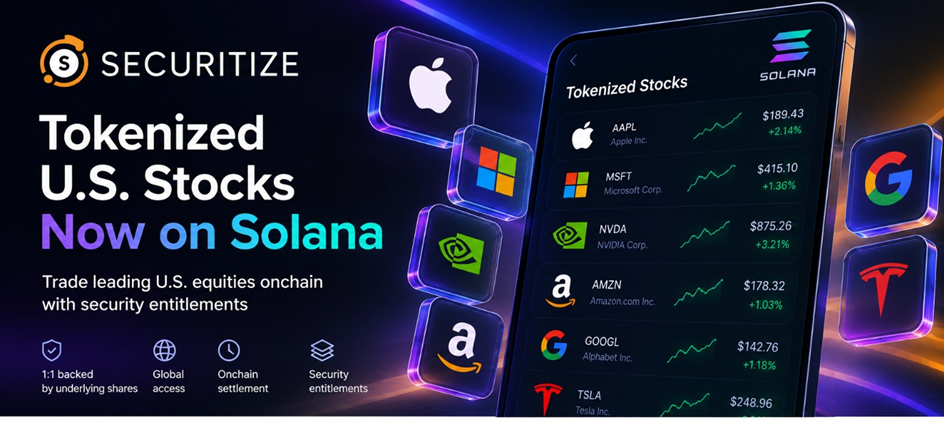
Securitize brings US equities onchain through tokenized security entitlements. Source: SEC, and Securitize
MoonPay’s own strategy reveals where brokerage may be heading
MoonPay’s expansion into regulated financial infrastructure challenges the idea that crypto wallets will eliminate traditional brokers. Instead, its strategy suggests that brokerage services could become integrated into wallet-based platforms.
On Sept. 23, MoonPay announced an agreement to acquire North Capital, a move that would bring regulated private-market infrastructure into its broader operations. Rather than bypassing securities infrastructure, the deal points toward combining blockchain technology with established brokerage functions.
MoonPay has also collaborated with Franklin Templeton on tokenized money-market access and with WisdomTree to expand access to tokenized funds. These initiatives show how digital-asset platforms are connecting wallet-based services with established financial products.
However, making these services easier to access does not remove the need for transaction controls.
Huth explained how MoonPay separates an AI agent’s ability to initiate transactions from direct control over a user’s wallet.
“The important piece is that the agent doesn’t need your private key to act on your behalf. PayBox provides controlled access to the functionality it needs.”
Although Huth was discussing AI-powered payments rather than securities brokerage, the distinction is relevant to the future of wallet-based financial services. Users may interact through a simplified interface while specialized systems continue to manage permissions, authorization and execution.
A similar separation exists in tokenized securities. Blockchain networks can record token transfers, while smart contracts can enforce certain restrictions. However, official ownership records and shareholder rights may still depend on transfer agents and other regulated entities.
The SEC’s proposed changes to transfer-agent rules reflect how these intermediary functions may evolve as securities infrastructure becomes increasingly programmable.
MoonPay’s approach therefore points toward a future in which brokerage functions are integrated into digital wallets rather than eliminated altogether.
Tokenization can remove friction without removing institutions
DTCC’s tokenization initiatives demonstrate how established market infrastructure is exploring blockchain-based securities workflows. These include potential applications involving securities transfers, delivery-versus-payment transactions, securities lending, collateral management and Treasury repo.
Institutional initiatives in tokenized Treasury and repo markets also highlight how blockchain infrastructure is being explored for securities financing and collateral management.
Self-custodial wallets and smart contracts may reduce reliance on some traditional brokerage functions and enable more direct trading or settlement. However, shareholder protections, securities-law compliance, ownership records and mechanisms for resolving disputes remain essential.
The same difference applies to AI-powered financial transactions, where automation introduces questions about authorization, accountability and user protection.
Huth emphasized that securing a transaction does not necessarily guarantee an appropriate outcome.
“Secure signing alone doesn’t establish that a booking is correct or that a financial decision is appropriate. Users need to understand what they’re authorizing and be able to review activity and revoke access.”
That said, technology can simplify how transactions are initiated and executed, but it cannot independently resolve questions of investor protection, legal responsibility or ownership rights.
Crypto wallets may therefore replace what investors think of as the stockbroker long before they replace the functions that brokers and wider market infrastructure perform.
The likely outcome is not an intermediary-free market, but one in which execution, custody, settlement, compliance and shareholder-record functions become increasingly automated and less visible behind the wallet interface.