preferred on


Points of Focus
- ECash plans to fork Bitcoin at block 973,728, creating a separate blockchain supporting drivechain functionality.
- BTC holders are expected to receive matching ECX balances, but exchanges and Bitcoin ETFs have different distribution policies.
- Citrea developer Chainway Labs warns that the fork could fragment Bitcoin liquidity and introduce additional security assumptions.
Bitcoin (BTC) holders may receive a new cryptocurrency when eCash forks at block 973,728, expected in late October. The exact timing depends on block production.
Led by drivechain researcher Paul Sztorc and LayerTwo Labs, the project will create a separate blockchain that mirrors existing BTC balances. Access to the new tokens will depend on custody arrangements, particularly as Wall Street exchange-traded funds (ETFs) hold substantial Bitcoin reserves.
The project is unrelated to the existing eCash (XEC) cryptocurrency.
What the eCash fork will introduce
Bitcoin Improvement Proposals (BIPs) 300 and 301 underpin the fork. BIP-300 governs miner-approved sidechain withdrawals, while BIP-301 allows miners to collect sidechain fees without operating separate software.
LayerTwo Labs lists several experimental projects, including Thunder for payments, zSide for privacy, and Truthcoin for prediction markets.
The fork proposes reallocating approximately 500,000 eCash (ECX) associated with the Patoshi mining pattern, commonly attributed to Satoshi Nakamoto, to investors and project development. Roughly 600,000 ECX would remain at the corresponding early addresses, whose original BTC holdings are unaffected.
ECX retains Bitcoin’s SHA-256 proof-of-work algorithm, with difficulty reset at launch. How much mining power the network can attract remains uncertain, particularly given the financial pressure already facing Bitcoin miners.
Who will receive ECX after the Bitcoin fork?
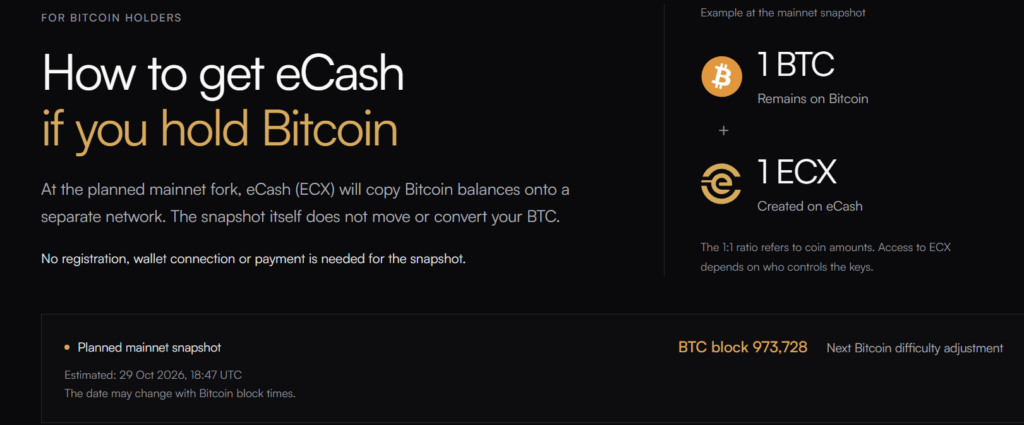
Most BTC balances will be mirrored at a 1:1 ratio, subject to the planned redistribution of early coins. ECX will trade independently.
Exchange policies already diverge. CoinW has confirmed distribution to eligible customers, while Coincheck has no plans to credit ECX. GMO Coin intends to provide tokens or Japanese yen proceeds, depending on its ability to sell the asset. It also plans to suspend Bitcoin deposits and withdrawals from Oct. 29 to Nov. 2.
BlackRock’s iShares Bitcoin Trust ETF (IBIT) states that shareholders will not benefit from forked assets. Other investment structures, including BlackRock’s proposed managed-protection ETF and corporate treasury holdings such as Metaplanet’s, have their own custody arrangements.
Self-custody holders will need compatible software. Developers warn that spending unsplit BTC could also move ECX through transaction replay. No registration or payment is required for the snapshot.
Citrea developer warns of Bitcoin liquidity fragmentation
Orkun Mahir Kılıç, co-founder and CEO of Chainway Labs — the team building Citrea — raised concerns about the implications of another Bitcoin-derived ecosystem.
“Forking Bitcoin to introduce new functionality creates another network with its own ecosystem, liquidity, and security assumptions,” Kılıç told AlphaWire.
He warned that dividing liquidity across additional networks could introduce friction for users and institutions, complicating broader adoption.
Citrea launched its mainnet in January, using zero-knowledge technology and its Clementine bridge to support programmable applications. Its September acquisition of privacy-focused wallet Crest expanded work on confidential transactions.
“We believe the answer lies in making Bitcoin more programmable through layers built on top of it, without asking users to compromise on the security and self-custody they value to access the functionality they need,” Kılıç added.