preferred on


Point of Focus
- FedNow will test support for the US leg of cross-border payments.
- FedNow settled nearly 5 million payments worth $274.66 billion in Q2 2026.
- Early adopters will test enhanced messages.
FedNow is preparing to support cross-border payments, giving US financial institutions a way to use the Federal Reserve’s instant payment service for the domestic portion of an international transfer.
Federal Reserve Financial Services said a group of early adopters will soon test enhanced payment messages for the service.
The international portion would continue to move through existing correspondent banking arrangements.
The plan comes as FedNow’s domestic activity grows: it settled nearly $275 billion across about 5 million payments in the second quarter of 2026.
FedNow targets the US leg of international payments
Under the proposed approach, a participating institution could send or receive a payment involving someone outside the US.
FedNow would handle the US domestic leg, while the institution’s chosen cross-border arrangements would handle the remainder. The Federal Reserve said the model resembles the use of correspondent banks in other payment systems, including Fedwire.
Federal Reserve Financial Services is on the verge of unlocking a new frontier within the FedNow® Service: cross‑border transaction support. This important milestone is designed to offer FedNow participants powerful new ways to serve internationally active customers:… pic.twitter.com/SFowlSNsGM
— Federal Reserve Financial Services (@FRBservices) September 23, 2026
The distinction matters: FedNow would not become a network that settles a payment from end to end across two countries. Faster US settlement could improve part of the process, but the full transfer would still depend on intermediaries and the systems used abroad.
Early adopters are expected to test message formats that let institutions identify and process the domestic leg of cross-border transfers. The Federal Reserve said it intends to make the messages available for other FedNow participants to adopt afterward. Potential uses include international payroll, corporate payments, property transfers and time-sensitive insurance disbursements.
The move follows an April Federal Reserve proposal to let US banks and credit unions use intermediaries when transferring funds through FedNow. At the time, the Fed said the change could allow a US bank to transact with a correspondent bank to facilitate an international payment.
Payment count jumps as dollar growth slows
FedNow settled 4,997,811 payments worth $274.66 billion in the second quarter, according to the Federal Reserve’s quarterly figures.
The number of payments rose 83.2% from the first quarter. Their combined value, however, increased only 1.3%, from $271.25 billion. The average settled payment consequently fell from about $99,414 to $54,957.
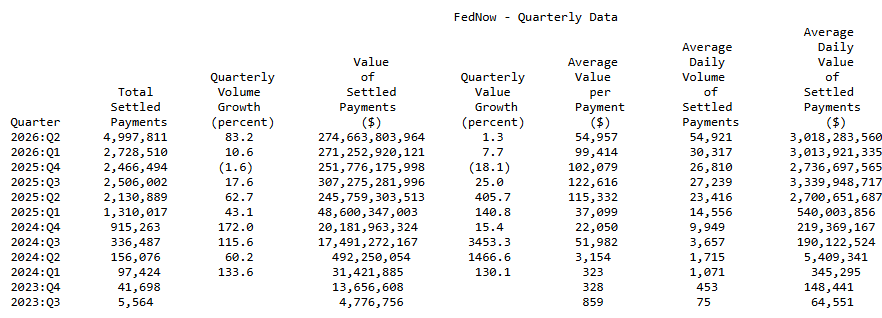
That gap between transaction and dollar growth indicates that smaller payments made up a greater share of activity in Q2. It also shows why FedNow’s progress cannot be judged by one measure alone: the rail processed far more individual transfers while settling only slightly more money.
The figures cover settled customer credit transfers. They exclude payment returns and liquidity-management transfers, according to the Federal Reserve’s data notes.
Faster domestic step, with global hurdles ahead
Cross-border functionality could give internationally active businesses quicker settlement on the US side of a payment. It could also provide institutions with more detailed messages for handling transactions that involve multiple parties.
The benefit to customers will depend on what happens beyond FedNow.
Currency conversion, sanctions checks, anti-money-laundering controls and the speed of correspondent banking arrangements can still affect a transfer’s cost and arrival time.
🚨 THE QUIET RIPPLE AND FedNow INTEGRATION JUST GOT LOUD.
TODAY FedNow just announced it’s enabling CROSS-BORDER payments.
Ripple already has a conditional U.S. NATIONAL TRUST BANK charter and is waiting on a FED MASTER ACCOUNT.
A Fed economist had said they could “delegate… https://t.co/WSE6fSjs64 pic.twitter.com/kiNL15MXdg
— Stellar Rippler🚀 (@Stellar_Rippler) September 23, 2026
The new capability therefore does not guarantee an instant international payment.
For now, the Federal Reserve has outlined testing by early adopters rather than a launch date for widespread use.
With domestic payment counts rising sharply, the next test is whether institutions can connect FedNow’s speed to international transfers without adding delays elsewhere in the chain.