preferred on


Points of Focus
- Binance’s $6.34-billion hack exploited transaction-signing infrastructure without a confirmed private key leak.
- Attackers abused EIP-7702 delegations to continue draining funds after Binance suspended withdrawals.
- The breach exposed security risks in transaction approvals and smart-contract permissions, even with protected private keys.
Binance’s Oct. 29 hot-wallet hack affected about $6.34 billion in assets, revealing how attackers can control assets without a confirmed private key leak. Attackers accessed an internal transaction-signing service, producing unauthorized transfers despite valid wallet signatures.
The exchange said on Oct. 30 it found no evidence of a leaked private key.
The US Federal Bureau of Investigation attributed the theft to North Korea’s TraderTraitor operation on Oct. 31. University of East London law professor Iwa Salami argued Nov. 2 that attribution should remain provisional, while North Korea denied involvement Nov. 3.
The $6.3bn Binance hack is a regulatory wake-up call: oversight, accountability, investor protection. My take for @ConversationUK:⁰[https://t.co/6WqtHSLRzg]⁰#CryptoRegulation #Cybersecurity @SBL_UEL @UELFinTech
— Prof Iwa Salami (@Iwaleso) November 3, 2026
Binance pledged to absorb customer losses using its own resources. By Oct. 31, it had replenished 98% of affected token assets; about $2.85 billion was frozen or intercepted as of its Nov. 3 report.
How attackers infiltrated Binance’s signing service
Binance’s incident timeline starts in June, when a wallet engineer downloaded a tampered Homebrew software installer while setting up an AI coding tool. Binance said it had detected the anomaly and rotated credentials. Fraudulent job interviews then lured another engineer into downloading a malicious code repository in September.
On Oct. 20, an internal AI tool helped attackers compromise the June engineer and a third engineer. Stolen credentials let the attacker deploy a container and run malicious code on Oct. 29.
TRM Labs traced $6.36 billion across 10 blockchains at transfer-time prices, mostly within 20 minutes beginning 20:05 UTC on Oct. 29. Blockaid found that other affected hot wallets made conventional transfers, signed by their own keys and interspersed with routine withdrawals.
How EIP-7702 prolonged the theft
Introduced through Ethereum’s May 2025 Pectra upgrade, Ethereum Improvement Proposal (EIP) 7702 lets regular accounts delegate execution actions to smart-contract code while retaining private keys.
At 20:20 UTC, attackers placed 50 signed authorizations covering different nonces into one transaction; one matched the wallet’s changing transaction nonce, Blockaid found. This gave an attacker-controlled contract ongoing access to an Ethereum hot wallet.
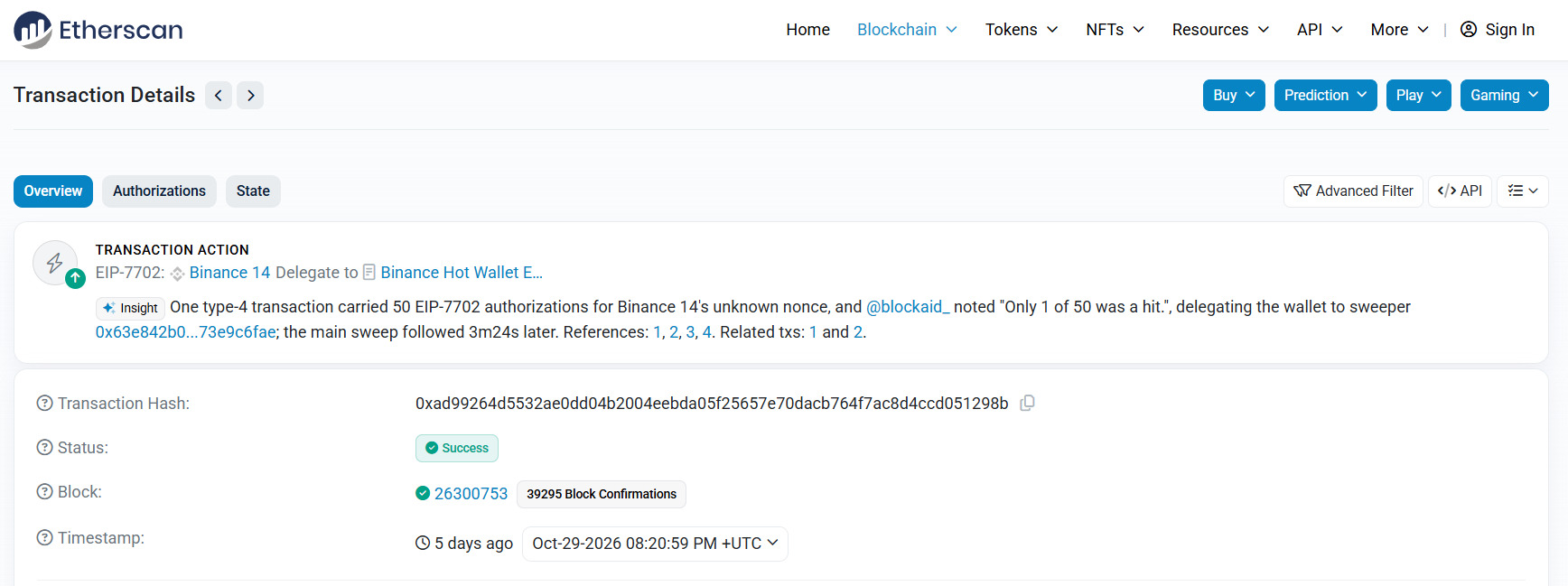
A sweep at 20:24 UTC moved about $2.5 billion, and another at 21:44 UTC took more than $200 million in new deposits, Blockaid reported. Suspending withdrawals did not disable that onchain delegation, leaving newly arriving assets exposed. The wallet’s multi-party computation setup, which divides signing authority, also meant no single key could revoke access immediately.
The final unauthorized transfer of 2,961.9 ETH was confirmed at 23:56 UTC on Oct. 29; Binance revoked the delegation at 00:10 UTC on Oct. 30.
The biggest theft in crypto history: an attacker hijacked Binance’s signing service and drained $6.3B from its hot wallets.
Using advanced AI models and our industry-leading exploit detection engine, Blockaid detected it in under two minutes.
Read more: https://t.co/lc2vjNhL1S pic.twitter.com/RlKI8rhCT9
— Blockaid (@blockaid_) October 30, 2026
What self-custody protects and what it cannot
Onramp Bitcoin CEO Michael Tanguma reportedly said offline storage can protect against this kind of attack, which hit internet-connected wallets. Yet Tanguma compared the manipulated approval process with Bybit’s February 2025 theft, which manipulated a cold-storage transfer.
Self-custody makes owners the weak point, through lost or tampered devices, compromised backups, and transactions approved under pressure, Tanguma said. Professor Sean Stein Smith wrote Nov. 3 that strong private key protection alone falls short once attackers compromise transaction-approval systems.
The $6.3 Billion Binance Hack Exposes Crypto's Biggest Internal Control Problem via @forbes https://t.co/JoUx4f5Y6P
— Dr Sean Stein Smith (@SeanSteinSmith) November 3, 2026
Valid signatures came from Binance’s own wallets across chains, so the failure sat in the signing infrastructure rather than the private keys themselves. For exchanges and self-custody wallets alike, signing privileges and contract permissions can enable asset transfers without exposing private keys.
Given HSMS, multisig, mpc environments and looking at the largest hacks in crypto to common thread in that keys aren’t stolen. They are misused to sign payloads that transfer ownership of the assets to threat actors.
True for Bitget, Bybit, and binance.
— Idobn (@idobn) October 30, 2026
This remains a developing story, and Binance said it has enlisted independent security companies to review its findings.
TRM Labs counted over 420,000 ETH and 18,270 BTC, about $2.4 billion that no issuer can freeze, in the attacker’s hands at 00:30 UTC on Oct. 30.