preferred on


Points of Focus
- Bitget Wallet surpassed 100 million users as payments overtook trading, a shift chief operating officer Alvin Kan considers permanent.
- Kan said self-custody distinguishes wallets from banks and exchanges, while AI agent transactions still require user approval.
- Stablecoins connect users to existing card and QR payment rails, expanding access to dollar payments and local spending.
Bitget Wallet announced on July 7 that it had crossed 100 million users. The self-custodial wallet also reported that more of its users were making payments than trading for the first time.
The shift comes amid heightened scrutiny of the Bitget brand. On Sept. 24, Bitget exchange detected unauthorized transfers from hot and warm wallets totaling about $388 million. Bitget Wallet, which operates independently of the exchange, reported no impact on its systems or users’ self-custodied assets.
Speaking with AlphaWire Senior Editor Dr. Guneet Kaur at Token2049 Singapore, Alvin Kan, chief operating officer of Bitget Wallet, described the shift toward payments as permanent. He expects payments and trading to become the two dominant uses for crypto wallets.
Kan estimates that fewer than 10% of users on any wallet made payments in 2025. However, payment transactions exceeded trading transactions on a single day in 2026, he noted. He sees that as evidence that more people use crypto as “an everyday finance app” today.
Payments and trading to coexist as stablecoin adoption grows
Kan expects two user profiles to coexist as wallets evolve.
Traders and speculators will keep coming, and a boom cycle would bring more retail traders.
Meanwhile, according to him, users in emerging markets increasingly seek stablecoins to manage volatile local currencies and high inflation. They want what Kan called “inflation-proof assets” alongside dollar-denominated cards and dollar spending options.
“I don’t think you can say one is more important than the other,” he said.
The distinction between these users is also narrowing. People may begin using wallets for payments and earnings before exploring investments, Kan argued, adding that “people actually may trade where they bank as well.”
Stablecoins open access to finance that was closed to many users, particularly the unbanked and underbanked, in Kan’s view. Access to tokenized stocks and some dollar payments is often “reserved for what we call accredited investors or the privileged.”
Kan noted that banks are adopting the same technology rather than competing exclusively against stablecoins. He expects “the playing field will be more level, and the banks are also catching up.”
Self-custody sets wallets apart from banks and exchanges
As wallets combine financial products, Kan sees increasingly blurred boundaries between banks, money apps, wallets, and trading platforms. He explained that assets held onchain are programmable, allowing for saving, spending, rewards, and investments to operate within one interface.
I asked Grok what people like about @BitgetWallet based on what they're saying on X.
Seeing these makes all the hard work worthwhile. Bitget Wallet is becoming the everyday money app for people. pic.twitter.com/PMKwjAaxmF
— Alvin Kan (@alvin_kan) September 18, 2026
As an example, Kan noted that Bitget Wallet’s card offers tokenized stocks as a cashback option. So, a coffee purchase can earn users rewards in tokenized Tesla or Nvidia shares, extending their use beyond trading.
Despite overlapping services, custody remains the fundamental distinction, in his view. Banks hold customer money, while Bitget Wallet users hold their own keys. “We are just an interface for you to manage these money features,” he stressed.
Kan expects self-custody to face fewer regulatory requirements than traditional banking. However, compliance obligations remain because payment service providers handle most transactions, requiring Bitget Wallet to select appropriately licensed partners.
That distinction also became important following the exchange breach. Kan acknowledged questions arising from the shared Bitget name, particularly whether wallet users were affected.
Bitget Wallet clarified the difference between a custodial exchange and a self-custody wallet, and most people understood, he believes.
“I don’t think such incidents with the exchange are going to affect us too much,” Kan maintained. He added that people are starting to appreciate self-custody and that funds should be diversified across both models.
AI agent payments to stay under user approval
Bitget Wallet is taking “quite a cautious approach” to autonomous AI agent payments, reflecting concerns around transaction security.
“For a wallet, security is most important,” Kan cautioned.
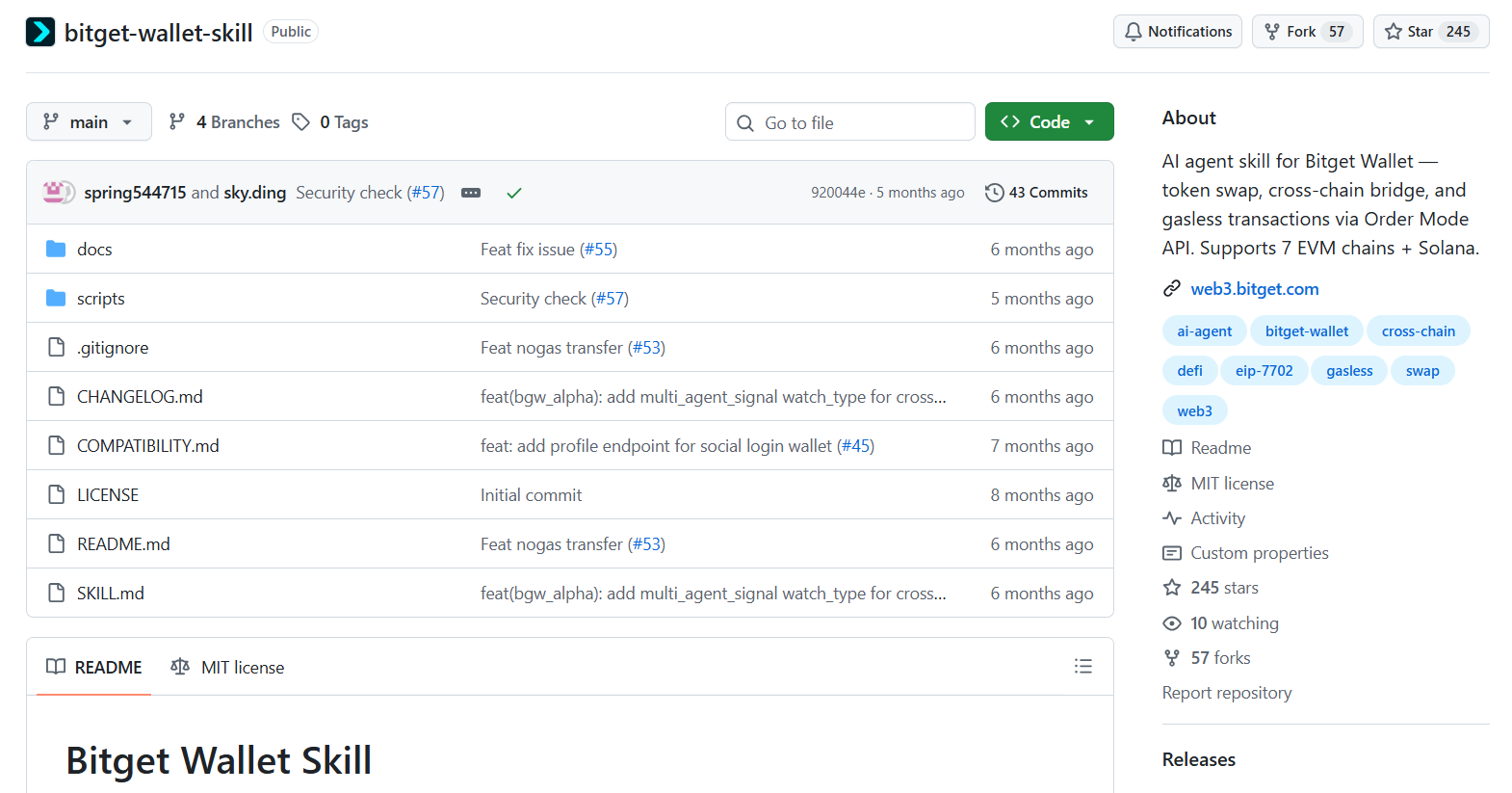
The company has released a skill that users can install into an AI agent, enabling functions including trading and transferring funds. However, every action “requires the user’s input and signature,” he said.
Kan contrasted this with other projects discussing agents operating autonomously under predefined rules. Bitget Wallet is still weighing that model, he explained, because agents may hallucinate and chargeback handling is unclear.
“The whole industry needs to come together to kind of uphold the standard,” he urged. For now, users must “approve every single transaction.”
Traditional payment rails remain key to stablecoin adoption
Kan described crypto’s dependence on traditional payment infrastructure as “an intermediate step.” While merchant acceptance of crypto or stablecoins is growing, existing traditional finance rails offer the fastest route to broader spending, he observed.
Crypto cards succeeded because “you don’t have to convince the merchants one by one to do it,” he argued.
More users want dollar-denominated cards but cannot always get them, Kan said. They include small businesses that buy social media advertising and travelers whose local bank cards carry unfavorable rates. Stablecoins are, in his words, “a shortcut again to these USD payments,” and QR payments work the same way.
Self-custody is still “crossing the chasm” and has yet to reach “the mainstream adoption phase,” Kan believes. He called the number of people globally who hold wallets “still very, very low.”
Beyond adoption figures, the other important indicator, he noted, is when friends traveling overseas say they could pay “like a local” with a stablecoin.
For crypto as a whole, he cited weekend prices on perps as “a leading indicator” of Monday’s market open. Kan reads stablecoins and crypto as “leading and even leapfrogging the TradFi industry” as the sign that “something big is happening.”
His own example came on a trip to Latin America about a month before the interview. In Brazil, people pay with Pix codes. Kan recalled that he lacked a Brazilian ID and could not have applied for a card that works with them.
“All I did was whip out my Bitget wallet app, scan the code, and I paid,” he recounted. Kan described the fee as “way lower” than on an international bank card, at less than 1% per QR payment.