preferred on


Points of Focus
- BNY settled a tokenized 2-year Treasury for Citadel, then ran it through overnight repo.
- BNY discloses no trade size, repo rate, or technology provider.
- Tokenized Treasury funds hold $14.91 billion, about 1.2% of one day’s triparty repo volume.
BNY said on Oct. 13 that Citadel Securities bought a 2-year US Treasury note through BNY on Tradeweb, and a tokenized representation of the note was recorded on BNY’s private digital ledger. BNY says the token settled near-instantly instead of on the standard T+1 cycle, and Citadel then used it as collateral in an overnight triparty repo with BNY providing the cash.
BREAKING: #BNY completes first-of-its-kind transaction with tokenized assets on major triparty repo platform in collaboration with @Citadel Securities.
A 2-year U.S. Treasury note was #tokenized on BNY's private digital ledger, settled within minutes, and used as collateral in… pic.twitter.com/gUNzBAvMxY
— BNY (@BNYglobal) October 13, 2026
BNY calls the trade the first use of tokenized assets on a major triparty repo platform. The release does not disclose the note’s face value, the repo amount, the rate, or the technology provider.
BNY tokenized Treasury repo workflow with Citadel Securities
BNY acted as settlement agent and collateral manager. Carolyn Weinberg, its chief innovation and market transformation officer, said “This transaction demonstrates what becomes possible when tokenized assets are used in institutional workflows.”
The release does not say whether the tokenized note is redeemable or whether the cash leg moved on a ledger. Citadel’s Dan Doherty said, “Efficient movement of high-quality collateral is fundamental to well-functioning markets.”
Triparty repo market size against tokenized Treasury funds
The New York Fed’s tri-party general collateral rate tracks overnight tri-party repo backed by Treasuries, and it showed $1,199 billion of volume at 3.85% on Oct. 9. RWA.xyz lists $14.91 billion of tokenized Treasury funds on Oct. 13, down 5.5% in 30 days, which is about 1.2% of one day’s triparty volume.
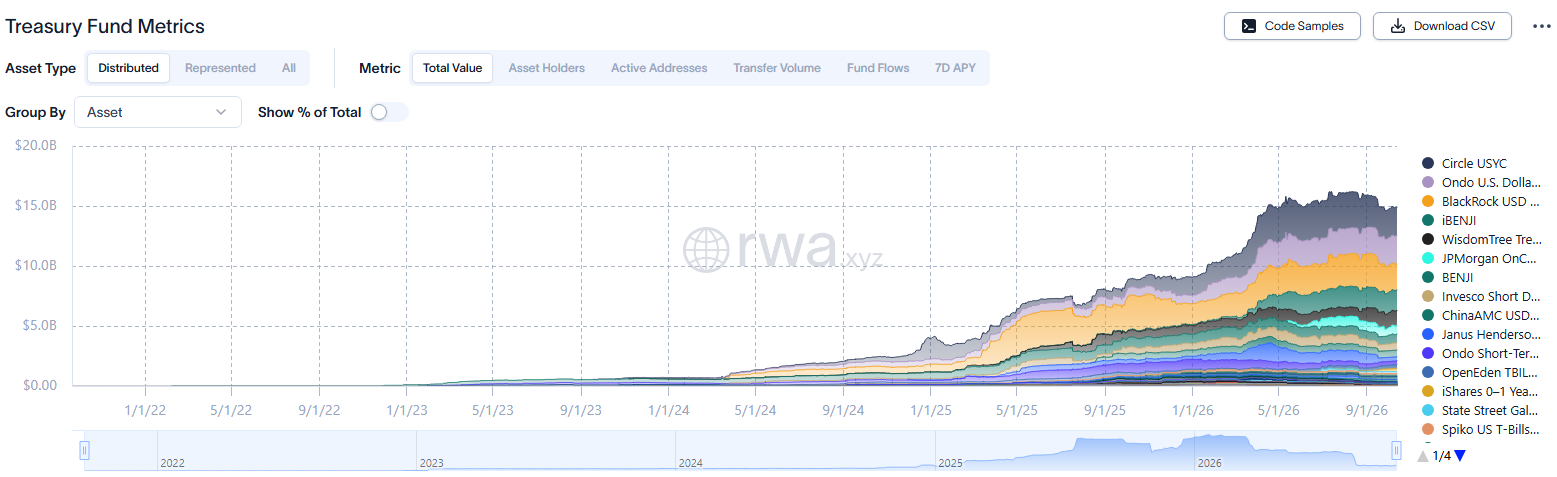
The figures cover different dates and different assets, so the ratio shows scale and not share. Circle’s USYC at $2.38 billion, Ondo’s USDY at $2.33 billion and BlackRock’s BUIDL at $2.20 billion lead the funds and hold 46% of the total.
Tokenized collateral trials at DTCC, Broadridge and J.P. Morgan
Ledger-based collateral already runs elsewhere. DTCC ran production trades on Jul. 15 across the Besu and Canton networks, including a Treasury repo delivery-versus-payment trade, with more than 30 firms, including Citadel Securities.
Broadridge says its Distributed Ledger Repo platform handles more than $350 billion in daily activity.
J.P. Morgan described using tokenized money market fund shares as collateral on its Kinexys network on Jul. 15, 2022. The BNY trade is distinguished by its venue, a triparty platform, and not by tokenized collateral.
BNY digital cash and extended settlement hours
BNY enabled on-chain mirrored representations of client deposit balances on Jan. 9, aimed at collateral and margin workflows, with Citadel Securities among the quoted participants.
The Oct. 13 release says BNY plans more digital cash and tokenized deposit capabilities and gives no timing. BNY also expects to extend operating hours on its traditional settlement platforms, aiming to reach European and Asian trading hours next year.
BNY describes tokenization and longer hours as steps toward 24/7 markets. It gives a timeframe only for the European and Asian hours.
US tokenization rules and venues around the BNY trade
The SEC granted tokenized venues a five-year exemption from exchange classification by Sep. 18, and OKXICE notified the agency by Oct. 5 of a 24/7 tokenized stock venue.
Securitize launched 12 tokenized US stocks on Solana by Oct. 9, and NYSE and Blockchain.com signed a memorandum by Sep. 24 to explore round-the-clock access to tokenized listings.
Ondo launched three tokens wrapping BlackRock-designed portfolios for non-US investors by Sep. 25. Paxos Labs co-founder Bhau Kotecha argues that technology will resolve stablecoin fragmentation while the US Treasury weighs rules for foreign issuers.
BNY gives no date for its digital cash capabilities, while DTCC’s Tokenization Service is scheduled to launch in October 2026.