preferred on

Points of Focus
- Sui announced an Alibaba Cloud partnership to let AI agents purchase cloud services within budgets set by their owners.
- Mysten Labs is developing agent verification with Google Cloud, while Sui Threat Intelligence monitors contracts holding about $452 million.
- Hashi has attracted more than $500 million in commitments, according to Abiodun, who also announced an Anchorage Digital partnership.
Cloud providers and payment networks are developing infrastructure for AI software to purchase services under predefined spending rules. Cloudflare recently introduced a closed beta for charging agents per request, while Mastercard announced Agent Connect to connect autonomous software with merchants and payment providers.
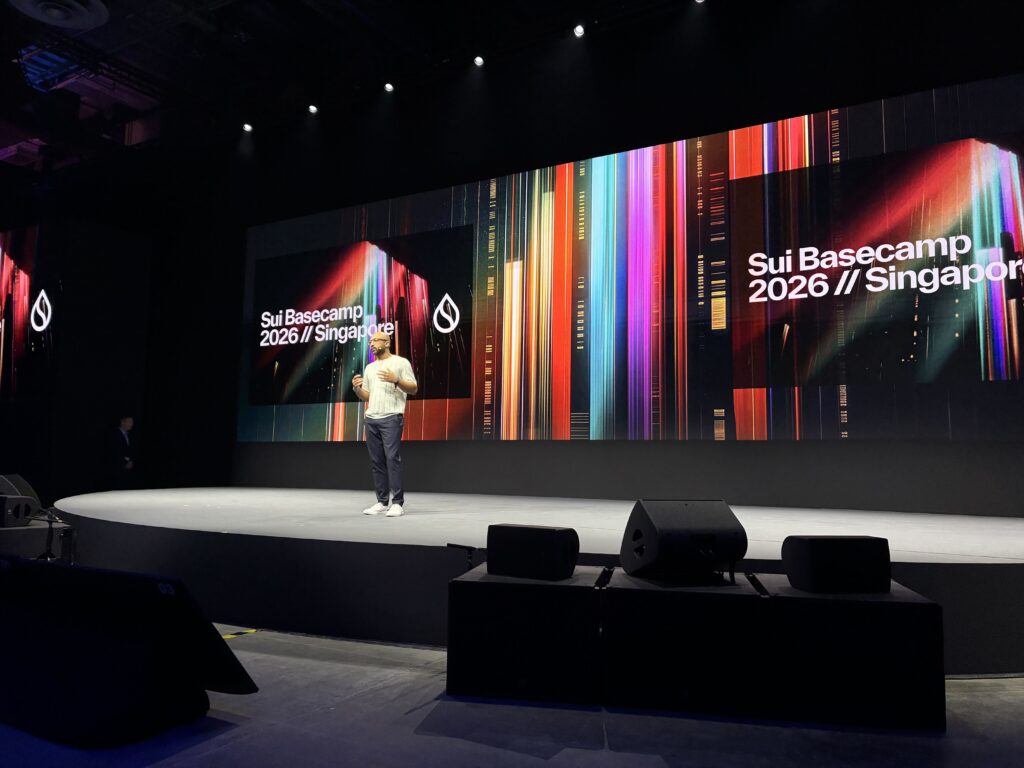
Sui joined that push on Oct. 7 with an Alibaba Cloud partnership for agent payments. Adeniyi Abiodun, co-founder and chief product officer of Mysten Labs, announced the collaboration during his keynote at Sui Basecamp in Singapore, held alongside Token2049.
The presentation also covered verification technology being developed with Google Cloud, Sui Threat Intelligence, and more than $500 million in commitments to Hashi, Sui’s Bitcoin (BTC) finance protocol.
Agents get spending limits and access to cloud services
Leo Li, head of digital native and AI sectors at Alibaba Cloud Intelligence, joined him onstage and explained that cloud accounts, subscriptions, and billing systems had been designed around human users. The collaboration aims to create a machine-oriented process for discovering, using, and paying for cloud services.
Under the model, owners could set budgets in advance, allowing purchases to proceed without human approval for every action. Li described the model as a new distribution channel for Alibaba Cloud.
The service currently runs on the Sui testnet, with paid calls available by invitation. Its public service directory remains marked as coming soon.
Abiodun also predicted that natural-language interfaces will increasingly mediate access to financial applications, with software coordinating lending protocols, transfers, and vaults according to user instructions.
“In five years’ time, websites are dead,” he said.
Financial applications have already begun giving assistants transaction capabilities. Aave’s recently launched agent interface lets compatible assistants inspect positions and prepare decentralized finance (DeFi) transactions, with wallet owners providing final signatures.
“If I tell my agent to spend $5, I need to know that it will spend at most $5,” Abiodun said.
Google Cloud verification and Sui Threat Intelligence
Mysten Labs is also working with Google Cloud on Verifiable Agent Arbiter (VAA), which it announced on Oct. 6.
VAA would record prompts, outputs, and tool calls in customer-controlled Google Cloud Storage, while cryptographic proofs would be stored on Walrus and coordinated through Sui.
Mysten says the technology could help reconstruct incidents and establish what an agent was authorized to do, what actions it took, and what a service delivered. It is also expected to connect with Sui Agent Payments.
Nvidia has also been working on controls for agent permissions and resource access through its agent safety platform.
Abiodun separately introduced Sui Threat Intelligence, an autonomous monitoring service he said is scanning more than 450 software packages and tracking smart contracts holding about $452 million. Contracts with more than $100,000 in value are automatically monitored, with developers alerted when vulnerabilities are detected.
According to Abiodun, the service has identified more than 12 vulnerabilities and will be made available free to Sui developers. AI was used to identify a Ledger signing bug as well.
He outlined plans to integrate Threat Intelligence into validator software and assign risk scores to individual transactions, which DeFi protocols could use for risk management and insurance products.
Hashi draws more than $500 million in commitments
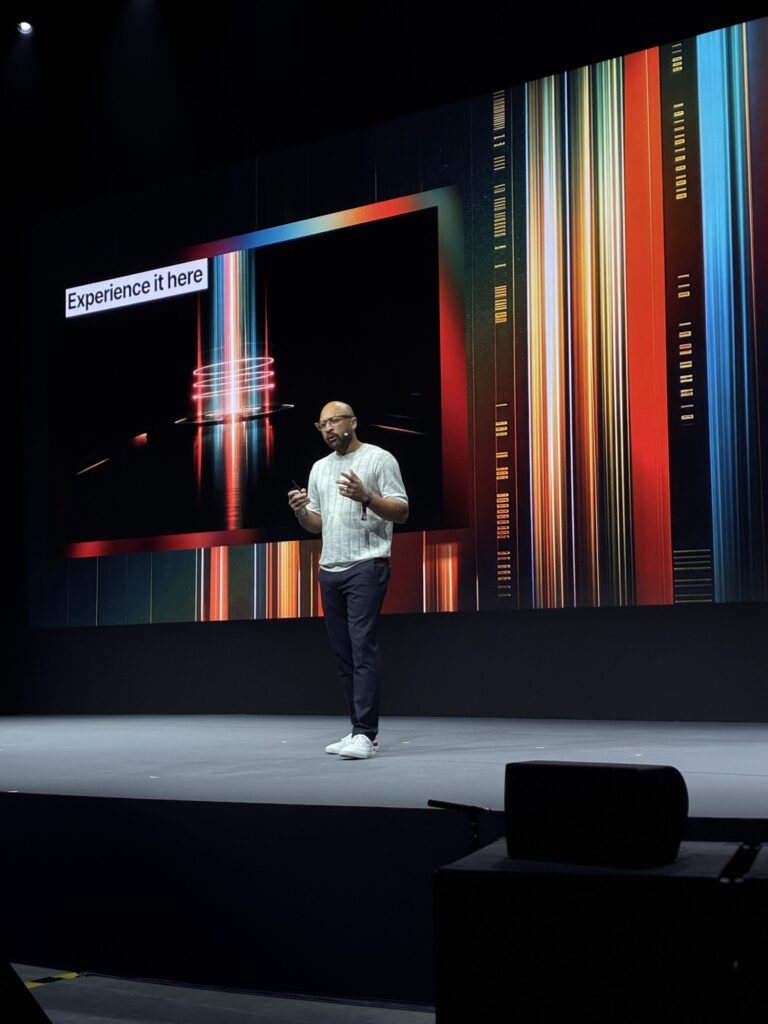
Abiodun said Hashi has secured more than $500 million in commitments, although he did not disclose how much capital has already been deposited.
Introduced in March, Hashi is designed to let Bitcoin (BTC) holders use native BTC as collateral for onchain lending and other financial services.
He traced the project to discussions with sovereign wealth funds, hedge funds, and other investors interested in DeFi but concerned about smart contract risk and the complexity of evaluating protocols.
Sui is also partnering with Anchorage Digital to give its clients access to Hashi vaults, lending, borrowing, and tokenized real-world assets, Abiodun said.
The keynote did not give a timetable for client access or specify how much of the committed capital has entered the protocol.