preferred on


Points of Focus
- Mike Massari expects tokenized RWAs to reach at least $1 trillion by 2029, versus $38.78 billion.
- He said regulation, risk, permissioning, and long redemption times still limit RWA use as DeFi collateral.
- RedStone is expanding beyond price feeds with settlement, risk intelligence, and atom auctions that recapture liquidation value.
Tokenized real-world assets (RWAs) held $38.78 billion in distributed asset value on Oct. 7, excluding stablecoins, according to RWA.xyz.
But the growth in tokenized value does not by itself show how much of that capital can be used as collateral, traded efficiently, or deployed across decentralized finance (DeFi). The gap between putting assets onchain and making them broadly usable has become a central challenge for the RWA market.
That said, Mike Massari, head of partnerships at RedStone, expects the first $1 trillion of RWAs to be tokenized onchain by 2029. Massari told AlphaWire Senior Editor Dr. Guneet Kaur during Token2049 Singapore that the 2029 figure is “potentially much more than $1 trillion.”
RedStone, an oracle provider, works with institutional assets, including tokenized products from BlackRock, Apollo, and Hamilton Lane.
Why tokenized RWAs still struggle as collateral
Massari acknowledged the growing number of tokenized assets and a strong tokenization push in blockchain. He splits tokenization into regulatory and technical work and, separately, utilization and adoption. “Obviously one doesn’t imply the other,” he said.
Tokenized stocks total $3.17B+ in onchain value.
Only 2.6% of that is used in DeFi.
Read our latest report with @FourPillarsFP and @AleaResearch, revealed at @TokenizeThisNYC Singapore edition, to learn why.
Features insights from: @Securitize, @DinariGlobal, @SuperstateInc,… pic.twitter.com/Q8NfAKfZ7L
— RedStone ♦️ (@redstone_defi) October 6, 2026
He sees nothing particularly wrong with the RWA boom and described the market as “quite early in the process.” Adoption still has to arrive, he said, because tokenizing an asset does not automatically create demand, utility, or liquidity.
Some of these assets cannot serve as collateral in lending markets, he added. Others carry strict permissioning, Know Your Business (KYB), and Anti-Money Laundering (AML) rules that restrict broader adoption, while composability is also sometimes lacking.
Several factors hold RWAs back, Massari said, because “it’s really not just a single thing.” Regulation, especially in certain locales, is a big bottleneck, and risk is another.
Institutions generally want more risk-averse investments, so transparency around the risk of a tokenized asset matters, in Massari’s view. The ability to use an asset as collateral is another big factor. Most of the time, Massari said, these assets “have somewhat long redemption times,” which blocks borrowing against them.
To address that problem, RedStone built Settle, a secondary liquidity infrastructure, Massari said. It can settle asset redemption liquidations and loop unwinding at T0 even for assets with much longer redemption times.
That unlocks collateral use and more utilization, he said, because holders can exit positions and rebalance portfolios much more quickly.
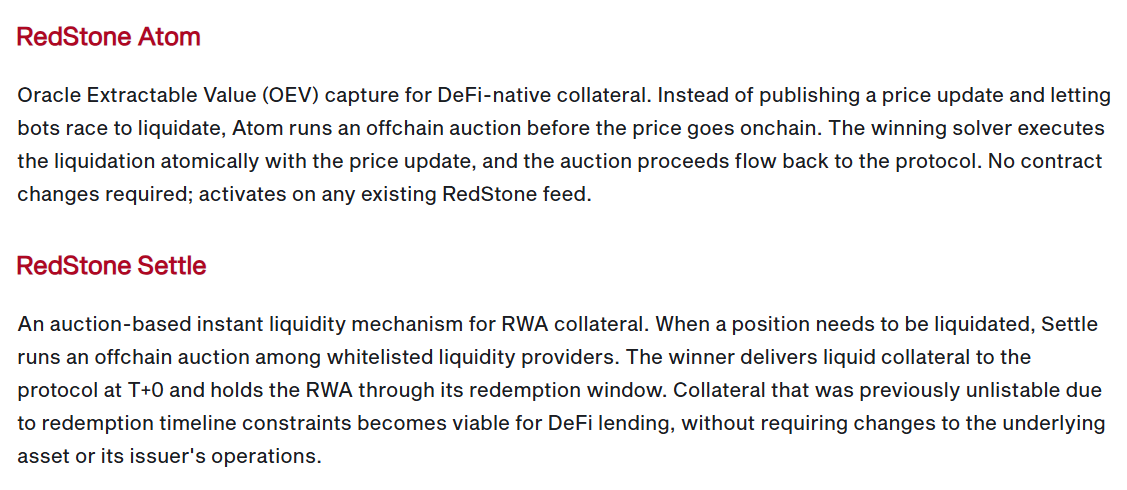
RedStone folds pricing, risk, and settlement into one stack
Massari said an oracle’s role now extends beyond market data and price feeds, which he called “table stakes nowadays.” “Everyone needs price feeds, but it’s not sufficient to support the tokenization of an asset,” he said.
RedStone organizes its offering into three areas, according to Massari, and the parts are “very much intertwined.” The first is the traditional oracle business, including 24/7 price feeds for assets such as commodities that lack 24/7 prices.
The second is a risk intelligence platform that assesses the risk of assets, vaults, and markets across protocols. It gives users transparent information to make informed decisions and build portfolios matching their preferred risk profile.
The third is the secondary liquidity and settlement layer, which adds utility through liquidations, settlement, and loop unwinding at T0.
Massari calls the combination the RedStone stack and describes it as one integration. Institutions are used to working with single infrastructure providers, he said, and “procurement takes time, and it’s an expensive process.”
A single vendor eases procurement, he argued, and provides the same reliability and security without fragmenting vendors and services.
Atom auctions liquidation value back to lending protocols
Atom is RedStone’s oracle extractable value (OEV) product and another feature of its stack, Massari said. It recaptures the maximal extractable value (MEV) that leaks out of lending-protocol liquidations by “running an auction on the liquidations event” within the oracle. Without the auction, he said, that value is lost.
The oracle redirects the recaptured value to the protocol, which decides what to do with it, according to Massari. Most protocols redistribute it to users, so users are indirect beneficiaries in many cases, he said.
More importantly, he said, protocols can offer better loan-to-value ratios and design more aggressive strategies because less value leaks during liquidations.
Each liquidation event triggers a sealed-bid auction that RedStone runs automatically within 300 milliseconds, Massari said. Multiple liquidators bid on the liquidation bonus, and the best bid wins.
RedStone then bundles the liquidation information and the price update into a single transaction and posts it onchain, he added.
Why do fast liquidations matter?
Our data shows that Atom increases liquidation speed by between 30 and 60 seconds.
This allows Atom users to set higher LTVs, delivering better risk-adjusted yield than competitors.It's that simple. ♦️⚛️
— Mike Massari (@mkmassari) July 29, 2025
Institutions want blockchain infrastructure as TradFi and DeFi converge
Institutions are interested primarily in what blockchain infrastructure can do for financial markets. “DeFi exposure for the sake of DeFi exposure, I think, is not something that they are seeking,” Massari said.
They want blockchain capabilities to solve or circumvent bottlenecks in traditional finance. He cited global access, instant remittance, faster settlement, greater transparency, programmability, and better access to liquidity.
Asked what the RWA market could look like in 2029, Massari said he would “start with the end.” He compared the shift to banking, where the line between banking and e-banking has disappeared: “It’s just banking.” Both models can coexist, he said, but he sees DeFi and TradFi ultimately converging into finance built on blockchain infrastructure.
Some use cases will lean toward blockchain and others toward TradFi, but it will be “one single bucket,” Massari said.
He expects a significant increase in RWA transactions and onchain tokenization. “This is why we’re betting so much onto it,” he said.
Massari recalled being bullish on RWAs when people favored themes such as AI. RedStone has been working on this already, he added.
He put analyst forecasts between $1.5 trillion and, at times, $10 trillion, placing himself “somewhere in the middle.” Massari did not name those analysts or identify which tracker his forecast uses.
A $1-trillion total would be roughly 26 times RWA.xyz’s $38.78 billion distributed RWA value recorded on Oct. 7.