preferred on


Points of Focus
- The CLARITY Act failed 49 to 50, short of the 60-vote cloture threshold.
- The failure triggered $292 million in crypto liquidations within one hour.
- Several Democrats who negotiated the bill for months still voted no.
The Senate’s cloture vote on the CLARITY Act failed 49 to 50 on Sep. 15, falling short of the 60 votes needed to advance the bill and even a simple majority.
The motion to invoke cloture on H.R. 3633, the Digital Asset Market Clarity Act, ends the Senate’s push for comprehensive crypto market-structure legislation this year, capping a week in which four distinct groups raised objections in the final 72 hours before the vote.
CLARITY Act failure triggers $292 million in crypto liquidations
The result triggered $291.45 million in crypto liquidations within a single hour of the vote, per CoinGlass data, with $265.58 million of that in long positions against $25.87 million in shorts, a roughly 10-to-1 skew toward traders who had been positioned for at least a narrow path to passage. That is the sharpest ratio any window CoinGlass tracks, suggesting the immediate reaction fell almost entirely on longs caught off guard.
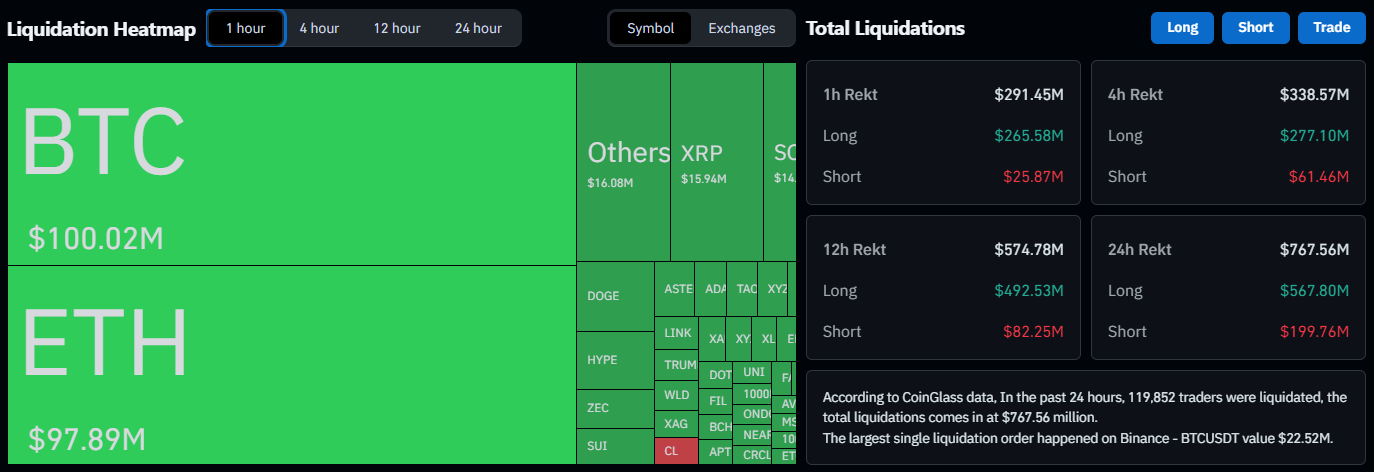
The damage kept building as the session wore on: $338.57 million over four hours (about 4.5-to-1 long-to-short), $574.78 million over 12 hours (about 6-to-1), and $767.56 million over a full 24 hours, where the ratio narrowed to roughly 2.8-to-1 as shorts also began taking losses. In total, 119,852 traders were liquidated, and the largest single order was a $22.52 million BTCUSDT liquidation on Binance.
Which Democrats voted no on the CLARITY Act
Not a single Democrat crossed over. All 46 Democrats and independents who voted, including Kirsten Gillibrand, Mark Warner, Cory Booker, Raphael Warnock, Ruben Gallego, Angela Alsobrooks, and Catherine Cortez Masto, voted no, according to the full roll call. Sen. Chris Coons was the lone senator not voting.
Here is the full list of votes for Clarity, you are are urged to vote accordingly!
**CLARITY Act cloture — Sept. 15, 2026 — 49 Yes, 50 No, 1 Not Voting**
Alsobrooks — No
Baldwin — No
Banks — Yes
Barrasso — Yes
Bennet — No
Blackburn — Yes
Blumenthal — No
Blunt…— Ran Neuner (@cryptomanran) September 15, 2026
One detail in that roll call stands out. Both architects of the ethics compromise the final bill text was built around, Sen. Thom Tillis (R-N.C.) and Sen. Ruben Gallego (D-Ariz.), voted no on the bill they had negotiated together.
On the Republican side, only four senators broke from their own conference: Susan Collins, Josh Hawley, Jerry Moran, and Tillis. Sen. Rand Paul, whose no vote several outlets had treated as all but certain heading into Tuesday, instead voted yes, the one genuine surprise in the final tally. The Republican count barely changed the outcome either way: even with full party unity, Republicans would have topped out at 53, seven short of 60, meaning the bill’s fate always rested on Democratic crossover votes, and it received none.
Sen. Elissa Slotkin (D-Mich.) laid out her reasoning in detail: the bill’s ethics provisions are “simply too thin” given that Trump, his children, and his Cabinet are “making billions of dollars” in the crypto space, in part “off of everyday Americans’ hard-earned money,” and she could not vote to codify that behavior for any president or Treasury secretary, present or future.
Today, I voted no on the Clarity Act, legislation meant to regulate cryptocurrency in America.
The ethics provisions in this bill are simply too thin. President Trump, his children, and his Cabinet are making billions of dollars in the crypto space, in part from bilking everyday…
— Sen. Elissa Slotkin (@SenatorSlotkin) September 15, 2026
She also flagged that federal agencies, including the CFTC, “lack the necessary oversight and staffing to implement this legislation,” an implementation-capacity objection distinct from the ethics fight that dominated coverage this week. Slotkin said she remains open to a future attempt built on the bill’s “strong, bipartisan provisions.”
Why state AGs, banks, and labor opposed the CLARITY Act
The Democratic defections capped a week of mounting opposition from outside the Senate. Eighteen state attorneys general, led by New York’s Letitia James, warned the bill would let the SEC preempt state securities registration authority.
18 State AGs Push Back on CLARITY Act Ahead of Key Senate Vote
New York Attorney General Letitia James led a bipartisan coalition of 17 other state attorneys general urging Congress to oppose the current version of the CLARITY Act ahead of Tuesday’s key procedural vote. The… pic.twitter.com/wQwmqjUTMj
— Wu Blockchain (@WuBlockchain) September 14, 2026
Eight banking trade associations, including the American Bankers Association and the Independent Community Bankers of America, said the bill’s stablecoin ‘circuit breaker’ only activates after damage is done.
JUST IN: 8 banking trade groups say the CLARITY Act’s new stablecoin “circuit breaker” is “not a safeguard at all.” 🚨
They argue it only kicks in AFTER substantial deposit flight has already happened.
They’re also demanding tighter rules around stablecoin rewards.
Seems like… pic.twitter.com/e3MNQGtImv
— The Moon Show (@TheMoonShow) September 14, 2026
AFSCME and labor allies warned the bill would expose pensions to crypto volatility “even if the workers don’t intend to invest in crypto.” Each objection targeted a different part of the bill- ethics, banking, and labor- yet all converged on the same vote.
JUST IN: Largest U.S. public union AFSCME demands Clarity Act rejection.
• Warns bill lets "unregulated crypto" into pensions.
• Claims legislation fuels the next financial crisis.
• Overrides state-level investor protection laws.
Is there any honesty in their stance? 🤥 pic.twitter.com/QrOYbBpfno
— Bitcoin Archive (@BitcoinArchive) September 14, 2026
How Grayscale and the crypto industry reacted to the failed vote
Grayscale’s official response struck a measured tone: ‘Today, the Senate did not advance the CLARITY Act to formal debate. While this was not the outcome we hoped for, the industry continues to make remarkable progress with the ongoing work of regulators like the SEC and CFTC,’ the asset manager said, adding it would keep working with policymakers.
Today, the Senate did not advance the CLARITY Act to formal debate.
While this was not the outcome we hoped for, the industry continues to make remarkable progress through the ongoing work of regulators like the SEC and CFTC.
Grayscale remains committed to advancing clear,…
— Grayscale (@Grayscale) September 15, 2026
Other reactions were sharper. Crypto commentator Scott Melker wrote, ‘Congrats to the big banks on lobbying to kill Clarity. Now the Genius ACT remains the law of the land and crypto exchanges can offer yield.’
Congrats to the big banks on lobbying to kill Clarity.
Now the Genius ACT remains the law of the land and crypto exchanges can offer yield.
Thanks!
— The Wolf Of All Streets (@scottmelker) September 15, 2026
His point is a real one worth stating plainly: with CLARITY dead for now, the existing GENIUS Act framework and current SEC and CFTC rules remain the operative law, not a regulatory vacuum, a distinction that matters for how this failure should actually be read.
What the CLARITY Act’s failure means for crypto regulation
A failed cloture vote does not repeal any existing rule; it keeps digital asset oversight running on the current patchwork of SEC and CFTC rulemaking and enforcement rather than a single federal statute. Neither party seriously contested Bitcoin and Ethereum’s treatment as commodities in this fight; the dispute centered on exchange and intermediary registration, DeFi developer liability, and the ethics provisions that ultimately sank the vote.
With the House having largely cleared its September calendar for midterm campaigning, sponsors and outside estimates this week described the next realistic window for comprehensive legislation as landing sometime between 2027 and 2029, depending on the outcome of the midterms and whether a new Congress restarts negotiations from scratch.
Sen. Cynthia Lummis, one of the bill’s lead sponsors, had warned before the vote that failure now could mean waiting until 2030. Adam Morgan McCarthy, lead researcher at digital asset data firm LO:TECH, offered a shorter estimate, saying that depending on how the midterms land, the bill “could be dead within two months.”
The failure’s practical effect may be felt more outside the US than inside it.
Vincent Chok, founder and CEO of stablecoin issuer First Digital, said “a failed vote in Washington does not slow Asia down,” pointing to Hong Kong’s Stablecoins Ordinance and Singapore’s stablecoin framework as reference points “built independently of the US,” and warned that a longer US delay risks widening the gap with jurisdictions that have already finished their frameworks.
Orest Gavryliak, Chief Legal Officer at DeFi protocol 1inch, made a similar point about Europe, noting the bloc “already has MiCA in force, at least for the centralized half of the market,” while the US remains reliant on “rescindable agency guidance, regulation by enforcement, and a patchwork of state rules.”
For crypto businesses, Tuesday’s result means the jurisdictional uncertainty between the SEC and CFTC that CLARITY was designed to resolve continues by default. Exchanges and token issuers remain subject to whichever agency’s enforcement posture happens to be in effect at a given time rather than a single statutory test for whether an asset is a security or a commodity, the exact ambiguity the bill’s House version passed 294-134 to fix back in July 2025.
Disclaimer: This article is for informational purposes only and does not constitute financial or investment advice. Cryptocurrency prices are highly volatile. Always conduct your own research before making investment decisions.