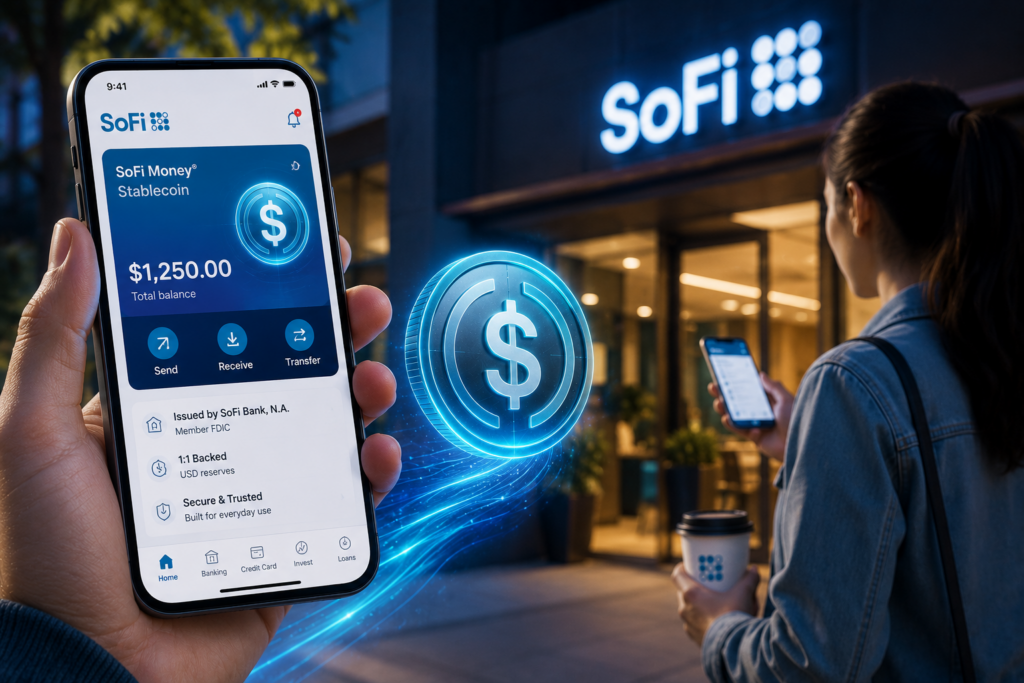
SoFi Technologies announced on May 27 that SoFiUSD, its fully backed US dollar stablecoin issued by SoFi Bank, N.A., is now available directly within SoFi’s retail banking app for its 13.7 million members. The announcement completes a seven-month buildout that began with the launch of crypto trading in November 2025.
Say “hi” to SoFiUSD (SoFiD) 👋
The first stablecoin issued by a U.S. national bank and redeemable 1:1 for cash or cash equivalents. Rolling out now, it’s built for how money moves today: fast, flexible, 24/7. pic.twitter.com/I0eHIxDR50
— SoFi (@SoFi) May 27, 2026
“People no longer have to choose between blockchain technology and regulated banking products,” said Anthony Noto, CEO of SoFi. “With SoFiUSD, we’re giving our members a single place to buy, hold, and pay with digital assets in the same app they already use to save, spend, borrow, and invest.”
The stablecoin market has three categories of issuers. Non-bank technology companies, including Circle and Tether, operate outside the federal banking system. State-chartered trust companies, the category several newer entrants occupy, carry limited banking licenses. National banks, chartered and supervised by the Office of the Comptroller of the Currency (OCC), sit at the top of the US banking hierarchy with access to Federal Reserve master accounts, Federal Deposit Insurance Corporation (FDIC) insurance infrastructure, and direct regulatory standing under federal banking law.
SoFiUSD is the only stablecoin issued by a bank in the third category that is now accessible to retail consumers inside that bank’s own app. JPMorgan’s JLTXX operates on a permissioned layer and targets institutional settlement. BlackRock’s BSTBL OnChain carries a $3-million minimum. SoFiUSD has no minimum, is available to every SoFi member, and runs on the public, permissionless blockchains Ethereum and Solana.
The reserve structure is the most conservative available. SoFiUSD is backed 1:1 by cash held directly at the Federal Reserve, the same counterparty that backs the US banking system itself. There are no money market funds, Treasury bills, or overnight repo agreements in the reserve stack. Cash at the Fed eliminates credit risk and liquidity risk simultaneously, a design that satisfies the US GENIUS Act’s reserve requirements for payment stablecoins without requiring any structural modification.
The retail launch is commercially significant on its own. The larger strategic play is the Galileo distribution network. Galileo Financial Technologies, SoFi’s technology platform subsidiary, powers financial services across nearly 160 million global accounts for banks, fintechs, and enterprise partners.
Every Galileo client can white-label SoFiUSD under their own brand. A fintech running on Galileo infrastructure does not need to build its own stablecoin, apply for a banking license, or assemble its own reserve-management infrastructure. It leverages SoFi’s OCC charter, Federal Reserve account, and GENIUS Act-compliant reserve structure as a service.
The competitive moat is the banking license itself. A non-bank trust company issues Circle’s USDC (USDC). Tether’s USDt (USDT) is issued outside the US regulatory jurisdiction. Neither issuer can offer white-label stablecoins to partner institutions under an OCC national banking charter. SoFi can. That distinction matters because the FDIC’s May 22 Bank Secrecy Act (BSA) and sanctions compliance rule, the GENIUS Act’s implementing regulations, and the CLARITY Act’s pending market-structure framework collectively raise the compliance bar for all stablecoin issuers operating in the US market.
The May 27 retail launch is the fourth milestone in a sequenced buildout.
Each stage built the compliance, technical, and operational infrastructure required by the next stage. The OCC’s regulatory approval, the Federal Reserve master account, the Galileo integration, and the big business banking launch all had to be in place before SoFi could responsibly put a stablecoin in front of 13.7 million retail consumers without the compliance risks that have tripped up non-bank stablecoin deployments.
PayPal USD (PYUSD), launched in August 2023 by Paxos Trust Company on behalf of PayPal, is the closest structural precedent: a consumer-facing stablecoin accessible within a mainstream financial app. But Paxos is a New York-chartered limited-purpose trust company, not a nationally chartered bank. PYUSD is backed by US Treasurys and cash equivalents held by Paxos.

SoFiUSD is backed by cash held at the Federal Reserve and issued by an OCC-supervised national bank. That distinction determines which regulatory framework applies, which reserve guarantees hold, and which partner institutions can access the white-label infrastructure.
USDC, with ~63% of all stablecoin transaction volume in Q1 2026 and $68 billion in circulation as per Visa’s stablecoin dashboard, reaches retail through third-party wallets and exchanges rather than a bank’s own app. Circle is a non-bank trust company. Tether operates outside the US jurisdiction. Neither can extend an OCC charter to Galileo partners.
Georgia’s GELT, launched on May 25 by Tether, targets a sovereign-currency use case rather than a consumer banking product.
A nationally chartered US bank just launched a stablecoin on @solana.
Not a crypto native. Not a neobank. A $50B OCC regulated institution with a Fed Master Account, which means reserves held directly at the Fed, not spread across commercial banks hoping they've matched their… https://t.co/VKXte4fwkO
— Maya (@CaddleMaya) May 27, 2026
SoFi reported $4.77 billion in 2025 revenue and $0.44 in earnings per share over the last 12 months.
The CLARITY Act Senate floor vote is expected in the June-August 2026 window, which would formalize the regulatory framework SoFiUSD already operates within.


 preferred on