On Au. 13, 2026, Tether announced that KPMG U.S. had completed a full independent audit of its 2025 financial statements and issued an unqualified opinion, the most positive an auditor can give.
It was the company’s first complete audit from a Big Four firm after more than a decade of relying on quarterly attestations from BDO Italia. This lower-assurance review confirms a single point-in-time snapshot rather than testing the systems and controls behind it.
Tether Completes the Largest Inaugural Financial Audit in History
Read more: https://t.co/vWG0fFSUxH
— Tether (@tether) August 13, 2026
As part of the process, KPMG physically counted and inspected every gold bar Tether holds rather than relying on custodian reports, and reserves exceeded liabilities by $6.81 billion as of Dec. 31, 2025.
The audit answers a specific, quantified accusation that has shadowed Tether since 2021. The CFTC’s order fined the company $41 million after finding USDT was fully backed only 27.6% of the time across 26 months, and the New York Attorney General separately extracted an $18.5 million settlement over misrepresented reserves. A clean opinion from a Big Four firm is Tether’s clearest rebuttal yet to findings that were never about crypto novelty but about disclosure.
What the audit does not do is answer a separate, newer question: whether USDT’s reserve composition would qualify Tether for lawful stablecoin issuance in the United States under the GENIUS Act. Those are two different tests, and Tether fails the second one by a wide margin, which is why the company spent 2025 and 2026 building an entirely separate product rather than trying to bring USDT itself into compliance.
The GENIUS Act, signed into law in July 2025, limits the reserve assets a permitted payment stablecoin issuer can hold to a short, specific list, defined in the statute’s text: cash, insured bank deposits, Treasury bills with a maturity of 93 days or less, repurchase agreements collateralized by those T-bills, and government money market funds. Gold, Bitcoin, corporate bonds, and secured loans to third parties do not appear anywhere in that list.
Tether’s full reserve breakdown, assured by BDO Advisory Services as of June 30, 2026, shows total assets of $187.75 billion, split across seven categories.
Five of those categories fall outside the GENIUS Act’s permitted list entirely: $18.84 billion in precious metals, $5.80 billion in Bitcoin, $13.45 billion in secured loans, $5.24 billion in an ‘Other Investments’ category BDO describes as assets that “do not meet any of the criteria set out in the other categories,” and $3.76 billion in ‘Public Equities,’ which the report defines not as operating-company shares but as indirect gold, Bitcoin, and other asset exposure traded on active markets, alongside a smaller $8.7 million in corporate bonds.
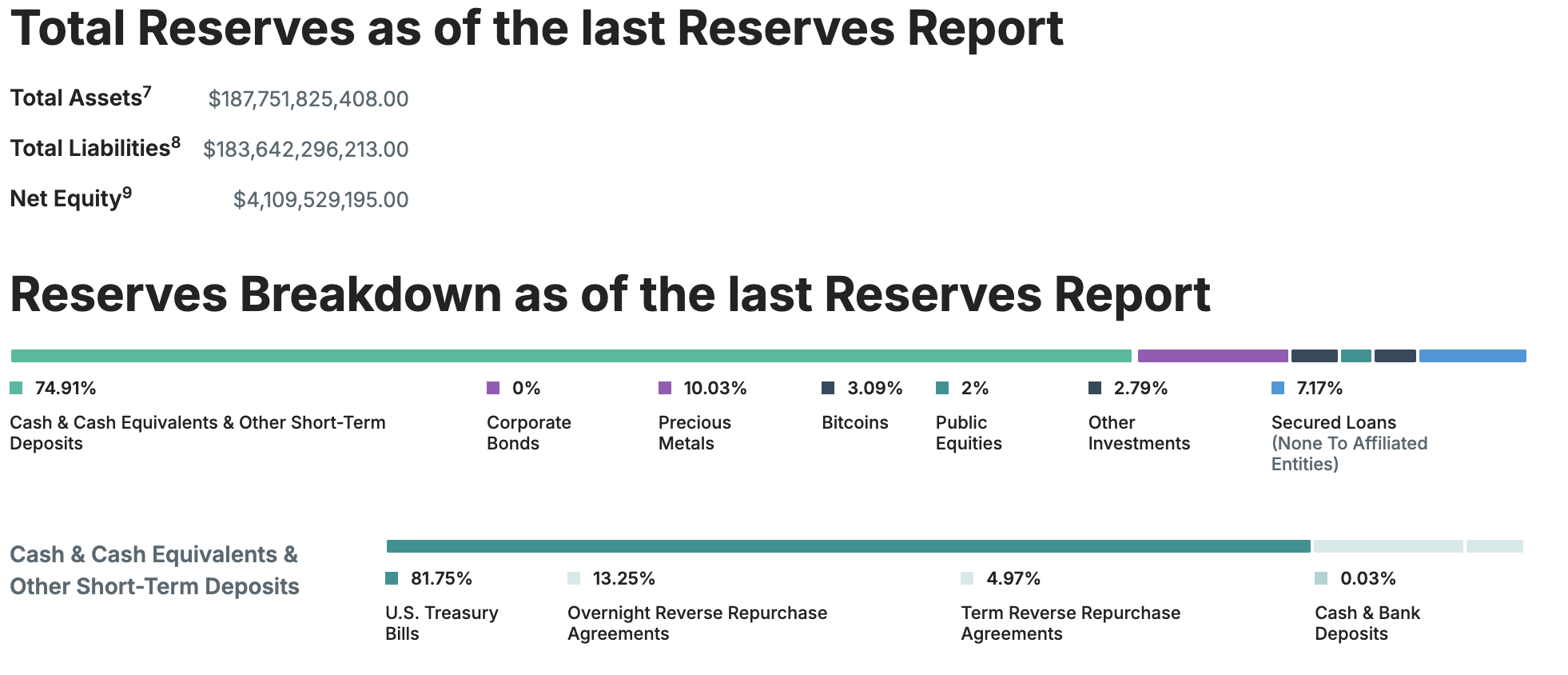
Summed together, these categories total $47.11 billion, or roughly 25% of Tether’s total assets. A stablecoin issuer holding three-quarters compliant assets is not three-quarters compliant; the statute requires reserves to be composed entirely of the permitted list, which means a quarter of Tether’s balance sheet is disqualifying on its own, not a rounding error against its compliance case.
This is also not a static problem. Tether’s excess reserve buffer, the cushion of assets above liabilities, has moved sharply and inconsistently even across Tether’s disclosures. KPMG’s audit put the December 31, 2025 figure at $6.814 billion. Tether’s attestation as of Jun. 30 shows the same date’s equity at $6.338 billion, a $476 million gap between two of Tether’s own reports for the identical balance sheet date.
That discrepancy likely reflects differences in scope and methodology between a full independent audit and a lower-assurance quarterly attestation rather than any restatement, but it underscores a point worth taking seriously: even Tether’s own reported solvency cushion is not a single, settled number depending on which of its own documents is doing the counting.
The buffer then climbed to a record $8.23 billion as of Mar. 31, 2026, according to Tether’s Q1 attestation, before falling to $4.11 billion by June 30, a roughly 50% contraction in a single quarter that Tether has not fully itemized.
Tether’s answer to that gap has a name, a launch date, and a track record now long enough to evaluate.
USAT launched on Jan. 27, issued not by Tether directly but by Anchorage Digital Bank, N.A., a national trust bank chartered by the Office of the Comptroller of the Currency in 2021, well before the current administration, a detail worth noting given how politically framed stablecoin coverage has become. Cantor Fitzgerald serves as reserve custodian and preferred primary dealer, while Tether contributes brand, distribution, and engineering support without acting as issuer of record.
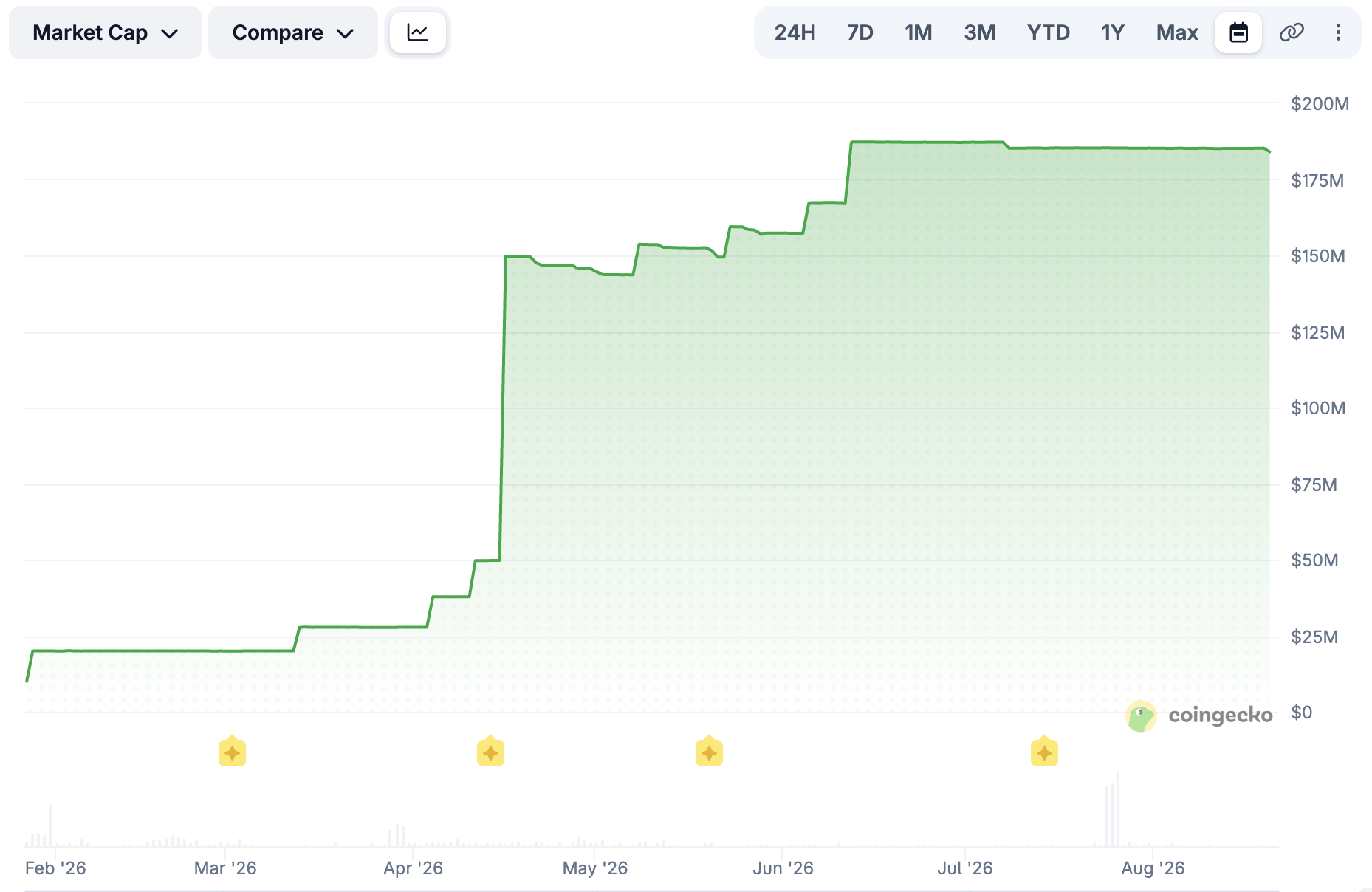
The design choice is visible in the numbers from day one. USAT’s first reserve report, covering Jan. 31, 2026, showed $17.6 million in reserves against 17.5 million tokens outstanding, composed of cash and reverse repurchase agreements collateralized by Treasury securities, both squarely inside the GENIUS Act’s permitted list, held in segregated fiduciary trust accounts under OCC oversight.
There is no gold line item. There is no Bitcoin line item. There is no secured-loan line item. Unlike USDT, which had to retrofit disclosure and audit rigor onto an existing $185 billion balance sheet built over a decade, USAT was constructed to fit the statute’s asset list from its first dollar.
Growth has been fast and increasingly well-documented. According to USAT’s June 2026 reserve report, circulation reached 176.8 million tokens as of June 30, up nearly 30% from May’s 156.5 million, itself up from roughly 22.1 million at the end of March. Reserve assets grew alongside circulation to $177.4 million, composed of $159.7 million (90%) in overnight reverse repos collateralized by US Treasuries and $17.7 million in cash, with reserves exceeding tokens outstanding by $628,518, a surplus that has grown every month reported so far.
“USAT issuance grew nearly 30% from May to June, with reserves once again exceeding circulation,” said Paolo Ardoino, CEO of Tether. “Consistent month-over-month growth like this reflects real demand for a dollar designed for the U.S. market.”
Even at $185.8 million, USAT’s circulation represents roughly 0.1% of USDT’s approximately $185 billion in circulation, a gap still wide enough that Hines’ public target of Tether becoming a ‘top 10’ US Treasury bill purchaser this year rests overwhelmingly on USDT’s existing T-bill holdings, not on USAT’s growth curve.
The strongest case against treating this gap as urgent is jurisdictional, and it is more time-pressured than it first appears. Tether International, S.A. de C.V. is organized under El Salvador law and, per its own reserve report, is ‘an authorized Stablecoin Issuer and Digital Assets Service Provider under the Digital Asset Issuance Law of El Salvador,’ reporting to that country’s National Commission of Digital Assets and Financial Investigation Unit.
On August 17, 2026, the Treasury Department proposed rules to implement Section 3 of the GENIUS Act, whose full text lays out two separate, sequential compliance tests rather than a single grace period.
U.S. Treasury Proposes GENIUS Act Rules for Stablecoin Issuers and Foreign Stablecoins
The U.S. Treasury issued proposed rules to implement key provisions of the GENIUS Act, clarifying when stablecoin issuers must obtain a federal or state license and when foreign-issued… pic.twitter.com/3zNG8Ozs4z
— Wu Blockchain (@WuBlockchain) August 17, 2026
The first arrives almost immediately. Beginning January 18, 2027, the Act’s expected effective date, Section 3(b)(2) makes it unlawful for a digital asset service provider to offer, sell, or make available a foreign-issued stablecoin unless that issuer has the technological capability to comply, and will comply, with the terms of any lawful order and any reciprocal arrangement between the US and its home jurisdiction. That is a real bar, but one USDT could plausibly clear through operational compliance.
The second test, arriving July 18, 2028, three years after the Act’s enactment, is considerably harder to satisfy. Section 3(b)(1) requires that a stablecoin be issued by a domestic permitted issuer or by a foreign issuer that meets separate criteria under Section 18(a): the Treasury Secretary must formally determine that the issuer’s home country maintains a stablecoin regulatory regime comparable to the GENIUS Act framework, and the issuer must be registered with the OCC. The Treasury has not yet made a comparable-regime determination for El Salvador or any other jurisdiction. That determination is a government-to-government process, not an operational checklist Tether can complete on its own timeline.
The NPRM does not hand USDT an 18-month grace period. It hands Tether a near-term compliance test it can likely pass, followed by a much harder one, dependent on a diplomatic determination that has not been made and may not arrive by 2028. USAT remains the vehicle for institutional counterparties who need GENIUS Act-compliant status today, while USDT’s longer-term US access now depends on a regulatory judgment outside Tether’s control.
KPMG’s audit resolves the question that has defined Tether’s reputation since 2021: whether the company’s reserves are real and sufficient.
They are, by a margin of $6.81 billion as of the date audited. It does not resolve, and structurally cannot resolve, whether those same reserves are the right kind of assets for a US-regulated stablecoin issuer, because roughly a fifth of them are categories the statute excludes by name.
Tether’s answer to that second question was not to change USDT’s balance sheet. It was to build a second, smaller, slower stablecoin next to it, one now seven months into proving whether a compliant product built from scratch can catch up to a nine-figure-per-month growth curve before regulatory deadlines or competitive pressure force the comparison to matter more than it has so far.


 preferred on