Zcash (ZEC) could emerge as the first serious challenger to Bitcoin’s (BTC) dominance in the digital currency market as AI increases the value of financial privacy, according to Grayscale Research.
Zach Pandl, head of research at Grayscale, argued that Zcash’s privacy technology and ongoing development could allow it to overcome some of Bitcoin’s powerful network effects.
Although ZEC has already risen roughly 19-fold over the past year, Grayscale believes the asset may still offer significant upside if it captures a larger share of the digital currency market.
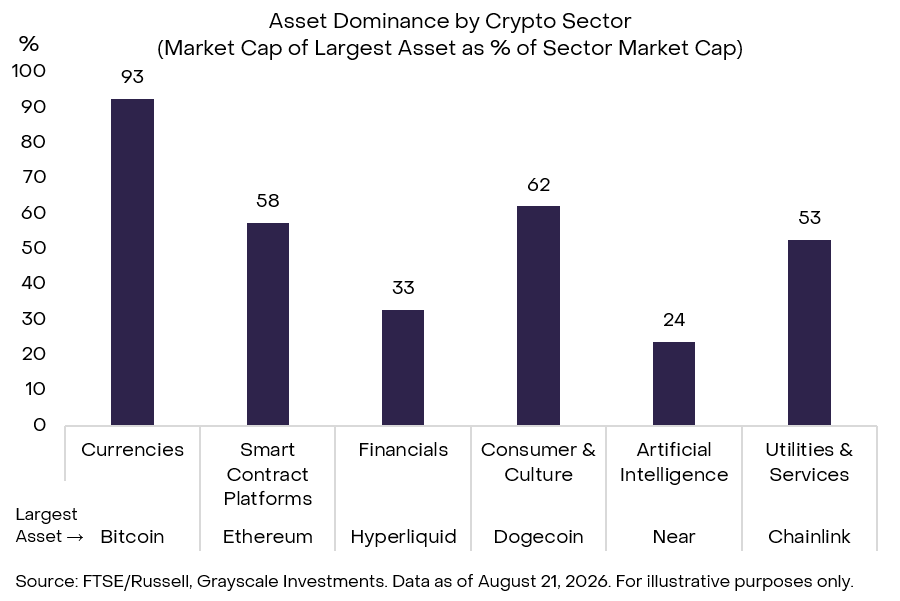
Bitcoin remains overwhelmingly dominant, representing about 93% of the Currencies Crypto Sector under Grayscale’s classification system. Zcash, by comparison, is valued at less than 1% of Bitcoin’s market capitalization.
Bitcoin’s first-mover advantage, liquidity, and established user base have helped it outperform rival digital currencies such as Litecoin (LTC). However, Bitcoin transactions are recorded on a transparent public ledger, allowing sophisticated analytics tools to trace funds and identify behavioral patterns.
Zcash $ZEC can challenge Bitcoin's network effects
Bitcoin $BTC is the dominant digital currency (>90% mkt share)
But financial privacy may be a "must have" feature in an age of AI
If correct, price of ZEC may still have significant upside. Read our Research perspective. ⬇️🛡️ pic.twitter.com/HQ2zA7c4LV
— Zach Pandl (@LowBeta) August 25, 2026
Grayscale believes this transparency may become a greater concern as AI-powered surveillance becomes more capable. Individuals, companies, and autonomous AI agents may increasingly require a way to conduct transactions without exposing their financial history to the public.
Zcash seeks to address that problem through shielded transactions, which can conceal information such as wallet addresses and transaction amounts while preserving the ability to verify transfers cryptographically.
While Bitcoin benefited from being the first decentralized digital currency, Zcash may benefit from technologies that were unavailable or less relevant during Bitcoin’s early development, Grayscale said.
Beyond financial privacy, the investment manager highlighted Zcash’s active development community and its efforts to prepare for emerging cybersecurity risks. These include the potential threat quantum computing could eventually pose to traditional cryptographic systems.
Grayscale also pointed to “intents,” a wallet technology designed to simplify transactions across different blockchain networks.
The system could allow users or AI agents to treat Zcash as a private asset hub while connecting with other networks, reducing the need for merchants to adopt ZEC directly.
Grayscale launched its Zcash exchange-traded fund (ETF) on Aug. 25 and said Zcash’s valuation suggests the market may still be underpricing privacy. If demand grows, even a relatively small gain in market share could provide substantial upside for ZEC.
However, the company warned that investing in Zcash remains highly speculative and that future gains are unlikely to occur in a straight line.
The Zcash ETF – Built by Grayscale (Ticker: $ZCSH) begins trading today @ZcashETF.
The world’s first Zcash ETF offering exposure to $ZEC, now accessible from brokerage or investment accounts.
Why $ZEC?
⟶ Zcash shares key features with Bitcoin: a 21 million… pic.twitter.com/nuaR2HBTWx
— Grayscale (@Grayscale) August 25, 2026
Bitcoin’s transparency, simplicity, liquidity, and entrenched network effects continue to support its leadership.
Zcash’s prospects, therefore, depend on whether users begin treating privacy as essential rather than optional and whether that demand proves strong enough to loosen Bitcoin’s grip on the digital currency market.


 preferred on