preferred on


Points of Focus
- All nine banks examined by the OCC maintained policies that could restrict financial services based on customers’ lawful activities or beliefs.
- Crypto issuers, exchanges, and administrators faced banking restrictions, frequently attributed to financial crime concerns.
- The CFPB has opened a related initiative, while the OCC considers further action against discriminatory banking practices.
The Office of the Comptroller of the Currency (OCC) found that nine major US banks maintained policies that could restrict financial services based on customers’ lawful business activities, political views, or religious beliefs. Cryptocurrency companies were among the affected industries.
The findings come as banks expand their involvement in digital assets. In September, Citi and Coinbase announced a partnership covering stablecoin payments and fiat settlement.
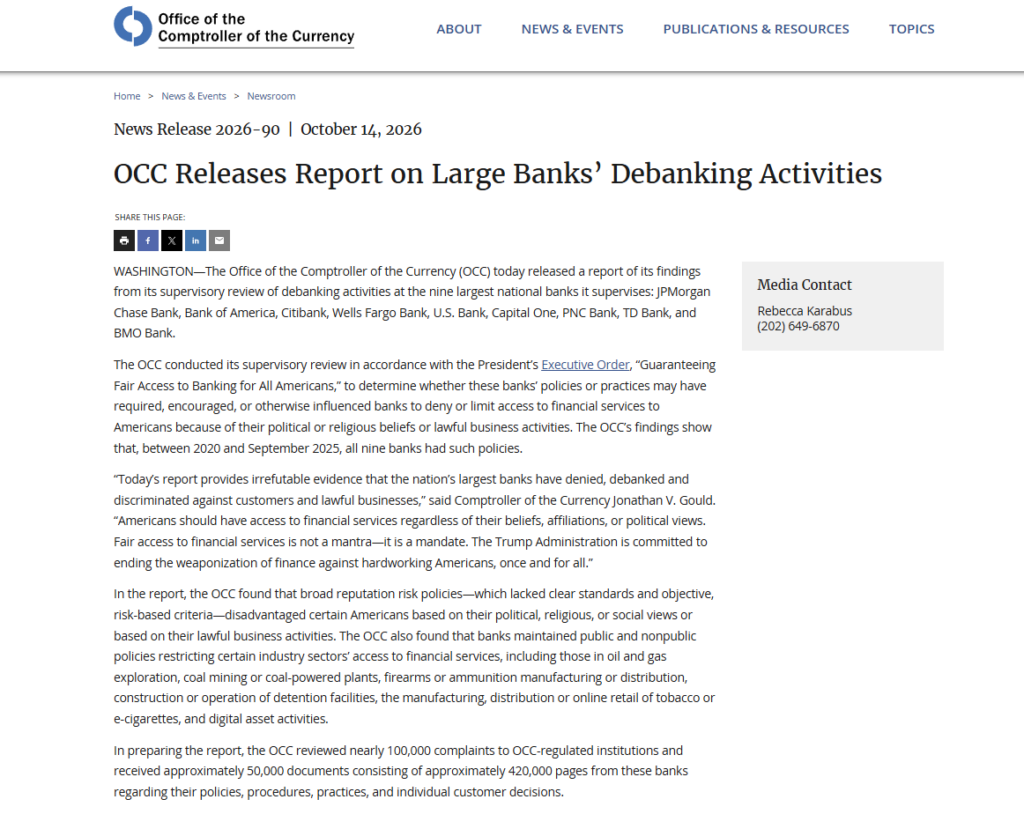
The OCC released its findings on Oct. 14 following a review of nearly 100,000 complaints and approximately 420,000 pages of documents. The investigation examined policies in place from 2020 through September 2025 at JPMorgan Chase, Bank of America, Citibank, Wells Fargo, US Bank, Capital One, PNC, TD Bank, and BMO.
Crypto businesses faced banking restrictions
The OCC’s report found that many institutions restricted services for digital asset issuers, exchanges, and administrators, frequently citing financial crime concerns.
Across the broader investigation, regulators identified reputation-risk policies that lacked objective standards. Decisions were sometimes influenced by fears of negative publicity or public pressure, potentially excluding customers engaged in lawful activities.
Financial crime compliance remains a concern for banks dealing with crypto businesses. A September Senate Democratic staff report on Iran-linked wallets questioned Tether’s sanctions controls, although the stablecoin issuer disputed the findings.
The OCC did not quantify the overall extent of debanking or the resulting customer losses.
Banks deepen stablecoin partnerships
Several banks have since expanded their digital asset operations, particularly in payments and custody.
Coinbase partnered with Moov in September to bring stablecoin infrastructure to a network serving more than 1,000 community banks and credit unions.
Outside the US, Standard Chartered added custody services for the Ripple USD (RLUSD) stablecoin through its Dubai branch.
Demand is also emerging from businesses engaged in international trade. XREX co-founder Wayne Huang has described exporters seeking stablecoin services from banks to facilitate payments from overseas buyers.
OCC and CFPB consider further action
The investigation followed US President Donald Trump’s August 2025 executive order on fair banking access and builds on the OCC’s preliminary findings published in December.
The agency has since removed reputation risk from bank examinations and clarified how improper debanking can affect licensing reviews.
On Oct. 14, the Consumer Financial Protection Bureau (CFPB) announced an initiative addressing potential consumer harm from the practices identified by the OCC.
Comptroller Jonathan Gould warned that banks’ efforts to address the issue may be insufficient. The OCC is weighing further regulatory and supervisory changes, including measures to prevent discriminatory account restrictions.