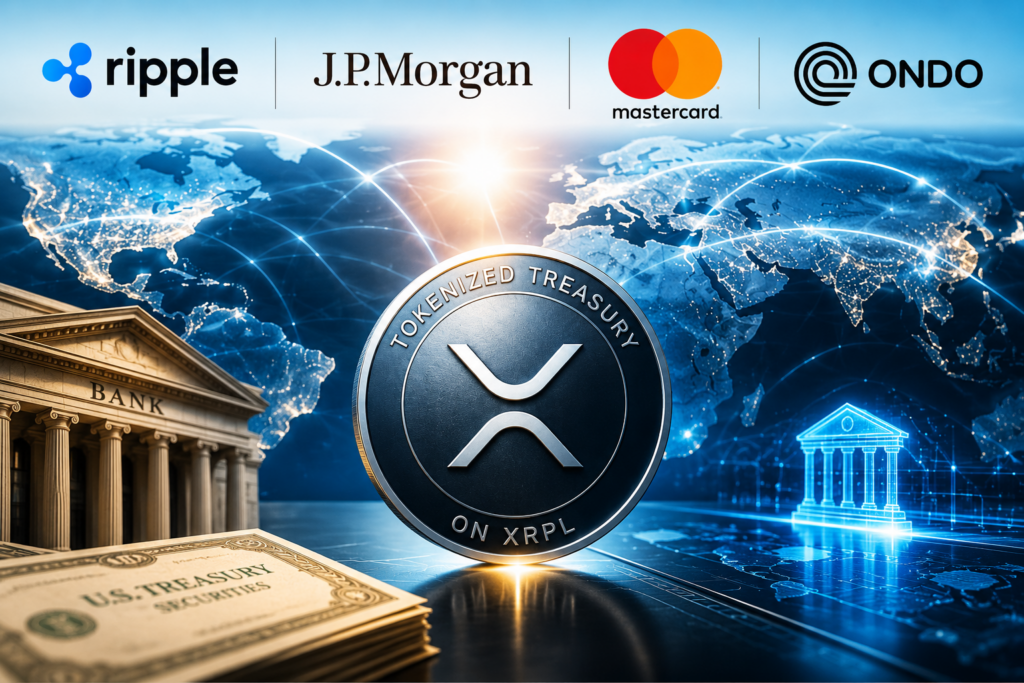
Ondo Finance announced on May 6 the successful completion of the first near real-time, cross-border, cross-bank redemption of a tokenized US Treasury fund, conducted in collaboration with Kinexys by J.P. Morgan, Mastercard, and Ripple.
Ondo, Kinexys by @jpmorgan, @Mastercard, & @Ripple successfully completed a landmark pilot transaction connecting the XRP ledger with interbank settlement rails.
This milestone marks the first time tokenized U.S. Treasuries have settled across borders and banks in near real time… pic.twitter.com/BUjvWwHBGg
— Ondo Finance (@OndoFinance) May 6, 2026
The transaction processed the blockchain leg in under five seconds on the XRP Ledger. It delivered US dollar proceeds to Ripple’s bank account in Singapore via J.P. Morgan’s correspondent banking network, entirely outside traditional banking cut-off windows.
The result was a unified settlement flow in which tokenized asset redemptions on a public blockchain directly triggered fiat settlement through regulated banking infrastructure.
The pilot used OUSG, Ondo’s Short-Term US Government Treasuries fund, which holds approximately $680 million in total value locked across Ethereum, Solana, the XRP Ledger, and Polygon, as per data from RWA.xyz.
Ripple redeemed a portion of its OUSG holdings on XRPL. Ondo processed the redemption and initiated a fiat payout via the Mastercard Multi-Token Network (MTN), which enables interoperability between on-chain assets and traditional fiat. MTN routed the instruction from J.P. Morgan to Kinexys, which debited Ondo’s Blockchain Deposit Account and settled US dollar proceeds to Ripple’s Singapore bank account via J.P. Morgan’s correspondent banking network.
The XRPL processed the asset transfer in under five seconds. Kinexys handled the fiat leg. Neither waited for the other to finish before triggering. That simultaneity is the architectural advance.
‘This milestone represents the first time tokenized US Treasuries have settled across borders and banks in near real time and outside traditional banking windows,’ said Ian De Bode, President of Ondo Finance.
Kinexys by J.P. Morgan is J.P. Morgan’s blockchain business unit, part of J.P. Morgan Payments, and has been operating since 2015. It has processed more than $3 trillion in transactions since its inception and averages more than $5 billion in daily transaction volume. It is live, institutional-scale financial infrastructure processing daily volumes comparable to mid-tier central bank settlement systems.
The Blockchain Deposit Account (BDA) at the center of this transaction is a Kinexys product that allows institutional clients to hold tokenized deposits on J.P. Morgan’s blockchain infrastructure, with programmable payment instructions triggering directly from on-chain events.
The debit to Ondo’s BDA upon XRPL execution eliminates the manual intervention step that characterizes every existing redemption process.
In May 2025, Kinexys connected with Chainlink and Ondo to execute a delivery-versus-payment transaction on the Ondo Chain testnet, the first time J.P. Morgan’s payment infrastructure directly interacted with a public blockchain. The May 6 pilot extends that precedent with live cross-border fiat settlement across a correspondent banking network.
The XRP Ledger’s role is specific and measurable: sub-five-second asset transfer with deterministic finality, compliant with the token standards and custody frameworks Ripple and Ondo have built on the network. Ripple holds OUSG on XRPL as a Treasury liquidity instrument.
The architecture is designed to be network-agnostic on the asset side. Ondo confirmed the framework supports redemptions from any public blockchain on which OUSG is issued, including Ethereum, Solana, and Polygon, not only XRPL.
The XRP Ledger is the first to go live in this configuration. The same infrastructure will extend to other networks as they are onboarded.
Tokenized US Treasuries crossed $10 billion for the first time on February 27, as per data from RWA.xyz. On May 8, the market stands at $14.4 billion, up 225% over 15 months. The broader tokenized RWA market surged 256.7%, from $5.42 billion at the start of 2025 to $30.91 billion on May 8.
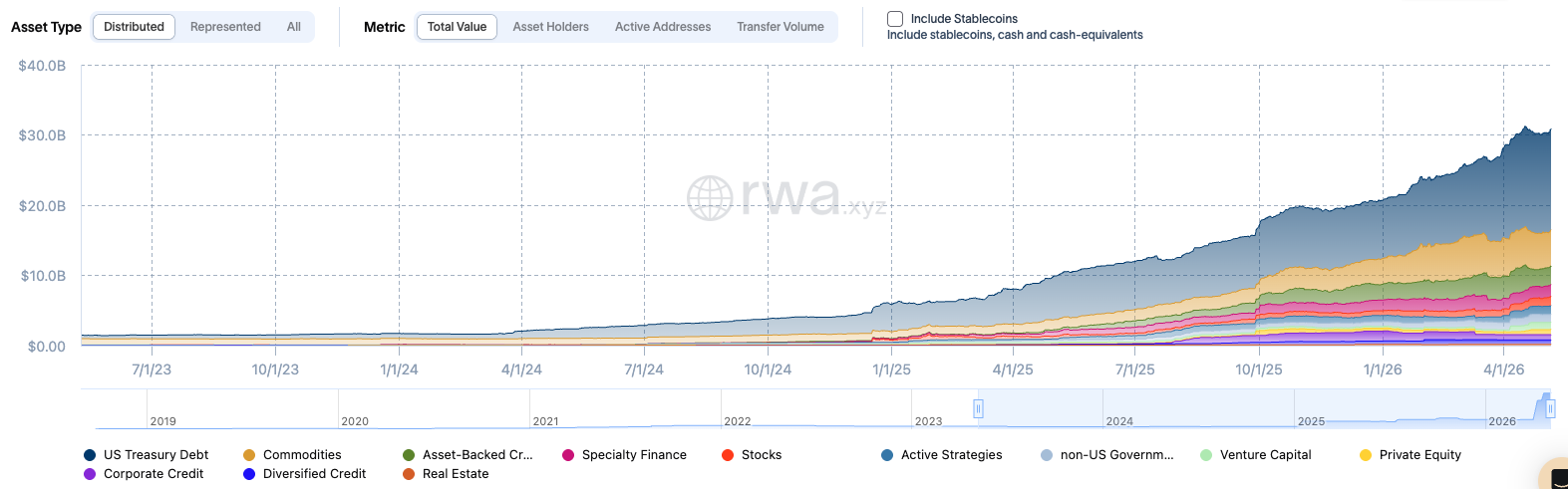
The settlement infrastructure question has been the bottleneck. Tokenized Treasuries can be issued and transferred on public blockchains in seconds. Converting the proceeds back to fiat, across borders and banks, has remained dependent on traditional rails operating on fixed schedules.
The DTCC is preparing limited production trades of tokenized securities in July 2026, with a full DTC tokenization service targeting October. Its working group of 50+ firms includes J.P. Morgan, BlackRock, Goldman Sachs, Circle, Ondo Finance, Ripple Prime, NYSE Group, and Nasdaq. The same participants who are completing this XRPL pilot are building the infrastructure that the DTCC will run on.
Building on the SEC's No-Action Letter related to DTC's tokenization service, DTCC has convened more than 50 firms through its Industry Working Group to inform the development of DTC’s tokenization service and support responsible exploration of digital asset use cases.
Join the… pic.twitter.com/QyGd0SW5KW
— DTCC (@The_DTCC) May 4, 2026
XRP trades at $1.38 on May 8, and has traded flat over the past month, as per data from CoinGecko. The CLARITY Act Senate markup is the next regulatory catalyst. Kevin O’Leary at Consensus Miami 2026 framed the institutional capital case plainly: ‘When that occurs, it’s going to change everything.’


 preferred on