preferred on


Points of Focus
- Tether led an undisclosed pre-seed investment in Peso to expand everyday USDT payments across four Latin American markets.
- Peso joins Bolivia’s growing USDT ecosystem amid exchange-rate reforms and an evolving regulatory framework.
- Peso’s commission-free QR payments can still involve currency conversion spreads and network deposit fees.
Tether said on Oct. 21, 2026, it led a pre-seed round in Bolivian fintech Peso to expand everyday USDt (USDT) payments across Latin America.
Peso operates in Bolivia, Brazil, Colombia, and Argentina. Tether did not disclose its investment amount, and the funding will support local payment connections and infrastructure for merchants and users.

Peso links USDT spending to food delivery and local banking
In Bolivia, customers can order food on Yango and pay in USDT through Peso’s integration with the platform. Beyond payments, Peso’s app also supports savings, investing, and international transfers. Its merchant point-of-sale service and virtual accounts in customers’ names connect USDT balances to Bolivian banks through QR payments and automated clearing house (ACH) transfers.
In Bolivia, digital dollars are becoming part of everyday life. 🇧🇴
Through the integration between Yango Food and Peso, users can order food from more than 2,000 restaurants and pay using USD₮.
Another example of how USD₮ is becoming part of daily commerce. pic.twitter.com/MEKMcxBlwO
— Tether (@tether) August 14, 2026
The investment will support expanded local on- and off-ramps across Peso’s four markets, plus merchant terminals and virtual account systems. Tether also targets retail, institutions, ride-hailing, food delivery, e-commerce, and banking rails. Tether CEO Paolo Ardoino framed the deal as a way to move USDT beyond saving and into daily payments.
Peso’s fee schedule also lists commission-free transfers through Brazil’s Pix and Colombia’s Bre-B instant-payment systems. However, Tether’s announcement disclosed no user count, merchant count, or payment volume for Peso.
Bolivia’s USDT options expand amid currency and regulatory shifts
Several other companies offer USDT services in Bolivia.
Banco FIE offers Cripto FIE service for buying and selling USDT, subject to a 2,000-USDT custody cap.
On Oct. 20, lender Tala announced that eligible El Dorado digital wallet users would receive and repay USDT loans on the Tempo blockchain, starting in Bolivia.
Tether also announced an Efy Finance seed-round investment on Oct. 13, citing the firm’s presence in Bolivia and five other markets. Efy offers cross-border payments, accounts, and custody built on stablecoins.
Tether Invests in EFY Finance to Accelerate Institutional Stablecoin Usage in LATAM
Learn more: https://t.co/GFcFx1EH5H— Tether (@tether) October 13, 2026
These developments coincide with changes to Bolivia’s monetary framework. The country’s economy ministry issued Resolution 245 on June 26, establishing a flexible exchange-rate regime. The central bank abandoned its fixed rate on June 29, when the official rate started at 9.73 bolivianos per dollar.
Bolivia remained on the Financial Action Task Force gray list in the latter’s June 19 update. A ministry memorandum published Sept. 10 under Bolivia’s International Monetary Fund program commits to a robust virtual-asset regulatory and supervisory framework, aimed at curbing improper capital outflows through crypto markets, but sets no completion date.
Peso’s commission-free payments still involve conversion and deposit costs
Peso’s fee schedule, effective Sept. 19, 2026, lists QR payments across Bolivia, Brazil, Argentina, and Colombia as commission-free.
However, according to Peso’s exchange-rate page, it applies different rates when customers buy and sell dollars, and that spread allows it to keep boliviano transactions commission-free. Dollar-to-dollar transactions avoid conversion, while immediately depositing and withdrawing bolivianos may return slightly less.
Tether’s announcement calls the payments low-cost but offers no comparison with conventional payment providers.
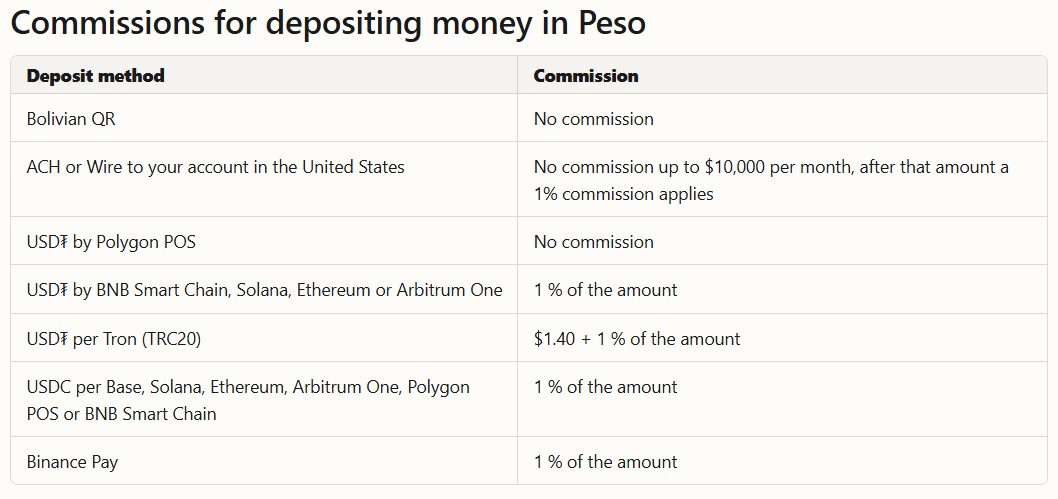
The spread applies only when currency is converted, and network deposit fees apply only when USDT is deposited. Polygon USDT deposits are free, while Ethereum, Solana, BNB Chain, and Arbitrum deposits cost 1%, and Tron deposits cost $1.40 plus 1%.