preferred on


Points of Focus
- The OCC urged community banks to explore stablecoin issuance under the GENIUS Act, including through approved subsidiaries.
- ICBA reiterated its warning that stablecoin yield could reduce community bank lending by at least $850 billion.
- Stablecoin issuers face a $5-million capital floor, a 12-month expense backstop, and mandatory weekly reporting.
The US Office of the Comptroller of the Currency (OCC) urged community banks on Oct. 26 to consider applying as stablecoin issuers under the GENIUS Act.
The agency said in an X post that banks may apply or have a subsidiary apply, depending on structure. It named no participating institutions and tied the push to its Community Bank Comeback initiatives.
The OCC wants community banks to help shape the future of payments and is encouraging the development of payment stablecoin capabilities within the community banking sector. Interested community banks are encouraged to consider applying to become, or for a subsidiary to become, a… pic.twitter.com/qf1TCaLkNm
— OCC (@USOCC) October 26, 2026
The Community Bank Comeback initiatives advanced on Sept. 10, when an interim final rule raised the asset threshold for regulatory 18-month bank examinations from $3 billion to $6 billion. The OCC estimated about 50 additional institutions would qualify for the relief.
Insured banks must issue stablecoins through subsidiaries, and applications remain closed
Insured national banks and federal savings associations must issue stablecoins through approved subsidiaries, which the final rule notes become permitted issuers under the GENIUS Act.
As of Oct. 27, applications remained closed, six days after the OCC finalized its rules. The OCC generally expects prospective issuers to await approval before operating. From Jan. 18, 2027, issuing a payment stablecoin in the US without being a permitted issuer carries criminal penalties.
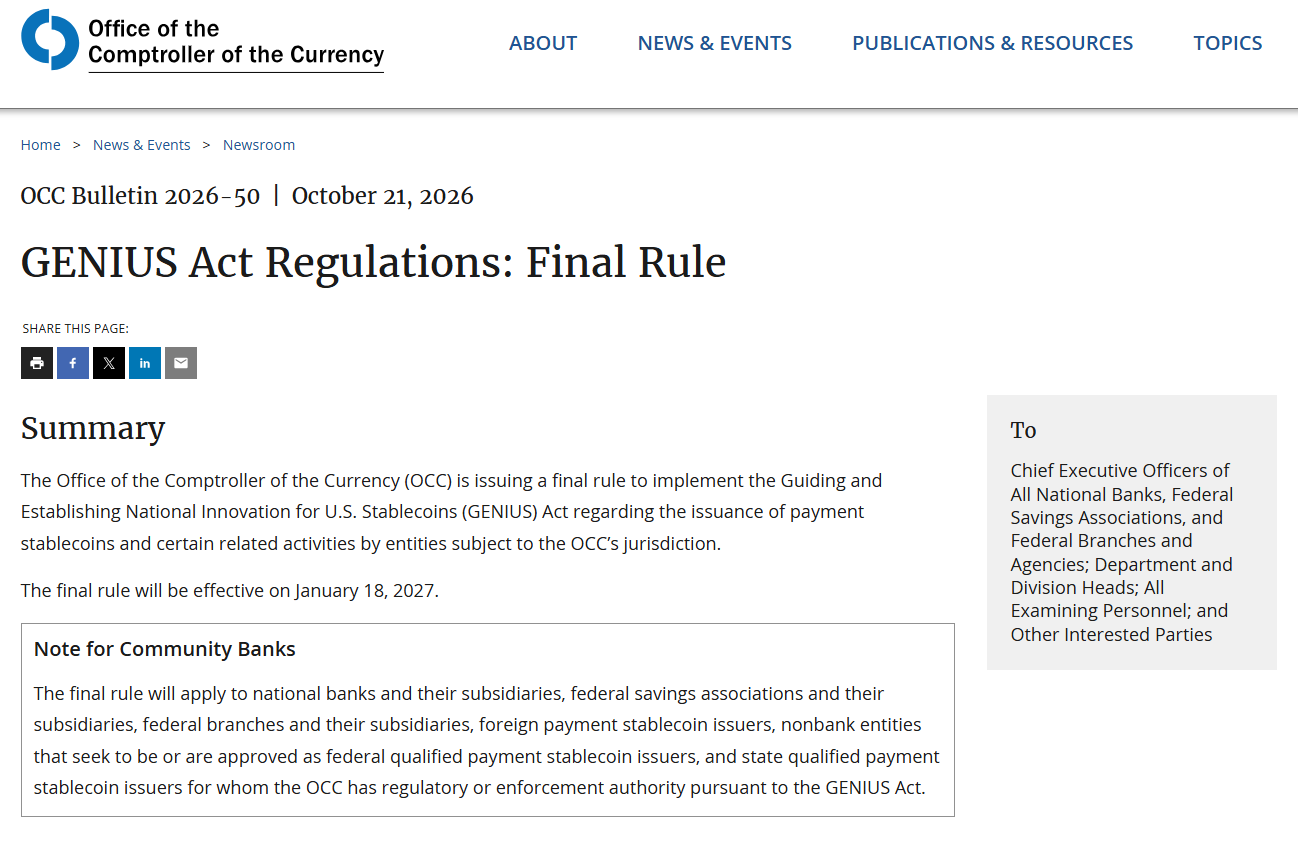
Addressing concerns that smaller banks lack resources to compete, the OCC’s fact sheet points to requirements tailored to each issuer’s size and risk.
ICBA ties $850-billion lending risk to stablecoin yield
The Independent Community Bankers of America (ICBA) said on Oct. 21 it was still reviewing the final rule. It reiterated its estimate that community bank lending could decline by at least $850 billion in the coming years.
That forecast comes from ICBA’s Dec. 15, 2025, analysis, which linked the risk to crypto intermediaries paying interest on stablecoin holdings. Drawing on two cited studies, the association projected a $1.3-trillion reduction in deposits from the $4.8-trillion community banks hold.
America’s small businesses, farmers, ranchers, and rural communities stand to lose access to capital and credit if deposits are diverted from community banks to stablecoin holdings. See our latest data analysis: https://t.co/bSl7YPHHZe
— Independent Community Bankers of America (@ICBA) December 16, 2025
The OCC’s fact sheet says bank deposits can serve as reserve assets. It calls the effect on community bank deposits uncertain and notes that estimates vary widely.
Under the final GENIUS Act rule, issuers must hold at least 5% of reserves in demand deposits, payable-on-demand share accounts, or Federal Reserve balances. That threshold fell from 10% in one proposed option. Because Federal Reserve balances also qualify, the rule imposes no minimum allocation specifically to bank deposits.
The OCC is committed to supporting a strong community banking sector as payment innovation advances. The effect of stablecoin adoption on community bank deposits remains uncertain, and estimates vary widely. The OCC takes community banks’ funding concerns seriously and is closely… pic.twitter.com/TYl5c3KPo1
— OCC (@USOCC) October 24, 2026
Capital floor and weekly filings persist despite examination relief
Issuers must maintain at least $5 million in capital, and the OCC can require more. Equity funding the separate 12-month expense backstop is deducted before testing the capital floor, and affiliate-funded debt cannot qualify as backstop debt.
Issuers must also file weekly confidential reports and quarterly financial reports, including those eligible for 18-24-month examinations with combined outstanding issuance below $1 billion. The OCC shortened that cycle from a proposed 18-36 months, saying the filings allow continuous monitoring.
A few commenters said the $5-million floor would restrict smaller applicants’ access, while one proposed $15 million. Several called weekly filings burdensome, but the OCC retained both requirements. Comments on the revised reporting forms close Nov. 23, 2026.