preferred on


Points of Focus
- The EBA classified USDC as the first significant e-money token of 45 notified under MiCA.
- From Nov. 12, the EBA will supervise USDC’s own funds, reserve, liquidity, and redemption plans.
- USDC supply is $72.98 billion, down 1.8% from a week earlier, per DefiLlama.
The European Banking Authority (EBA) classified USDC (USDC) as a significant e-money token under Markets in Crypto-Assets (MiCA) on Oct. 14, the first of 45 notified e-money tokens in the EU to receive that status.
On Nov. 12, the EBA will take over supervision of the issuer’s own funds, asset reserves, liquidity requirements, and recovery and redemption plans.
Circle's USDC Becomes EU's First "Significant" E-Money Token Under MiCA
The European Banking Authority (EBA) has classified Circle's USDC as the EU's first "significant" e-money token (EMT) under MiCA, making it the first of 45 notified EMTs to receive the designation. USDC is… pic.twitter.com/BV3TLKyBiY
— Wu Blockchain (@WuBlockchain) October 15, 2026
Circle said on July 1, 2024, that the EU issuer is Circle Internet Financial Europe SAS, an e-money institution licensed by France’s Autorité de Contrôle Prudentiel et de Résolution (ACPR). That release covers USDC and EURC and says holders can redeem at par at any time. The ACPR supervises governance, qualifying holdings, fit-and-proper checks, outsourcing, and conflicts of interest.
What significant e-money token status means for USDC
MiCA classifies an e-money token as significant when at least three Article 43(1) criteria are met across two consecutive reports. Those criteria include more than 10 million holders, value or reserves above 5 billion euros, and over 2.5 million daily transactions worth above 500 million euros. The EBA release does not say which criteria USDC met or give its measured figures.
Article 56 also gives the EBA 60 working days after notifying a draft decision to adopt a final one, and supervision moves within 20 working days of notice of that decision. The EBA reassesses every classification annually so that it will review USDC’s status again within a year. Its reporting calendar sets Nov. 11, a day before the handover, as the issuer remittance date for Sept. 30 reference data.
Article 58 requires the issuer to undergo an independent audit every six months after classification. The EBA said its additional requirements fall mainly on liquidity and own funds, and it chairs a supervisory college for each significant issuer. It also signed a memorandum with the New York State Department of Financial Services on cross-border stablecoin supervision.
USDC supply and the stablecoin market under EBA oversight
DefiLlama shows USDC supply at $72.98 billion when checked on Oct. 15, down 1.8% from $74.29 billion a week earlier and 1.8% from $74.34 billion a month earlier, against $183.93 billion for Tether’s USDt (USDT).
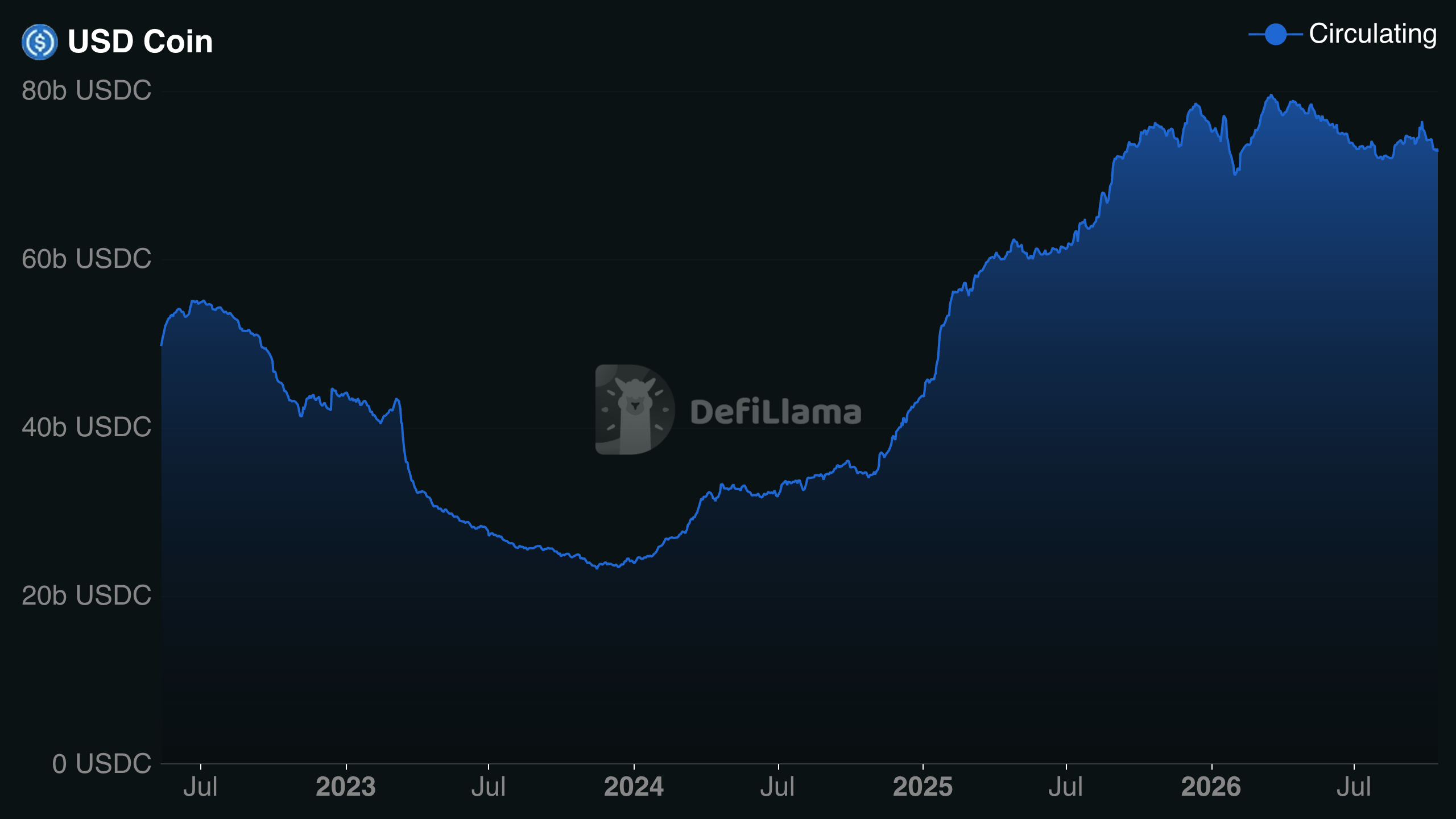
USDC’s supply was $72.85 billion a day earlier, so the latest reading is a rise of about $121 million. USDC’s supply on Solana fell 9.5% in a week to about $6.75 billion, which is 42.3% of the network’s $15.95-billion stablecoin supply.
Banks and payment firms already settle in USDC
Lloyds settled $750,000 with Visa in USDC during a seven-day pilot, and Coinbase and Citi launched Coinbase Virtual Accounts on Sept. 28.
Visa’s annualized stablecoin settlement run rate passed $20 billion on Sept. 8, and the US Commodity Futures Trading Commission registered a USDC-native clearinghouse for Coinbase on Sept. 28, which will use USDC collateral and offer 24/7 settlement.
Lloyds said funds reached Visa in under an hour, including over a weekend. Visa’s survey of 14,250 people across 14 Asia Pacific markets found 46% likely to use stablecoins within five years, while only 6% understood how they work.
MiCA, ESMA, and non-compliant stablecoins
The European Securities and Markets Authority (ESMA) said on Oct. 8 that MiCA-authorized crypto-asset service providers should stop offering services tied to non-compliant stablecoins and remediate existing exposures no later than three months after publication, or about Jan. 8, 2027.
The expectation covers trading, exchange, order execution, transfers, custody, and portfolio management. The ESMA also wants binding opinions on how tokens are classified under MiCA.
In the US, the Clarity Act failed a Senate procedural vote on Sept. 15, so comprehensive market structure law is unlikely before 2027.
Circle reports Q3 2026 results on Nov. 4, eight days before the EBA takes over USDC’s reserve and liquidity supervision on Nov. 12.