


 preferred on


Points of Focus
- Vitalik Buterin’s Sept. 27 essay projects Ethereum reaching 8- to 32-second finality by 2030.
- Hegota, Ethereum’s next fork, has only two EIPs scheduled for inclusion so far.
- The post-Hegota roadmap Buterin describes has no EIPs scheduled on Ethereum’s own tracker.
Ethereum co-founder Vitalik Buterin published an essay on Sept. 27 arguing the network is evolving from a Satoshi-style blockchain into what he calls a “cryptographic world computer,” a system that replaces brute-force transaction reexecution with SNARK verification, layered alongside data availability sampling and private account abstraction.
The cryptographic world computer:https://t.co/ueayODeUPo
My attempt to express in somewhat concise terms the true meaning of basically everything planned to happen to Ethereum starting from the fork after Hegota. It's really not just a blockchain anymore. It's a hybrid…
— vitalik.eth (@VitalikButerin) September 27, 2026
The essay projects that by 2030, Ethereum could reach slot times of 4-8 seconds and finality of 8-32 seconds, a steep drop from the network’s current finality window of about 15 minutes, per ethereum.org.
Buterin’s essay singles out Hegota, the fork planned for next year, as “likely to be Ethereum’s last ‘normal’ fork.” Everything after that, he wrote, involves recursive STARKs, automated formal verification, and quantum-safe cryptography built into the protocol itself.
What’s actually locked in for Hegota
Ethereum’s tracking document for the fork, Ethereum Improvement Proposal (EIP) 8081, lists only two proposals “Scheduled for Inclusion”: EIP-7805, which adds fork-choice enforced inclusion lists to resist censorship, and EIP-8141, which introduces a new frame transaction type for account abstraction.
Eleven more proposals sit in a “Considered for Inclusion” category, and 24 others, including EIP-8025 for optional execution proofs and EIP-8355 for ML-DSA verification precompiles, remain “Proposed for Inclusion,” a step below scheduled.
The tracker’s activation table, meant to list target dates for the Sepolia, Hoodi, and Mainnet networks, is still empty across all three, with client teams yet to set activation times. A separate privacy proposal, EIP-8182 for private Ether (ETH) and ERC-20 transfers, was declined for Hegota specifically, though that does not rule out a similar mechanism reappearing in a later fork.
The fork after Hegota has no EIPs on the books yet
Buterin’s own supporting document, published as EIP-8288 and titled “A note on recursive STARK mempools,” sketches what a fork after Hegota, which developers have informally called “I-star,” could contain: quantum-safe signatures using SPHINCS+ that keep most data offchain, privacy mechanisms that cut costs from millions of gas to the tens of thousands, and a “dependency frame” system letting mempool nodes aggregate transaction proofs into a single recursive STARK roughly every 500 milliseconds.
Buterin calls the broader concept “The Proof Singularity.” No EIP for that fork appears on Ethereum’s public tracker, and no meta-EIP currently names a fork after Hegota.
The community-run Strawmap projects seven forks by 2029 on what it calls “a rough cadence of one fork every six months,” while cautioning that its own timelines “should be treated with healthy skepticism.”
Ethereum’s actual fork history is already running slower than that pace: Pectra activated May 7, 2025, and Fusaka activated Dec. 3, 2025. Glamsterdam, the fork that precedes Hegota in sequence, is targeting the fourth quarter of 2026, a gap of 10-13 months from Fusaka depending on where in the quarter it lands, roughly double the Strawmap’s assumed cadence. Hegota itself is not expected until 2027, per ethereum.org’s roadmap.
Why the gap between vision and tracker matters
Buterin’s essay describes a coherent endpoint for Ethereum’s cryptography.
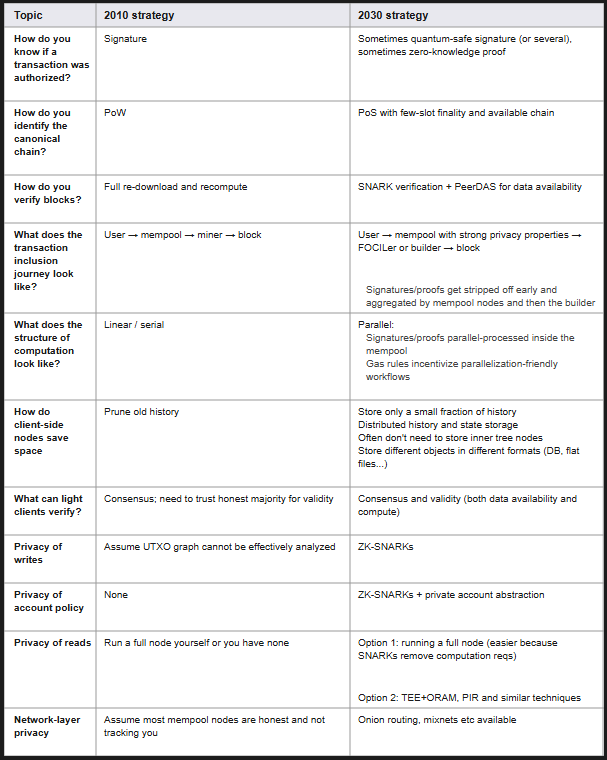
The distance between that endpoint and what is scheduled today is the open question the essay does not resolve on its own: FOCIL and the frame transaction are locked in for next year; the zero-knowledge and quantum-safe components Buterin treats as central to the 2030 vision remain unscheduled proposals; and the fork meant to carry the most ambitious of them has no formal EIP at all yet.








