preferred on


Points of Focus
- US authorities arrested two Americans and seized 187 devices linked to a $3 million North Korean IT fraud scheme.
- Previous DOJ cases exposed crypto theft, stablecoin laundering and over $7.74 million in targeted forfeitures.
- The indictment reveals attempts to bypass fingerprint checks and in-person interviews using fraudulent identities.
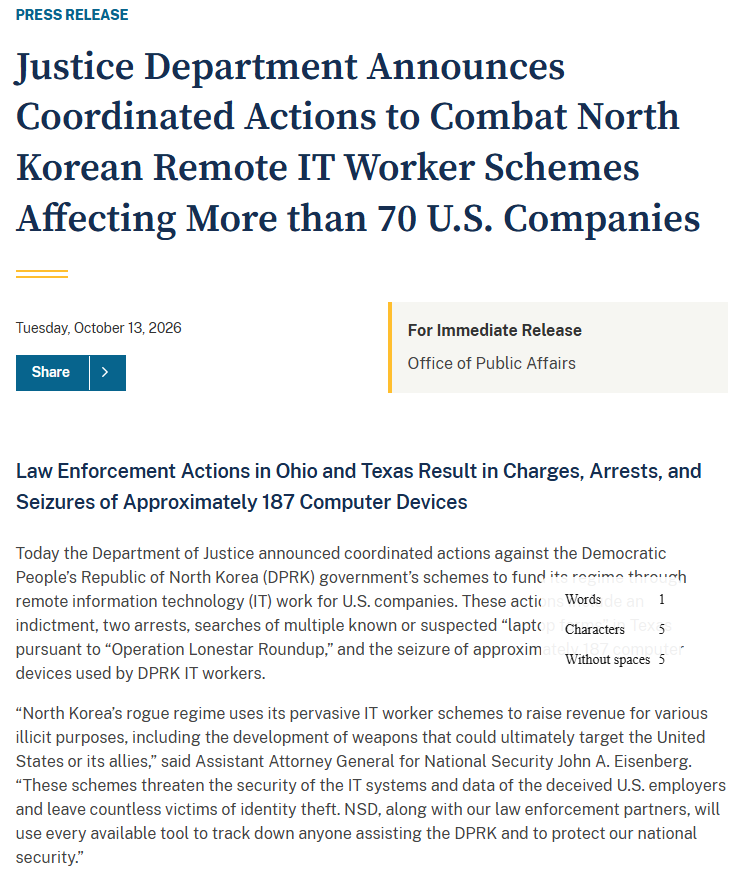
The US Justice Department announced on Oct. 13 the arrests of two Americans accused of aiding North Korean IT workers. Prosecutors say the scheme affected more than 70 US companies and generated about $3 million for overseas workers.
Between Sept. 21 and Sept. 25, the FBI searched more than 40 known or suspected laptop farms across Texas under Operation Lonestar Roundup. Agents seized around 187 laptops and keyboard-video-mouse (KVM) devices during the operation.
Ohio indictment and Texas searches target US-based facilitators
Michael James Bostelle of Pennsylvania and Juan Cecilio Pena Carrillo of Texas face conspiracy counts in the Ohio federal indictment, filed Oct. 1. Charges span wire and mail fraud, money laundering and identity theft; Pena also faces an aggravated identity theft count.
The indictment also charges 10 China-based defendants, with the identities of two more defendants remaining sealed.
Prosecutors allege Ohio resident Trey Michael Nolte, named but not charged, recruited and trained US facilitators, including Bostelle. The DOJ has not publicly explained why Nolte was not charged. Facilitators received or hosted company laptops at their homes and lent their names in exchange for a share of proceeds.
Prosecutors also allege over 25 stolen identities, false data to federal agencies and employer losses of at least $3 million.
The department said North Korean workers increasingly turn to American facilitators as detection and enforcement tighten. According to an Oct. 13 FBI advisory, workers now run more farms with fewer laptops each, avoiding single points of failure.
🚨 Today, the @FBI and @TheJusticeDept announced a series of coordinated actions against the North Korean IT Worker threat – securing charges against 14 individuals, making two arrests, seizing nearly 190 devices, and conducting operations at more than 40 suspected “laptop farms”… pic.twitter.com/GmBjBaSUGs
— FBI Cyber Division (@FBICyberDiv) October 13, 2026
Crypto links run through payment routes and a $7.74M forfeiture case
The indictment describes crypto as one route for sending proceeds overseas. On July 8, 2024, Nolte allegedly described spreadsheets for managing transfers between bank accounts and virtual currencies.
DOJ lists the victim sectors as health care, communications, cyber support, retail and manufacturing. The indictment doesn’t cite any specific tokens, wallet addresses or crypto amounts.
In April 2023, DOJ alleged North Korean workers used fake identities to join US blockchain firms and sought stablecoin payment.
A DOJ complaint filed June 5, 2025, sought forfeiture of over $7.74 million tied to the workers. DOJ alleged they laundered earnings through chain hopping, token swaps and NFT purchases.
Department Files Civil Forfeiture Complaint Against Over $7.74M Laundered on Behalf of the North Korean Government
🔗: https://t.co/T6nh2ETMYY pic.twitter.com/o23HY6C6Zw
— U.S. Department of Justice (@TheJusticeDept) June 5, 2025
On June 30, 2025, DOJ charged four North Korean nationals posing as IT workers with stealing over $900,000 in crypto and laundering the proceeds through Tornado Cash.
On Sept. 3, 2026, Judge Rudolph Contreras ordered forfeiture of funds seized from one wallet address, but denied the rest without prejudice. The wallet allegedly received about 158,123 USDC and 54,574 USDT.
The department also said that such North Korean IT workers extorted employers and stole proprietary company data. However, the FBI warns that aggressive screening can wrongly flag legitimate employees or exclude qualified applicants, while identity-based blocklists risk harming identity-theft victims.
Indictment details attempts to bypass employer identity checks
In June 2023, defendant Sun Sheng Ming allegedly instructed Nolte to drop a fraudulent identity after paperwork requested fingerprints. The group had used that identity for over a year.
Sun allegedly went further in July 2024, directing Nolte to hire an actor for an in-person job interview in Akron, Ohio. The indictment does not establish whether the interview occurred.
Another employer, identified as Victim Company 8, fired a worker using Pena’s identity around May 12, 2025, after repeatedly avoiding in-person meetings and video calls. Pena had received around $13,728 for the fraudulent employment.