preferred on


Points of Focus
- Token2049 Singapore brought together executives from Nasdaq, BlackRock, Polymarket, and Hyperliquid to discuss tokenization, institutional trading, and 24/7 markets.
- Samsung announced plans to introduce USDC transfers across 82 million compatible US Galaxy devices, while executives outlined ambitious targets for tokenized assets and Bitcoin collateral.
- Discussions highlighted challenges involving liquidity, regulation, AI, privacy, and institutional settlement.
Token2049 Singapore brought cryptocurrency executives, investors, and developers to Marina Bay Sands on Oct. 7-8, with organizers expecting 25,000 attendees from 160 countries and 250 speakers.
The conference featured executives from Nasdaq, BlackRock, Fidelity Investments, and Morgan Stanley alongside leaders of Polymarket, Hyperliquid, and Aave.
Across the two days, executives discussed how to bring tokenized securities, Bitcoin (BTC) lending, and stablecoin payments into wider use, while weighing the risks of markets that operate around the clock.
1. Tokenized stocks face a 24/7 pricing test
Tokenized US-listed stocks can continue trading after Wall Street closes, leaving market makers to establish fair prices without an active underlying market.
Arcus CEO Eddie Zhang said his platform uses perpetual futures data and controlled price movements to manage thin liquidity. One mechanism allows prices to move by approximately 1% per hour, with limits gradually relaxing when prices remain at the boundary.
“As liquidity comes online, real price discovery is more accurate,” Zhang told AlphaWire at Token2049 Singapore.
On Sept. 17, the US Securities and Exchange Commission (SEC) granted temporary, conditional exemptions for certain permissioned venues trading tokenized US-listed stocks, subject to shareholder-rights requirements and trading halts.
2. Tokenization needs deeper liquidity
Tokenized real-world assets (RWAs) continue attracting institutional interest, although many remain difficult to trade, redeem or use as collateral.
RWA.xyz recorded $38.78 billion in distributed tokenized asset value, excluding stablecoins, on Oct. 7.
RedStone’s head of partnerships, Mike Massari, expects the market to exceed $1 trillion by 2029. He identified lengthy redemption periods, regulatory restrictions, and limited secondary liquidity as obstacles to broader adoption in decentralized finance (DeFi).
“Everyone needs price feeds, but it’s not sufficient to support the tokenization of an asset,” Massari said.
RedStone is developing risk assessment and settlement tools to support collateralized lending and faster liquidations.
3. Bitcoin lending ambitions outpace deployment
Babylon Labs co-founder Fisher Yu wants approximately 10% of Bitcoin’s circulating supply used as collateral within three to five years.
“Then we realized that staking itself is not enough,” Yu said. “We need Bitcoin to do more things while it’s being locked.”
Babylon plans to offer Bitcoin-backed lending vaults through Aave, though the integration remained on testnet after missing its April 2026 launch target.
A RootstockCollective survey cited by founder Sascha Goetz revealed another gap. Among more than 600 wealthy investors and family offices, 88% reportedly expressed willingness to invest in Bitcoin-related assets, while 23% had deployed capital.
Goetz identified security, education, and trust as major barriers to participation.
4. Samsung brings stablecoin payments closer to mainstream users
One of the biggest announcements of conference week came from Samsung Electronics, which introduced plans to integrate USDC (USDC) transfers into Samsung Wallet.
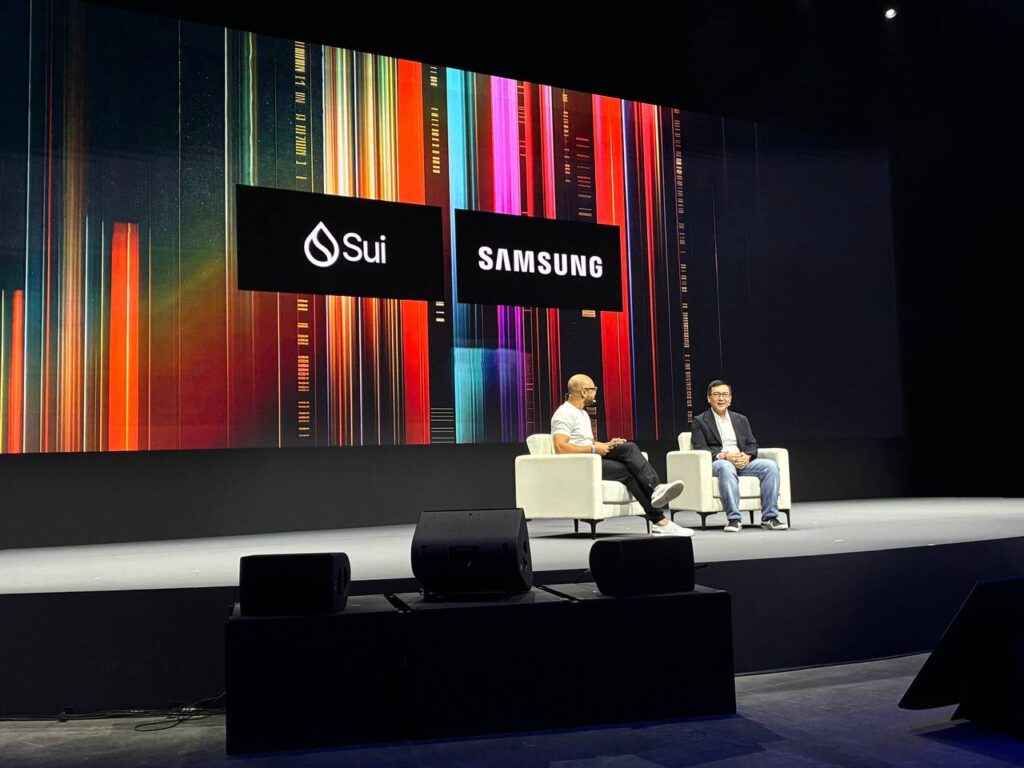
The service is set to launch in late October on 82 million compatible US Galaxy devices, enabling USDC transfers to crypto wallets and bank accounts in over 60 countries. It uses infrastructure from Bastion and Coinbase, with support from Solana and Sui.
Visa reported on Oct. 1 that approximately 17% of its stablecoin-linked card volume in the fiscal year 2026 year-to-date came from business and commercial programs. More than 160 programs operated across its network, with payment volume increasing nearly 200% year-on-year.
5. Stablecoin regulation creates an interoperability challenge
As stablecoin services expand, issuers and payment companies face different regulatory requirements across jurisdictions.
Paxos Labs co-founder Bhau Kotecha expects conversion technology to connect stablecoins issued under different frameworks, potentially reducing fragmentation across international payment systems.
“The more likely way I see this being solved is through technology,” he said.
The Monetary Authority of Singapore (MAS) has proposed rules addressing foreign-issued stablecoins, multi-jurisdictional issuance, redemption arrangements, and financial safeguards. Public consultation closes Oct. 16.
WasabiCard CEO Ray Yang identified another constraint: Rapid blockchain transfers still depend on connections to banks, card networks, and local payment systems.
Singapore is exploring settlement using regulated stablecoins and tokenized commercial bank money through its Bloom initiative.
6. Polymarket looks beyond event betting
Polymarket CEO Shayne Coplan said during Token2049 that the platform is exploring an onchain asset with programmable utility tied to its economy, describing the concept as “what stocks should have been.”
The remarks followed Polymarket’s earlier confirmation of plans for a native token and airdrop, alongside trademark filings for “POLY” and “$POLY.” Coplan disclosed no launch date, tokenomics, or airdrop eligibility criteria.
🚨 BREAKING: POLYMARKET CEO, SHAYNE COPLAN ON $Poly
Polymarket CEO Shayne Coplan says the platform is exploring an onchain asset tied directly to Polymarket’s economics, with real utility built into it.
“how the idea of stock should work” pic.twitter.com/LcdPmuuPfI
— AlphaWire (@AlphaWireHQ) October 7, 2026
7. Hyperliquid and AI agents broaden the trading debate
Hyperliquid CEO Jeff Yan discussed the platform’s expansion into perpetual futures linked to equities and commodities, raising questions about liquidity and risk management.
AI trading also drew attention. Nansen CEO Alex Svanevik explored whether AI agents could outperform human traders, while Dragonfly’s Haseeb Qureshi examined their applications in crypto.
BridgePort CEO Nirup Ramalingam warned that prefunding trades across exchanges ties up capital and creates counterparty exposure. “The moment it’s a bear market, that’s when risk management comes into the fore again,” he told AlphaWire. He expects greater reliance on specialized custodians, clearing houses, and prime brokers.
8. Privacy and post-quantum security gain attention
Chainway Labs CEO Orkun Mahir Kılıç highlighted the privacy risks of Bitcoin payments. “If I need to pay you for this coffee in Bitcoin, you will see all my portfolio, and I don’t want that,” he said.
His team is focusing on Crest, the private Bitcoin wallet acquired by Citrea in September, which aims to support confidential transfers, cross-chain payments, and stablecoin access.
Zcash also featured at Token2049, with Gemini co-founders Tyler and Cameron Winklevoss participating in The Zcash Moment.
On Oct. 7, Project Eleven introduced Strongpoint, a custody platform designed to address quantum computing risks. Zcash Foundation joined as an initial development partner, with production deployment targeted for the fourth quarter of 2026.
The risks extend to financial stability. Digital Assets Association Singapore co-chairman Danny Chong argued that strict regulation could attract long-term institutional capital while warning that continuous settlement may accelerate the spread of liquidity shocks and operational failures across connected markets.