preferred on


Points of Focus
- A seven-day, non-binding poll asks eligible STRK voters whether to research an independent blockchain.
- StarkWare says Ethereum dependencies limit Starknet’s quantum-resistance timetable.
- An independent chain would need its own security design while retaining STRK and Ethereum bridges.
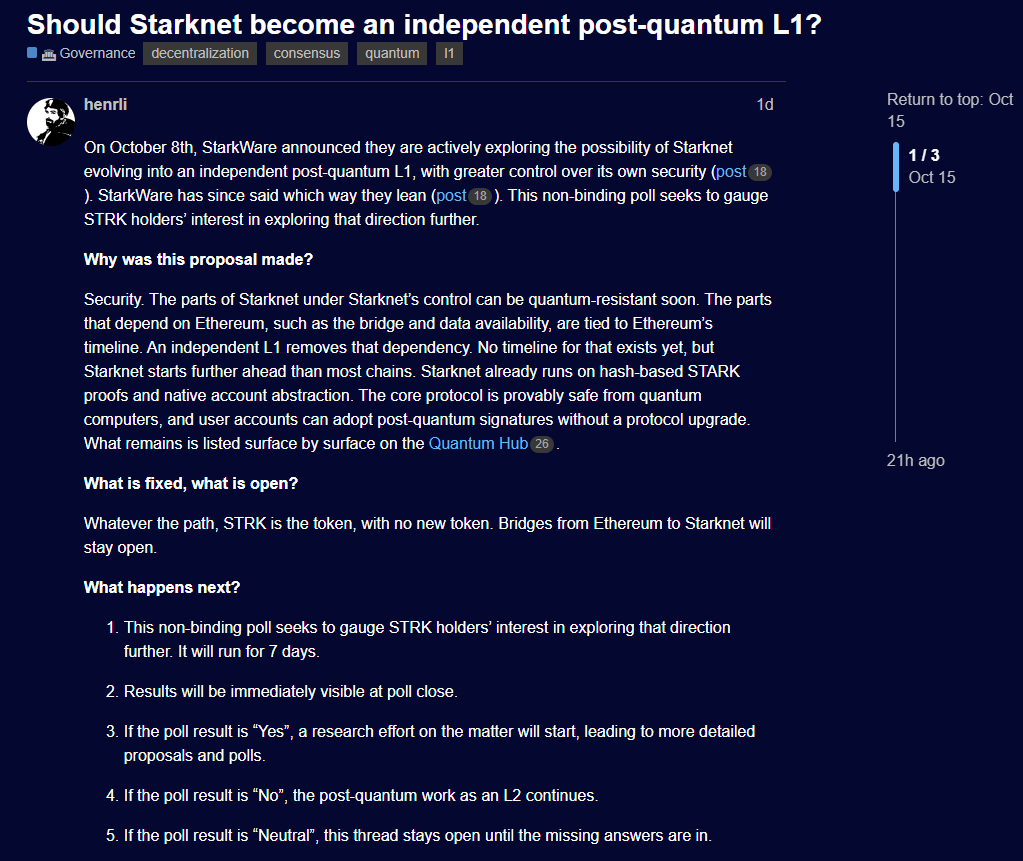
Starknet opened a non-binding governance poll on Oct. 15 asking STRK holders whether to explore becoming an independent, post-quantum layer-1 (L1) blockchain. The network currently operates as an Ethereum layer 2 (L2), and StarkWare previously outlined plans to pursue the transition.
The seven-day vote closes on Oct. 22. Under the governance proposal, a “Yes” would initiate research and further proposals; a “No” would continue quantum-resistance work as an L2, while a neutral result would leave discussions open.
Why Starknet is reconsidering Ethereum
Starknet is targeting full quantum resistance by 2027 if it becomes an independent L1. The Ethereum Foundation aims for December 2029 across its execution, consensus, and data layers, including validator cryptography upgrades. Neither deadline is guaranteed.
Starknet already uses hash-based scalable transparent arguments of knowledge (STARK) proofs and programmable accounts that can adopt new signature schemes without a hard fork.
In July, an experimental wallet using Falcon-512 post-quantum signatures completed a mainnet transfer costing about six cents. However, StarkWare acknowledged on Oct. 13 that the implementation remains unaudited and unavailable to ordinary users. Standard accounts still rely on quantum-vulnerable elliptic-curve signatures.
Ethereum introduces another obstacle. Starknet normally publishes transaction state changes through Ethereum’s blob infrastructure, which uses the quantum-vulnerable Kate-Zaverucha-Goldberg (KZG) commitment scheme.
StarkWare’s migration register warns that compromised KZG security could undermine independent state reconstruction, although Starknet’s separate STARK verifier would still protect against invalid state transitions. A calldata fallback avoids that specific dependency.
What Starknet would have to replace
Ethereum currently verifies Starknet’s validity proofs and provides data needed to reconstruct its state. An independent L1 would require its own consensus, transaction finality, and data availability systems, changing the security assumptions for applications, including Starknet’s Bitcoin finance ecosystem.
Existing accounts and contracts would also need attention. StarkWare is researching tools to migrate legacy contract storage, while wallet upgrades and adoption remain unfinished. Similar challenges have emerged in Bitcoin’s post-quantum migration debate.
The proposal would preserve STRK as the network token and keep Ethereum bridges operational. Those connections would retain exposure to Ethereum’s cryptography and cross-chain messaging risks, even after Starknet completed its own upgrades.
No replacement architecture, migration plan, or launch date has been announced. A favorable vote would begin research into those questions, with any transition requiring further governance decisions.