preferred on

Points of Focus
- Safeheron clients can still leave single-signer risks in place even when using MPC custody infrastructure.
- Foo said the Bybit hack showed how compromised interfaces can trick multiple signers without exposing private keys.
- Foo sees humans as crypto security’s weakest link and said AI, training, and stronger approval policies must work together.
Some Safeheron clients let one signer approve transfers regardless of value, even on multi-party computation (MPC) infrastructure, its security chief said.
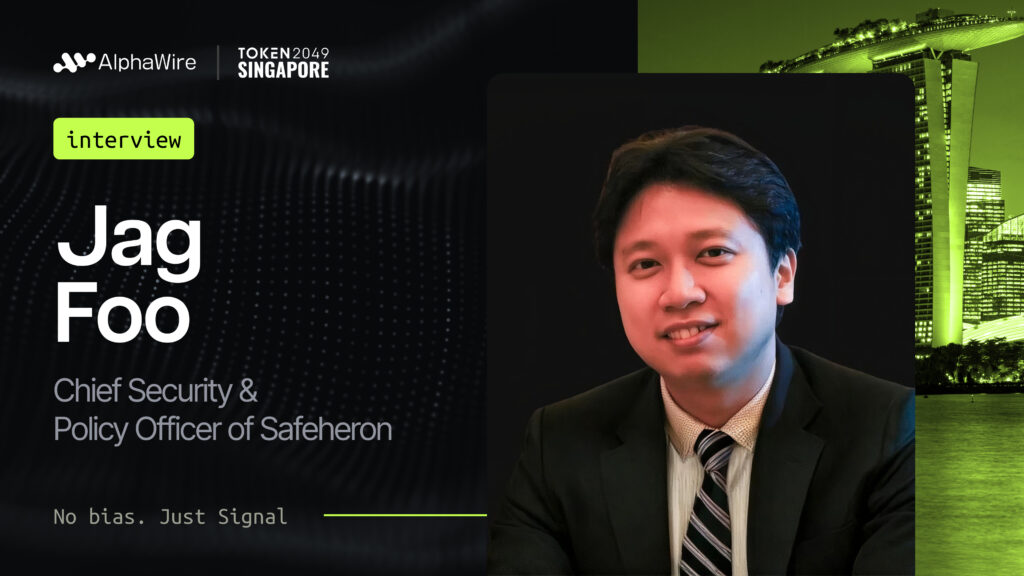
Jag Foo, chief security and policy officer of Safeheron, spoke to AlphaWire’s Dr. Guneet Kaur on Oct. 6, ahead of Token2049 in Singapore.
Foo said he chairs the digital asset security subcommittee at the Digital Assets Association and called humans the weakest link in crypto security, pointing to Bybit as an example.
Single-signer policies leave the weak point in place
Foo described Safeheron as custody and operating system infrastructure that allows clients to store, manage, and govern digital assets. Its governance layer provides checks and balances over how clients approve users, introduce admin keys, and initiate transactions.

Those controls are meant to flex with the scenario. “Not all transaction scenarios are created equal,” Foo said, and larger amounts merit greater oversight.
Some clients, however, configure approvals differently, letting the same initiator and signer approve transactions “regardless of the transactional value.”
“Even for higher transactions, say, 1 million, 10 million, there’s still one signer,” he said. Foo did not say how many clients work this way.
He said MPC helps mitigate the single point of failure at the private key level. But a policy that lax “becomes independent of the infrastructure that you provide.”
Strong infrastructure can therefore go underused when clients do not configure or operate it properly. Foo sees the system as one part of security, with human awareness, training, and processes the other.
In his view, “the human, the process, and the system” must work in tandem.
Bybit’s signers shared one compromised interface
Foo cited Bybit as a case of social engineering at work. The US Federal Bureau of Investigation attributed the roughly $1.5-billion February 2025 Bybit theft to North Korea.
In Foo’s account, the attack began with phishing of a SafeWallet engineer, “a single point of failure, which is the human.” A tampered interface then targeted Bybit’s signers.
Although there were multiple signers, all saw the same compromised interface and were tricked into signing. “Even though the private key was not compromised, the funds could still flow out,” Foo said.
Sygnia’s analysis describes a compromised SafeWallet developer workstation and “a potential social engineering vector” but does not mention phishing.
Bybit detected unauthorized activity involving one of our ETH cold wallets. The incident occurred when our ETH multisig cold wallet executed a transfer to our warm wallet. Unfortunately, this transaction was manipulated through a sophisticated attack that masked the signing…
— Bybit (@Bybit_Official) February 21, 2025
He called private key leakage and social engineering two of the most widely reported causes of major exploits. The two are not mutually exclusive, he added.
Other cases involved social engineering that compromised the key itself. Those arose especially where one user manages a key on a single device at a single location.
Foo called that single point of failure a concern “to this day.”
Defenders must outpace attackers on AI
AI is an enabler, in Foo’s words, “for good defense, but also an enabler for the attacker.” Bad actors have used AI to find vulnerabilities “at machine speed,” and he expects them to keep doing so.
Defenders must also use AI to the best of their ability, he argued. Foo calls himself a strong believer in using AI “as a force multiplier to strengthen the defense.” That includes threat detection, monitoring, fast remediation, and ongoing audits of systems and processes.
Safeheron’s own clients illustrate the use case, in his view. Foo said Safeheron has met clients who don’t use its infrastructure to the fullest or don’t know how to set it up properly. Their approvals and policies still leave a single point of failure.
Not all users are familiar with risk management, Foo noted. AI could analyze the setup for such clients and “guide them step by step,” reducing both friction and the knowledge gap.
“We need to be ahead of the curve,” he said. Foo argued that defenders must use AI faster and at a greater scale than bad actors.
Foo puts education ahead of better systems
Asked about the next billion-dollar hack, Foo again pointed to people. “History repeats itself because human behavior never changed,” he said.
In his view, many projects and institutions focus on survival, profitability, and business sustainability while giving security little thought. He called awareness generally weak and wants more effort on staff training and continuing security awareness education.
He also wants internal and external auditors to vet systems continually, alongside drills, awareness exercises, and tests. “I think that will go a long way,” he said.
The security mindset takes time and repetition to become ingrained as “an enabler for the whole business,” Foo argued. Only when that mindset changes, he said, can the industry see “the reversal or change” in the current pattern of attacks.
Speaking from his subcommittee role, he ranks education “even more so than having a good system.” He wants buy-in from top to bottom and calls security “good for business long term.” He expects that approach to drive “a more fundamental shift” toward good practices.
Staff still need to remain vigilant, he said, with that awareness paired with good systems.
“It starts with the mindset first,” Foo said, followed by investment in systems, training, and resources.
He sees industry associations playing a big role in education and in working with law enforcement. In the near to mid term, however, he expects “the spate of attacks that we’re seeing right now” to continue.
Foo cited a Verizon study, saying about 62% of cases were due to social engineering. By far, he said, “The human remains the weakest link in the chain.”
Verizon’s 2026 Data Breach Investigations Report puts the unintentional human element at 62% of breaches and social engineering at 16%.