preferred on


Points of Focus
- Zcash and Just gained more than 300% between October 2025 and October 2026, while Quant and NEAR more than doubled.
- Monero, Dash, and Uniswap also recovered, although their gains were considerably smaller.
- None of these cryptocurrencies was technically dead, but their comebacks reflect renewed market interest, not necessarily a return to former dominance.
In cryptocurrency markets, a project does not need to shut down to be declared dead.
Some cryptocurrencies survive for years after losing their place among market leaders. Their prices collapse, investors move elsewhere, and newer projects take over the headlines.
But occasionally, an old cryptocurrency returns to prominence.
Ahead of Halloween 2026, seven established cryptocurrencies recorded positive year-on-year returns, with some climbing more than 300% since October 2025.
The strongest recoveries include Zcash (ZEC), Just (JST), Quant (QNT), and Near Protocol (NEAR). Monero (XMR), Dash (DASH), and Uniswap (UNI) also gained, although their performances tell different stories.
Seven cryptocurrencies that made a comeback in 2026
For this analysis, “dead” does not mean a blockchain stopped producing blocks, its developers abandoned the project, or its cryptocurrency became worthless.
Instead, it describes older cryptocurrencies that experienced prolonged market declines, diminished investor attention, or a substantial loss of their former market position.
Likewise, rising from the grave means a measurable recovery in price and market capitalization, rather than proof that the underlying network has become successful again.
To keep the comparison consistent, the analysis uses historical snapshots from Oct. 24, 2025, and Oct. 24, 2026.
The figures below come from CryptWatch’s historical cryptocurrency market comparison, which uses CoinMarketCap-derived data. Prices are rounded snapshots, not necessarily daily closing prices.
| Cryptocurrency | Oct. 2025 | Oct. 2026 | One-year return |
| Zcash (ZEC) | $271 | $1,182 | +335% |
| Just (JST) | $0.033 | $0.14 | +327% |
| Quant (QNT) | $81.90 | $181 | +121% |
| Near Protocol (NEAR) | $2.27 | $4.68 | +106% |
| Monero (XMR) | $327 | $584 | +78.8% |
| Dash (DASH) | $41.98 | $51.77 | +23.3% |
| Uniswap (UNI) | $6.24 | $6.96 | +11.5% |
1. Zcash (ZEC): From forgotten privacy coin to top-10 cryptocurrency
Zcash, launched in 2016, spent years struggling to regain the prominence it enjoyed during earlier cryptocurrency market cycles.
Privacy coins also faced exchange restrictions and regulatory scrutiny, raising questions about their accessibility.
ZEC climbed from $271 in October 2025 to $1,182 a year later, a 335% gain.
Its market capitalization increased from $4.42 billion to $20 billion, lifting it from 28th to ninth place in CryptWatch’s rankings.
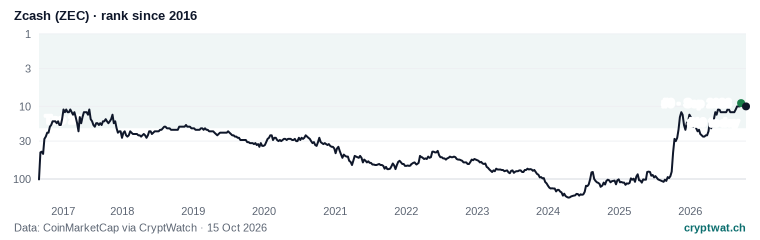
The rally also had identifiable developments behind it. Grayscale’s Zcash exchange-traded fund (ETF) began trading on NYSE Arca in August 2026, expanding access through traditional brokerage accounts.
Bitfinex reported that approximately 30% of circulating ZEC was held in shielded addresses, compared with about 8% in early 2024.
That suggests growing use of the network’s privacy functionality, although it does not establish that every holder actively uses shielded transactions.
2. Just (JST): A forgotten DeFi token gains 327%
Just launched in 2020 as part of the Tron decentralized finance (DeFi) ecosystem.
It never achieved the same mainstream recognition as larger DeFi platforms such as Uniswap or Aave, and its token spent years outside the industry’s most closely watched assets.
Yet JST became one of the strongest performers in this comparison.
Its price increased from $0.033 to $0.14, a gain of 327%, while market capitalization rose from $327 million to $1.13 billion.
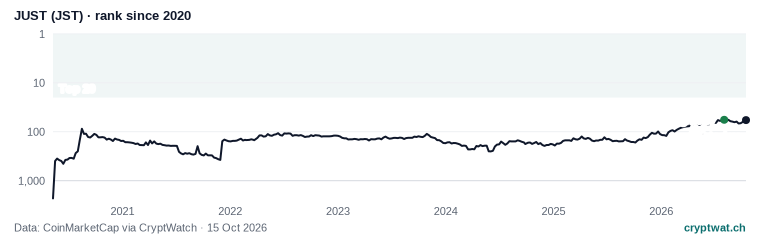
The token also climbed 86 places in CryptWatch’s market rankings, reaching 59th.
However, these figures establish a substantial token recovery, not necessarily a corresponding revival in lending activity or protocol usage.
3. Quant (QNT): An older interoperability project doubles
Quant gained prominence during the 2021 market cycle for its ambition to connect blockchain networks and traditional enterprise systems.
As newer crypto sectors attracted investor attention, QNT lost much of its earlier momentum.
By October 2025, the token had been trading near $81.90.
A year later, QNT reached $181, representing a 121% increase.
Its market capitalization grew from $989 million to $2.19 billion, while its ranking improved from 72nd to 39th.
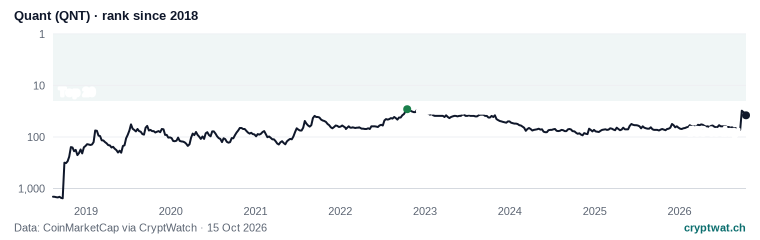
Those figures support the argument that Quant regained market relevance.
They do not, however, establish that enterprise adoption of its Overledger technology increased at the same pace. Commercial deployment and customer activity would require separate verification.
Most people look at $QNT and ask, “How high can the price go?”
I start with a completely different question: what happens if banks in different countries start issuing tokenized money on different systems and all of those systems need to talk to each other?
Warning: this one… https://t.co/Wnr5kXyVg2 pic.twitter.com/hfzuh9szFq
— X Finance Bull (@Xfinancebull) October 23, 2026
4. Near Protocol (NEAR): A layer 1 finds a new purpose
Near was a prominent layer-1 competitor during the previous market cycle but struggled to maintain investor attention as competition intensified.
Its token rose from $2.27 to $4.68 between the two October snapshots, a 106% increase. Market capitalization more than doubled from $2.90 billion to $6.13 billion.
Unlike some price-led recoveries, NEAR also reported measurable product activity.
In July 2026, the project said its Intents infrastructure had processed more than $20 billion in cumulative cross-chain volume.
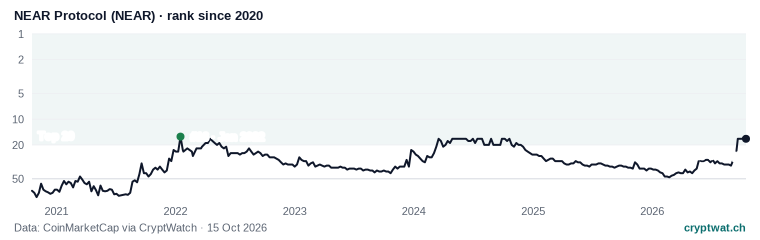
Its February fee changes also introduced a mechanism directing protocol revenue toward NEAR buybacks.
These figures are project-reported, but they provide evidence of operating activity beyond token appreciation.
5. Monero (XMR): A privacy coin that survived delistings
Monero’s comeback is primarily a story of resilience.
The cryptocurrency faced exchange delistings and regulatory restrictions because its privacy features make transaction tracing difficult.
Nevertheless, XMR rose from $327 in October 2025 to $584 in October 2026, gaining 78.8%.
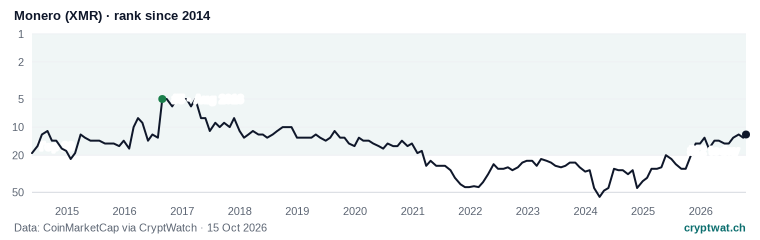
Its market capitalization increased from $6.03 billion to around $11 billion, lifting it from 22nd to 12th place.
Monero was never abandoned, and its recovery began before 2026. Its inclusion reflects renewed market strength despite reduced access through some centralized exchanges.
That makes it a survivor rather than a cryptocurrency revived from inactivity.
6. Dash (DASH): A former payments leader rebuilds its privacy offering
Dash, launched in 2014, was once a leading cryptocurrency payments project.
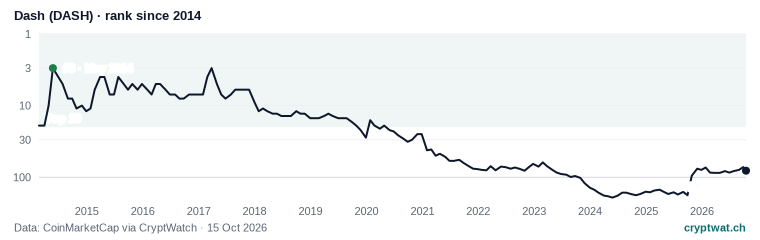
Over time, newer networks overshadowed it, and DASH lost much of its former market prominence.
Its token gained 23.3% over the comparison period, increasing from $41.98 to $51.77. Its market ranking improved from 109th to 76th.
Dash also delivered a technical upgrade.
On Aug. 4, 2026, the project announced that shielded transactions had gone live on its Evolution mainnet, using zero-knowledge technology based on Zcash’s Orchard protocol.
That gives Dash a concrete development behind its privacy revival, although the price recovery is considerably smaller than Zcash’s.
7. Uniswap (UNI): The protocol survived, but its token struggled
Uniswap presents the weakest case for a dramatic price comeback, but one of the clearest examples of a change in token economics.
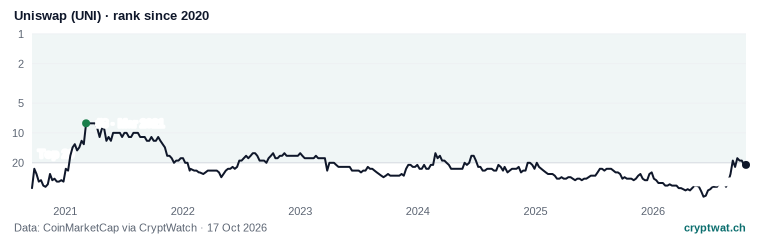
UNI rose from $6.24 to $6.96 over the year, gaining 11.5%.
Its market capitalization increased from $3.93 billion to $4.35 billion.
The more important development came in December 2025, when Uniswap governance activated protocol fees on selected liquidity pools.
Those fees are used through an onchain mechanism to purchase and burn UNI, linking certain protocol revenues to reductions in token supply.
The change does not guarantee token appreciation, and UNI holders do not receive an automatic claim on protocol revenue.
Uniswap, therefore, represents a modest market recovery accompanied by a meaningful governance change, rather than a dramatic resurrection.
Did these cryptocurrencies really come back from the dead?
The historical figures reveal three different stories.
Zcash and Just delivered the strongest price recoveries, each gaining more than 300%. Quant and NEAR more than doubled, while Monero and Dash benefited from renewed attention to older cryptocurrency sectors.
Uniswap’s recovery was comparatively small, but its token economics changed.
There is also an important timing issue: Zcash and Dash had already begun recovering in 2025. Their October-to-October returns measure continued performance, not rallies that started exclusively in 2026.
A higher token price does not necessarily mean more users, greater revenue, or a healthier blockchain ecosystem.
These cryptocurrencies were not technically dead, but several had lost considerable market relevance. Their price recoveries demonstrate renewed investor interest, while lasting adoption remains a separate question.
Disclaimer: This article is for informational purposes only and does not constitute financial or investment advice. The term “dead cryptocurrencies” is used figuratively to describe projects that experienced prolonged price declines or diminished market prominence, not cryptocurrencies whose networks ceased operating.
Methodology: Price, market capitalization, and ranking comparisons use CryptWatch’s CoinMarketCap-derived snapshots for Oct. 24, 2025, and Oct. 24, 2026. Returns are approximate US dollar price changes, not total investment returns. Project announcements are identified separately from independent market data. The seven assets were selected for their age, history of diminished market prominence, and positive year-on-year performance, not as the seven highest-returning cryptocurrencies overall. Past performance does not guarantee future results.