preferred on


Points of Focus
- Binance estimates $6.3 billion in affected assets, with about $3 billion frozen following a suspected breach.
- Its SAFU emergency fund holds 15,000 BTC, potentially covering only a fraction of the estimated losses.
- Binance promises full reimbursement using its SAFU and corporate funds, but its available liquidity remains publicly unverified.
Binance has promised to cover all customer losses following a suspected multibillion-dollar cryptocurrency hack, raising questions about whether its emergency protection fund can absorb an incident potentially six times larger than its original $1 billion reserve.
In an Oct. 30 security update, the cryptocurrency exchange estimated the incident’s impact at $6.3 billion, with about $3 billion in affected assets frozen onchain.
Binance’s preliminary investigation identified a compromised DevOps engineer’s laptop as a possible entry point. The attacker allegedly accessed an internal service container and initiated unauthorized withdrawals.
Binance's initial investigation suggests that the security incident may involve a compromised DevOps engineer’s laptop, which allowed an attacker to gain access to a service container and submit unauthorized withdrawal transactions. We have found no evidence of any wallet private… pic.twitter.com/5REncAI77y
— Binance (@binance) October 30, 2026
The exchange said it found no evidence that wallet private keys had leaked.
Binance temporarily suspended deposits and withdrawals, revoked affected authorizations, and began working with law enforcement and blockchain analytics companies.
Co-founder Yi He promised that Binance would cover all hacking losses, according to Reuters.
However, the estimated exposure raises a question: Can Binance’s Secure Asset Fund for Users (SAFU) cover the losses, or will the exchange need billions from elsewhere?
How much can Binance’s $1-billion SAFU fund cover?
Binance established SAFU in 2018, allocating a portion of trading fees to an emergency reserve designed to protect customers during security incidents.
In February 2026, the exchange completed the conversion of $1 billion in reserve assets into 15,000 Bitcoin (BTC).
At the time, the holdings were valued at around $1.005 billion.
Binance also committed to replenishing the fund if Bitcoin price movements reduced its value below $800 million.
The largest hack in crypto history just hit the largest exchange.
And Binance is absorbing it.
$6.3B drained. ~$3B already frozen. The rest covered by its SAFU fund and its own money.
User funds: safe. What the on-chain data shows 🧵 pic.twitter.com/4di21NAQkt
— CryptoQuant.com (@cryptoquant_com) October 30, 2026
However, the reserve’s dollar value fluctuates with Bitcoin’s price.
At a BTC price of $78,000, the fund’s 15,000 BTC would be worth $1.17 billion. That would cover just 18.6% of the $6.3-billion loss if the entire amount became unrecoverable.
Even if Binance used every Bitcoin in its SAFU, it would still face a substantial funding gap.
The fund’s replenishment policy addresses Bitcoin price volatility, not necessarily losses arising from a security breach.
Why Binance’s $6.3-billion exposure may be smaller
The $6.3-billion figure represents the estimated incident impact, not necessarily the exchange’s final financial loss.
Binance reported that $3 billion in affected assets had been frozen onchain.
Stablecoin issuers Tether and Circle reportedly helped restrict transfers involving tokens linked to the attack.
However, frozen cryptocurrency is not automatically recovered cryptocurrency. Assets may remain inaccessible while investigators and issuers determine how they can be returned.
If the entire $3 billion is eventually recovered, Binance’s remaining exposure would fall to around $3.3 billion.
Using the $1.17-billion SAFU valuation, that would leave $2.13 billion requiring other funding.
These calculations are hypothetical. The actual shortfall depends on recoveries, Bitcoin’s market price, and the exchange’s financial resources.
Where would Binance find billions beyond SAFU?
Binance has said it will use both SAFU and corporate funds to compensate affected customers.
That second source is particularly important because the exchange’s dedicated emergency reserve is much smaller than the estimated exposure.
Reportedly, Binance held $144 billion in platform assets before the incident.
However, customer assets cannot be treated as corporate capital available to cover losses.
Binance would need its own liquid reserves or other financing to replace missing customer-backed holdings. The exchange has not publicly disclosed how much corporate liquidity it can immediately deploy for reimbursement.
Its published SAFU terms also give Binance discretion over compensation eligibility, making the latest promise of full coverage broader than the fund’s ordinary provisions.
I want to speak to you directly about what happened.
Bottom line – your money is safe, and we're covering every loss.
Our initial investigation suggests this security incident may have started with a compromised DevOps engineer's laptop. That gave an attacker access to a…
— Richard Teng (@_RichardTeng) October 30, 2026
Could the hack affect Binance’s proof-of-reserves?
The incident could also test Binance’s ability to maintain sufficient cryptocurrency holdings against customer balances.
Independent onchain analysis identified affected hot wallets in Binance’s Oct. 1 proof-of-reserves report.
Its analysis estimated that the loss of 204,500 Ether (ETH) could temporarily reduce Ether reserve coverage from 100% to around 94%, assuming Binance had not already replaced the missing assets.
That calculation does not establish insolvency or prove the exchange cannot meet withdrawal requests.
It illustrates why replenishing affected wallets matters.
Proof-of-reserves reports can provide evidence of cryptocurrency holdings, but they do not independently establish a company’s complete liabilities, corporate finances, or available emergency liquidity.
Binance’s next reserve snapshot, scheduled for Nov. 1, could offer an early indication of whether customer-backed assets have been restored.
What caused the hack, and can Binance recover?
Blockchain analytics company Bitquery traced $6.3 billion moving from 17 Binance hot wallets across nine blockchains within four hours.
The transactions carried valid signatures, supporting the possibility that attackers compromised withdrawal authorization infrastructure rather than directly stealing private keys.
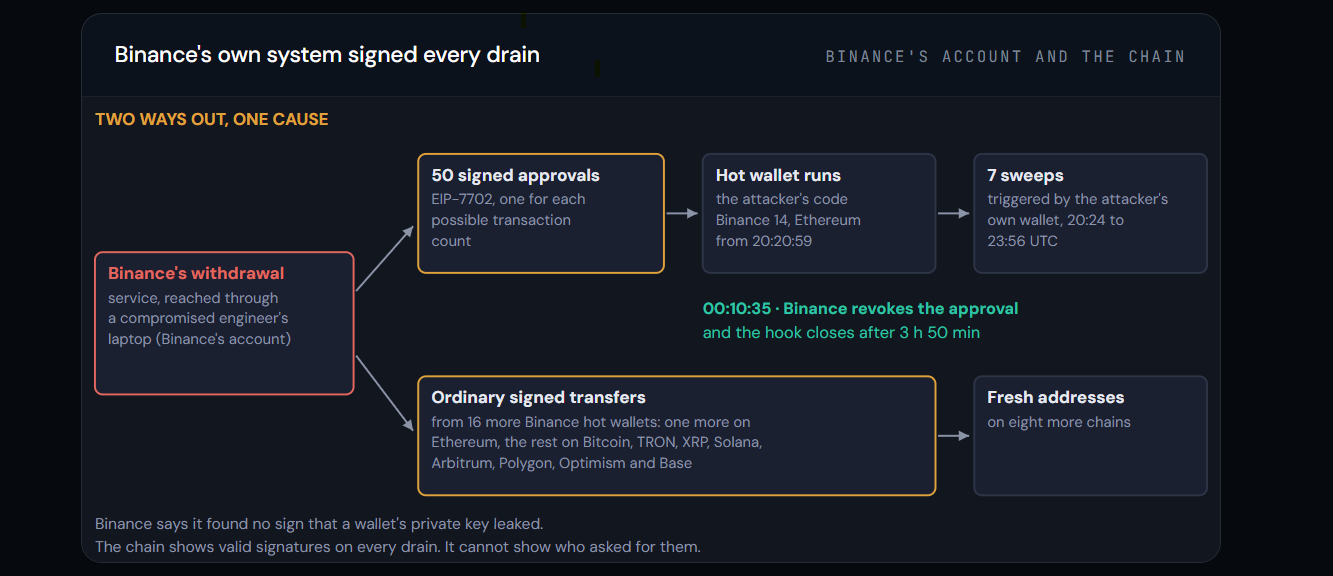
Bitquery separately identified $2.7 billion in frozen assets, compared with Binance’s estimate of $3 billion.
The incident also recalls the February 2025 Bybit hack, which resulted in $1.5 billion in stolen cryptocurrency. Bybit worked to restore its reserves through external support and asset purchases.
For Binance, the critical questions are how much cryptocurrency can be recovered and whether sufficient corporate funds are available to cover the remainder.
Binance’s SAFU alone appears insufficient for a multibillion-dollar unrecovered loss. However, that does not establish that Binance cannot fulfill its reimbursement promise.
The clearest evidence will come from restored withdrawals, updated reserve disclosures, and a transparent explanation of how customer losses are funded.
The incident has turned Binance’s $1-billion protection fund into a much larger test of the exchange’s financial resilience.