preferred on


Points of Focus
- Binance processed $4.65 billion in withdrawals and $1.01 billion in deposits after reopening, leaving $3.64 billion in net outflows.
- DefiLlama reported a $5.93-billion decline, but the destinations of withdrawn funds remain unverified.
- CZ’s 98% user-retention claim lacks account-level evidence, while Binance’s reserves snapshot predates the withdrawal surge.
Binance customers withdrew $4.649 billion between 06:00 and 15:30 UTC on Nov. 1 as the exchange reopened withdrawals in phases, the company said.
Deposits of $1.01 billion over the same period left a net outflow of $3.64 billion. Binance put that at 2.1% of the $171 billion in assets under management in its Oct. 28 proof-of-reserves data.
Binance began restoring withdrawals in phases at 06:00 UTC on November 1, 2026. By 12:36 UTC, withdrawals had resumed for all 15 networks and assets in the initial phase. After an initial spike, withdrawal volumes have declined and are stabilising as expected, while deposit… pic.twitter.com/ZSnYGCTp9d
— Binance (@binance) November 1, 2026
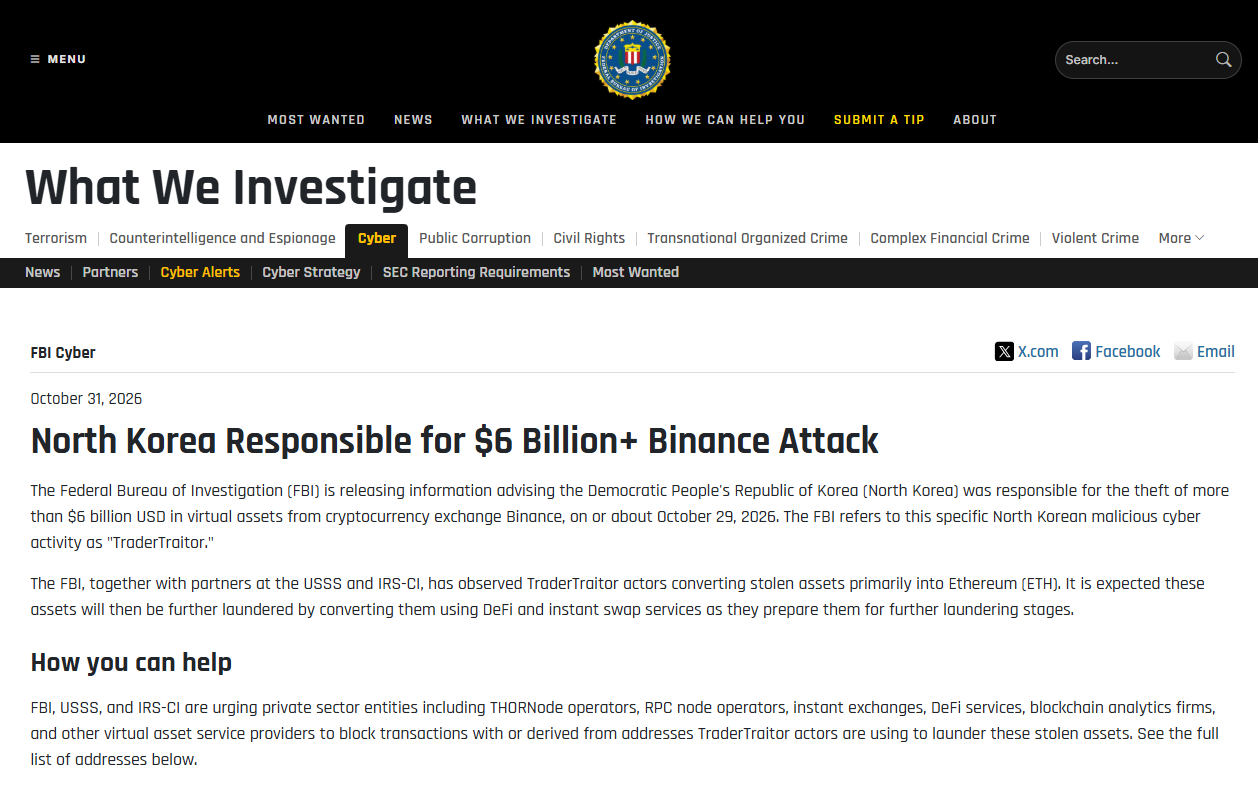
Binance said withdrawals declined after an early spike while deposits stayed substantial. On Oct. 31, the exchange announced that hackers compromised its hot wallets around 20:05 UTC on Oct. 29, stealing around $6.3 billion. The US Federal Bureau of Investigation blamed North Korea for the theft on Oct. 31.
This is a developing story, and Binance added five fiat currencies for withdrawals at 08:00 UTC on Nov. 2. It has yet to say when the remaining crypto networks and assets will reopen.
Fiat Withdrawal Update
Fiat withdrawals are now available for the following currencies:
New
✅ USD
✅ AED
✅ VND
✅ PHP
✅ IDRCurrent:
JPY, VES, BRL, MXN, ARS, BHD, KZT, EUR, CHF, CZK, HUF, KWD, PLN, RON, SEK, CDF, KES, SLE, UGX, XAF, XOF, ZMW, and KGS.We will continue to… pic.twitter.com/QSvm6GY4Nt
— Binance (@binance) November 2, 2026
DefiLlama shows $5.93-billion decline, but withdrawal destinations remain unknown
As of 08:04 UTC on Nov. 2, DefiLlama’s 24-hour inflows showed Binance down $5.93 billion and other tracked exchanges up a combined $613 million. DefiLlama tracks balances in wallets listed in Binance’s proof-of-reserves data, not customer deposits and withdrawals, and its window is longer than Binance’s.
A Binance spokesperson reportedly said DefiLlama’s earlier $4.36-billion reading omitted transfers into Binance’s own new hot wallet, making it inaccurate.
OKX led the gainers with $406 million, while DefiLlama’s feed carries no reserve data for Coinbase, Upbit, or Bithumb. Neither DefiLlama nor Binance stated where the withdrawn funds went. Customers can withdraw to personal wallets, so some remaining funds may have landed there, although that remains unverified.
CZ’s 98% trust claim lacks customer-level evidence
Changpeng “CZ” Zhao, Binance’s co-founder and former CEO, wrote on X 12 hours after withdrawals resumed that 98% of users chose to stay. His post cites the 2.1% net outflow, an asset-based figure, and says most of it occurred in the first couple of hours.
Neither his post nor Binance’s gives the number of accounts that withdrew, though Binance has 335 million registered users.
12 hours after withdrawals resumed: 2.1% net outflow, with most occurring in the first couple of hours. Over $1 billion in flow, too.
98% choose to stay!
Trust isn’t earned by what you say in good times. It’s earned by what you do in hard times.
Thank you for your trust!… https://t.co/r3f6s9c2fy
— CZ 🔶 BNB (@cz_binance) November 1, 2026
TRM Labs global policy head Ari Redbord reportedly said spot Bitcoin exchange-traded funds (ETFs) shed $643 million on Oct. 30, the largest daily outflow of October. He added that the hack unsettles conservative institutional investors.
Jay Koh, vice president at the Asia Web3 AI Association, reportedly said he withdrew nothing from Binance but considers diversifying custody prudent.
Crypto investor Leonidas warned on Nov. 2 of an emerging Binance bank run, citing alleged withdrawal caps and urging users to withdraw all funds. However, Binance’s network data attributes network-specific withdrawal suspensions to maintenance or hot-wallet replenishment, without identifying withdrawal caps.
I don't think people realize how bad the situation at Binance is getting
Less than 24 hours ago Binance began enabling withdrawals for 21 coins
But there are still 531 coins that you can't withdraw
And of the 21 that you can withdraw they have a "Partial Withdrawal Suspended"…
— Leonidas 🧡 $DOG (@LeonidasNFT) November 2, 2026
Harsha MV, head of marketing and growth at OrbitX, wrote the same day that withdrawals, not statements, test trust in Binance.
Last 24 hours in Stablecoins | 2 Nov 2026
A quiet weekend on the surface, a lot underneath. Covering 31 Oct to 2 Nov.
🔓 Binance reopened withdrawals on Sunday after the $6.3B hack and saw $3.64B in net outflows in a day, about 2.1% of its assets. It says it has covered about… pic.twitter.com/fy936b3bzJ
— Harsha MV | OrbitX 💳 (@harshamv) November 2, 2026
Binance’s reserves snapshot predates the $4.65-billion withdrawal wave
Binance said on Nov. 2 that it had covered about 95% of the stolen assets. The remaining 5% involved less-liquid tokens, excluding the 10 assets it reported as fully backed. It had disclosed on Oct. 30 that about $3 billion in stolen assets had been frozen onchain.
The exchange also said on Nov. 1 that its updated proof-of-reserves report was expected Nov. 2. As of 08:04 UTC that day, its reserves page showed backing ratios ranging from 100.00% to 106.08% across six assets. However, the snapshot was taken at 00:00 UTC on Oct. 31, 30 hours before withdrawals reopened on Nov. 1.