preferred on


Points of Focus
- This Halloween, 10 crypto zombie tokens remain 96.4% to nearly 100% below their all-time highs despite continued trading.
- Six of them hit record lows between June and August 2026, years after their original peaks.
- Despite network upgrades, tokenomics overhauls, and institutional access, these former market leaders haven’t recovered.
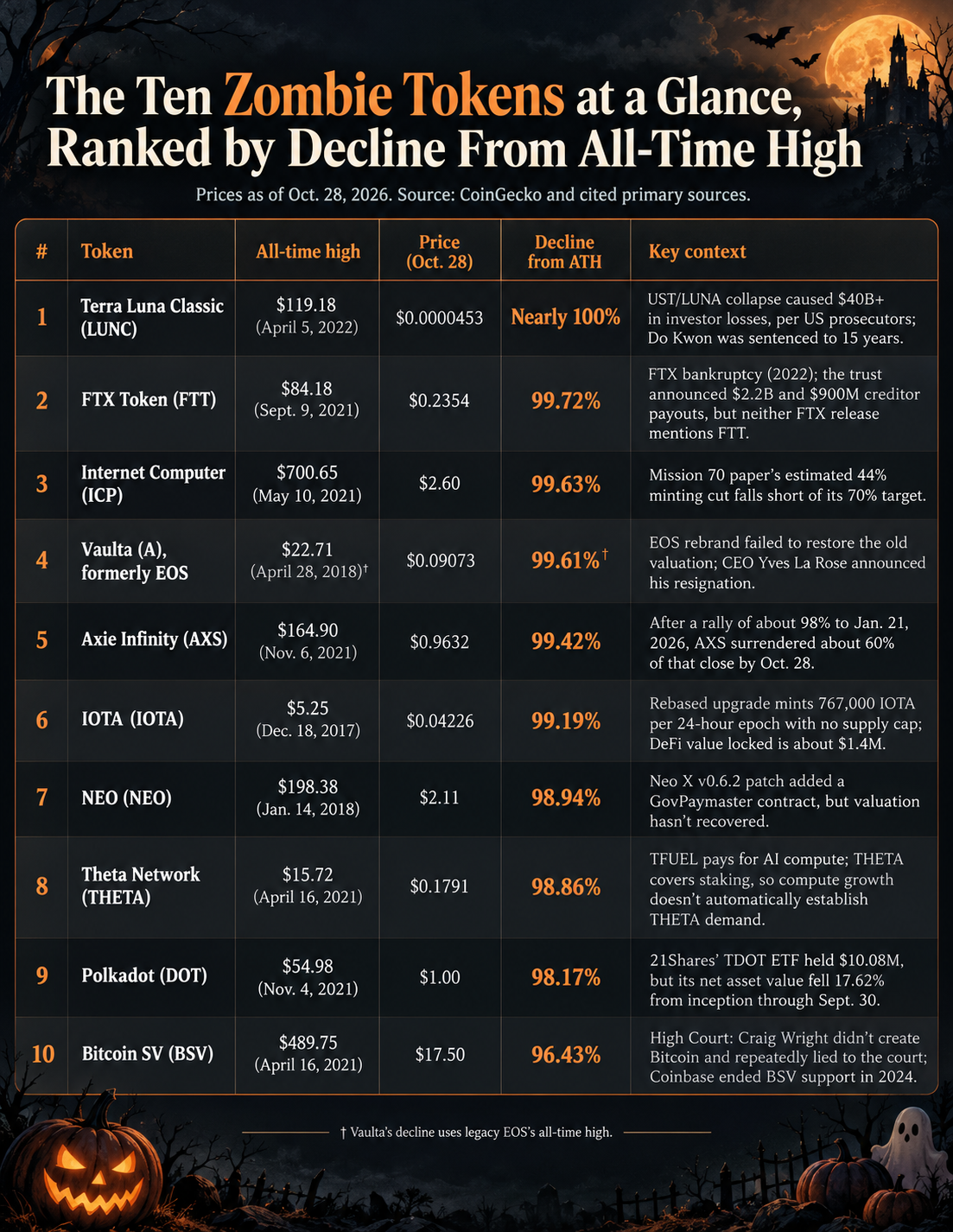
It’s Halloween, and crypto’s graveyard is crowded with former market leaders whose tokens continue trading years after their valuations plunged. Ten remain 96.4% to nearly 100% below their all-time highs, from Bitcoin SV to Terra Luna Classic.
For this ranking, a “zombie” is a former market leader whose token price never recovered, even if its underlying project remains active.
Ranked by losses from peak prices, the list uses CoinGecko readings from Oct. 28. Six tokens recorded all-time lows between June 6 and Aug. 18, 2026. Their stories span institutional collapses, tokenomics overhauls, and functioning networks whose development has outlasted investor enthusiasm.
1. The deepest grave: Terra Luna Classic (LUNC)
Trading at $0.0000453, LUNC has virtually disappeared from its $119.18 high on April 5, 2022. Its $249.7-million market capitalization is spread across 5.51 trillion circulating tokens. CoinGecko lists LUNC’s maximum supply as infinite, with a total supply of 6.445 trillion tokens.
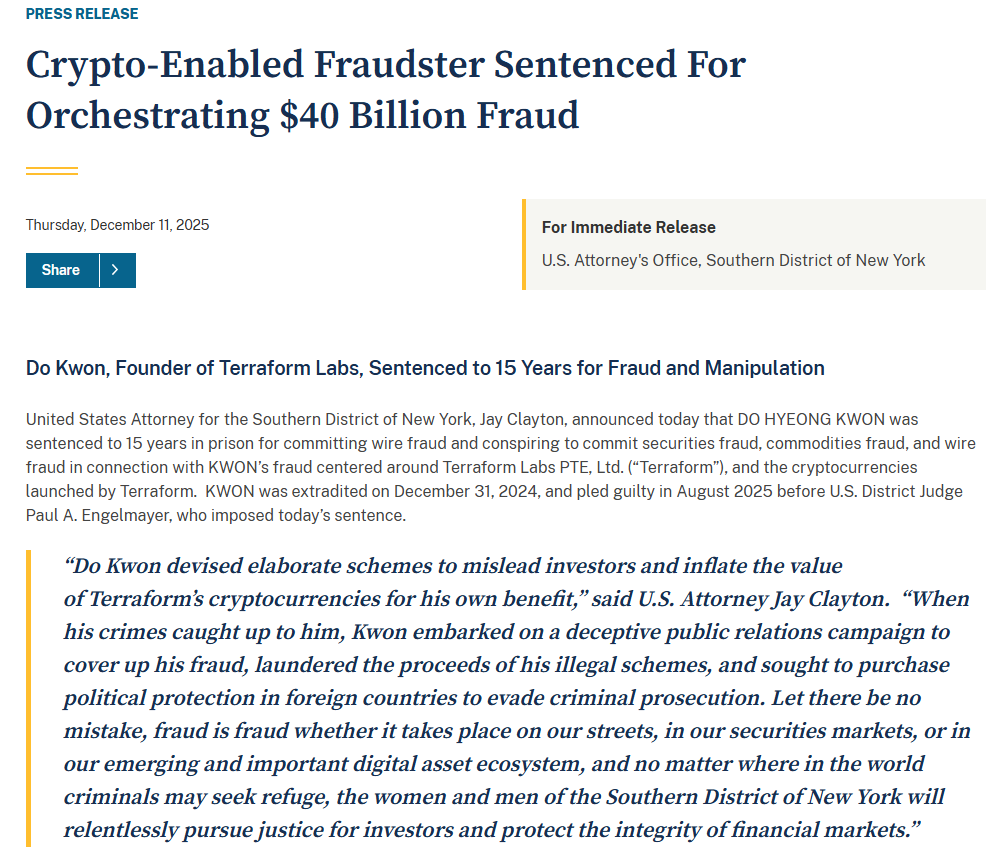
The May 2022 collapse of Terra’s UST stablecoin and LUNA caused more than $40 billion in investor losses, according to federal prosecutors in New York. On Dec. 11, 2025, US District Judge Paul Engelmayer sentenced Terraform Labs founder Do Kwon to 15 years in prison. The legacy chain, rebranded as Terra Luna Classic, continues to trade.
2. The exchange ghost: FTX Token (FTT)
The bankrupt FTX exchange’s token trades at $0.2354, 99.72% below its $84.18 peak of Sept. 9, 2021. CoinGecko puts FTT’s all-time low at $0.191, set on July 30, 2026.
Although FTX entered bankruptcy in 2022, its recovery trust continued paying eligible creditors. It announced $2.2 billion in fourth-round distributions beginning March 31, 2026, followed by a fifth distribution of another $900 million beginning July 31. Creditor recoveries have progressed, but neither of those releases mentions FTT.
$FTT (per request)
This is a cat chart. It died 9 times and couldn't be more dead. Couple dead cat bounces along the way to waste more lives. Dead.
Me-ow. pic.twitter.com/mhfEvulYDS
— Nebraskangooner (@Nebraskangooner) July 28, 2026
3. The billion-dollar disguise: Internet Computer (ICP)
ICP’s $2.60 price represents a 99.63% decline from its $700.65 peak on May 10, 2021. It reached an all-time low of $2.00 on Aug. 1, 2026. Yet its $1.45-billion market capitalization and 64th-place ranking make ICP one of the group’s largest survivors and a zombie that looks alive.
Dfinity’s Feb. 6, 2026, Mission 70 paper proposed reducing ICP minting from 9.72% in January 2026 to 5.42% in January 2027. That estimated 44% cut falls short of its 70% target. The paper says that at current prices ($2.24 on Feb. 6), achieving the full target requires cycle burns to increase from 0.05 to 0.77 XDR per second. XDR stands for Special Drawing Rights, an International Monetary Fund reserve asset used to price network computation.
UPDATED Mission 70 white paper — proposing to 5X the cost of ICP's onchain compute as provided sovereign cloud will remain very competitive.
↗️↗️↗️ Caffeine & cloud engine demand
↗️↗️ cost of onchain compute
↙️ inflation (gov + nodes)
🔥 huge deflationhttps://t.co/T6HiI2wSUY— dom | icp (@dominic_w) February 4, 2026
4. The costume change: Vaulta (A), formerly EOS
Vaulta trades at $0.09073, with a $152.1-million market capitalization at the time of writing. CoinGecko lists a peak of $0.7787 on May 28, 2025, leaving A down 88.35% at the time of writing. It hit an all-time low of $0.05764 on June 6, 2026.
CoinGecko’s legacy EOS page shows the deeper 99.61% decline used in this ranking, from a $22.71 peak on April 28, 2018. A May 7, 2025, announcement scheduled a one-for-one EOS-to-A swap for May 14, without changing supply or allocation. The rebrand failed to restore the old valuation.
Vauta Foundation CEO Yves La Rose announced his resignation on Nov. 12, 2025, acknowledging disappointing results, including market performance.
On October 29th, I informed the @Vaulta_ Block Producers of my decision to step down as CEO of the Vaulta Foundation. This decision formally triggered the governance process that allows the network to elect its next representative(s) through our regular on-chain mechanisms. The…
— Yves La Rose (@YvesLaRose) November 12, 2025
5. The revival attempt: Axie Infinity (AXS)
AXS trades at $0.9632, 99.42% below its $164.90 all-time high recorded on Nov. 6, 2021. Axie Infinity’s team announced the start of the game’s new season, “Origins S16,” on Jan. 21, 2026. It said that all season rewards would be paid in bonded AXS (bAXS), a non-transferable token backed one-to-one by AXS.
Sky Mavis’ guide says bAXS converts to AXS at a rate set by the Axie Score designation, with the difference going to the community treasury. The team’s Jan. 19 recap says bAXS aims to pay genuine players and curb bot activity.
The developers hoped that the change would revive the game, and AXS rallied around 98% from $1.21 on Jan. 14, the day when co-founder Jihoz announced bAXS on X, to $2.40 on Jan. 21. However, by Oct. 28, the token had surrendered roughly 60% of its Jan. 21 closing price.
Axie Infinity turned play-to-earn into a global side-hustle,, then the economy ate itself and the players vanished!!!
Filipinos were quitting call center jobs because a few hours battling Axies paid better than salary.
Scholarships spread like wildfire, You didn’t even need… pic.twitter.com/smqWjB9wLx
— Rifat Ahmed (@Rifat_EE) June 18, 2026
6. The bottomless pit: Iota (IOTA)
IOTA trades at $0.04226, 99.19% below its Dec. 18, 2017, peak of $5.25. It lost 71.1% over the preceding year and reached an all-time low of $0.03113 on July 31, 2026.
The network’s May 2025 “Rebased” upgrade introduced a Move-based architecture and new tokenomics, minting 767,000 IOTA per 24-hour epoch without a supply cap. Its white paper also schedules biweekly unlocks through September 2027.
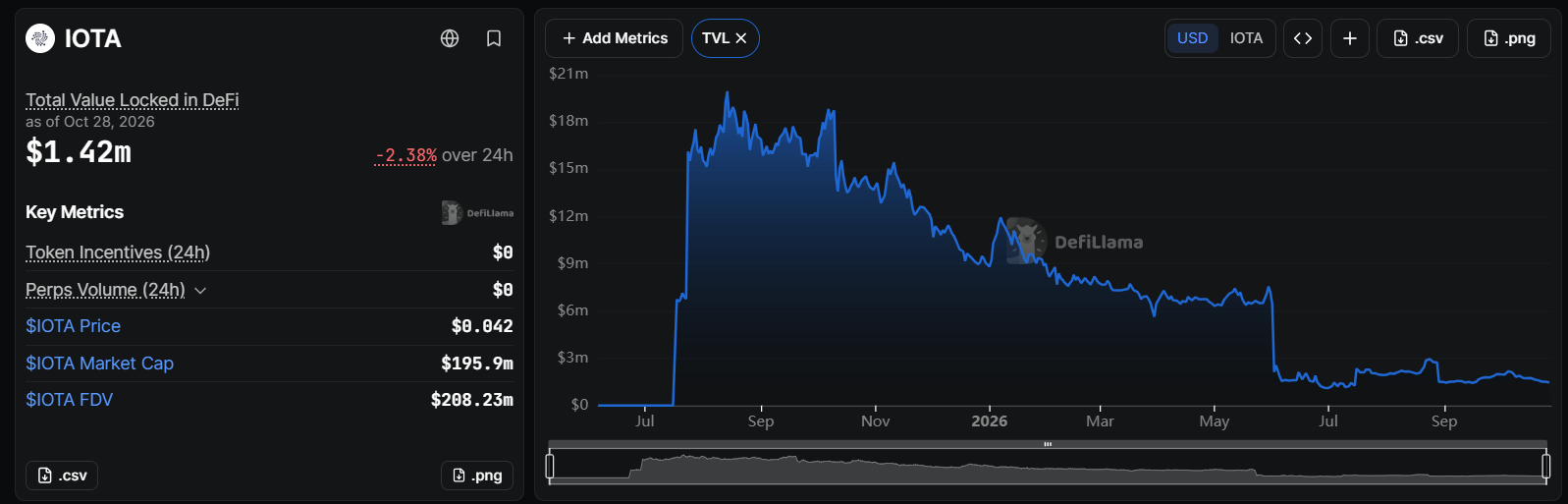
DefiLlama recorded about $1.4 million in decentralized finance (DeFi) value locked on IOTA and $319,000 on Iota Ethereum Virtual Machine (EVM) on Oct. 28, versus a $199-million market cap, according to CoinGecko. The figures highlight continuing supply expansion and limited DeFi adoption despite the technical overhaul.
7. The undead veteran: NEO (NEO)
NEO trades at $2.11, down 98.94% from its $198.38 high on Jan. 14, 2018.
Development continues through Neo X, an EVM-compatible sidechain. Its v0.6.2 upgrade, announced Aug. 10, 2026, introduced a GovPaymaster system contract to improve the ERC-4337 user experience. The patch also refined v0.6.1, with the team recommending upgrades, particularly for mainnet nodes. That said, continued engineering hasn’t translated into a recovery of NEO’s former valuation.
8. The ghost in the machine: Theta Network (THETA)
THETA trades at $0.1791, down 98.86% from its $15.72 peak on April 16, 2021.
Theta launched its EdgeCloud AI computing platform on May 1, 2024, according to its documentation. However, the docs assign different jobs to its two tokens. TFUEL pays Edge Nodes for AI computation, while THETA serves staking and governance. Growing compute usage therefore does not automatically establish increased demand for THETA.
9. The institutional survivor: Polkadot (DOT)
DOT trades at $1.00, 98.17% below its Nov. 4, 2021 peak of $54.98. It reached a $0.727 all-time low on Aug. 18, 2026.
Institutional access nevertheless exists through the 21Shares Polkadot Staking exchange-traded fund (TDOT), whose primary exchange is Nasdaq and inception date is March 6, 2026. The fund held $10.08 million on Oct. 27, with 94.42% of its holdings staked. Its assets represented roughly 0.6% of DOT’s Oct. 28 market cap. TDOT’s net asset value fell 17.62% from inception through Sept. 30, illustrating that regulated market access has not reversed the token’s long-term decline.
Polkadot is dead.
Raised $500M. Promised a revolution.
Now? No users. No devs. No future.
Here’s how one of crypto’s biggest bets faded into a ghost chain 👇🧵 pic.twitter.com/XMHElzhOl0
— Nonzee (@0xNonceSense) June 27, 2025
10. The fork with baggage: Bitcoin SV (BSV)
BSV trades at $17.50, 96.43% below its $489.75 high recorded on April 16, 2021. Its all-time low of $10.49 came on June 25, 2026, CoinGecko shows.
According to BSV’s wiki, the network emerged from a Bitcoin Cash split on Nov. 15, 2018, when Bitcoin ABC nodes adopted new transaction-ordering rules.
Forbes included BSV among hard-fork zombie chains in March 2024, identifying Craig Wright as a central figure. A UK High Court judgment dated May 20, 2024, found Wright had neither created Bitcoin nor written its white paper. Justice James Mellor also found that Wright repeatedly lied to the court, mostly about forged documents.
Coinbase ended BSV support on Jan. 9, 2024, liquidating customer balances through Feb. 2 at weighted-average rates near $74. At $17.50, BSV trades roughly 76% below those liquidation prices.
BSV is a dead chain that can't make a new high. A million transactions per second that nobody uses is still zero.
— Jeff Swanson (@theswansjr) October 26, 2026
These 10 tokens show that continued trading, network upgrades, and institutional interest don’t guarantee a recovery. Despite years of development, all remain at least 96% below their peaks.
Disclaimer: This article is for informational purposes only and does not constitute financial or investment advice. Cryptocurrency prices are highly volatile. Always conduct your own research before making investment decisions.