preferred on


Point of Focus
- Zcash (ZEC) jumped another 19%, triggering nearly $49 million in short liquidations.
- One major ZEC whale is sitting on an estimated $25.7 million unrealized loss.
- ZEC has surged into the crypto top 10 by market cap.
Zcash (ZEC) has extended its explosive rally, climbing another 19% as a wave of liquidations punished traders betting against the privacy coin.
Nearly $49 million worth of ZEC short positions were liquidated over the past 24 hours as the token surged above $1,000 and pushed into the global top 10 cryptocurrencies by market capitalization.
The move adds to an extraordinary run for Zcash, which has gained more than 100% over the past month and over 2,000% in the past year.
However, the rally is creating increasingly painful losses for traders positioned on the wrong side of the market. Beyond forced liquidations, at least one major whale is now sitting on a $25.7 million unrealized loss from a large ZEC short position.
Zcash shorts get crushed as price surges
ZEC’s latest rally has developed into a textbook short squeeze.
When prices rise against heavily leveraged short positions, exchanges begin closing trades that no longer meet margin requirements. Those forced closures require traders to buy back the underlying asset, creating additional demand and potentially accelerating the rally.
That feedback loop appears to have amplified Zcash’s rally. ZEC futures open interest jumped from roughly $838 million on Sept. 2 to $1.24 billion by Sept. 4, while futures volume surged from $1.99 billion to $5.77 billion. Average funding simultaneously flipped from +0.0100% to -0.0085%, signaling growing bearish positioning as prices climbed.
The pressure eventually forced shorts out: when ZEC broke above $1,000, roughly $34.5 million in bearish positions were liquidated in 24 hours. Open interest later climbed above $2.6 billion, suggesting leverage continued building alongside the rally. Together, rising OI, negative funding and heavy short liquidations provide stronger evidence that forced covering accelerated ZEC’s gains.
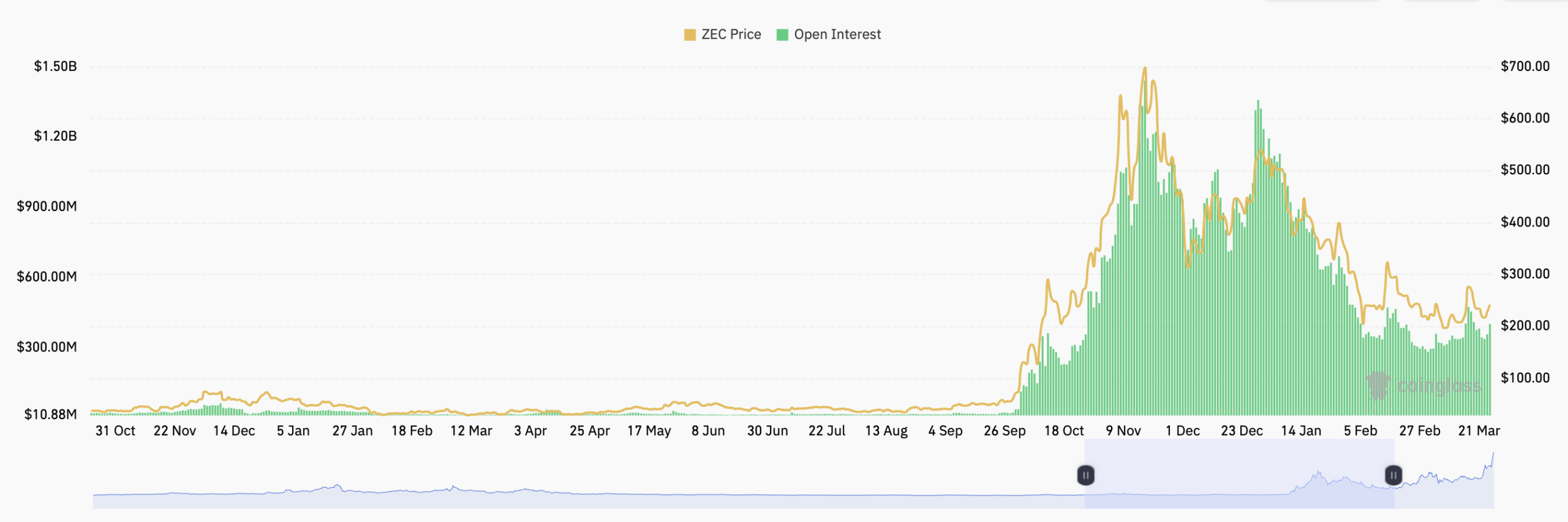
Around $49 million in ZEC shorts were liquidated within 24 hours, highlighting just how aggressively traders had positioned for a reversal.
The latest squeeze follows another wave of liquidations earlier in the rally. When ZEC initially broke through $1,000, CoinGlass data showed $13.24 million in total liquidations, including $11.26 million from shorts.
Zcash had previously struggled around $888, encouraging bearish traders to position for another rejection. Instead, buyers pushed through resistance and sent ZEC above four figures for the first time since 2018.
ZEC whale faces $25.7M paper loss
The rally has also put major individual traders under pressure.
One large whale is feeling that squeeze particularly hard. On-chain data linked to address 0x92ea…050e9 shows a 32,760 ZEC short opened around $444, now carrying roughly $25.7 million in unrealized losses after ZEC surged above $1,200. The position was previously reported at 2x leverage, with a liquidation price near $2,550.70, illustrating how much room the trader has maintained despite ZEC nearly tripling from the entry price.
ZEC going from $0 to $17bn in less than a decade is important, because Zcash is important for society. A civilization requires three coordination primitives to survive and prosper: communication, computation, and money. Zcash is money. Money for an infinite civilization. pic.twitter.com/gulWZqqm3c
— zooko🛡🦓🦓🦓 ⓩ (@zooko) September 5, 2026
The position could become particularly important if ZEC continues higher. Large short positions can face mounting pressure to add collateral or close exposure as unrealized losses increase.
Any eventual short covering could add another source of buying pressure to an already volatile market.
Zcash rally goes beyond short liquidations
Leverage is not the only factor behind ZEC’s surge.
Demand for Grayscale’s Zcash product has grown alongside ZEC’s rally. Since converting into the ZCSH ETF on Aug. 25, the fund has attracted at least $34.4 million in net inflows, including a record $12.6 million on Sept. 2. Its assets under management rose from roughly $260 million on Aug. 22 to $463 million by Sept. 4, although much of that increase also reflects ZEC’s sharp price appreciation.
$ZEC just hit $1,000.
Six months ago, ZEC was trading around $200.
Now it briefly crossed $1,000 and pushed its market cap toward $17B.
That's roughly a 5x move.
But the price is only part of the story.
Grayscale's Zcash ETF began trading on August 25.
Since launch, it has… pic.twitter.com/E7fKhIoYb5
— The Wolf Of All Streets (@scottmelker) September 6, 2026
Separately, Zcash’s NU6.3 “Ironwood” upgrade went live on July 28, replacing Orchard with a formally verified shielded pool after developers discovered a vulnerability in the previous system. More than 40,000 ZEC had migrated to Ironwood shortly after launch, confirming the upgrade was already being used on mainnet.
However, with activation occurring more than a month before ZEC’s 19% rally, there is no clear evidence that Ironwood directly triggered the latest price move.
Zakura developers introduced cryptographic tools that reportedly cut private mobile transaction construction times from roughly three seconds to less than 200 milliseconds.
Meanwhile, Zcash’s privacy technology remains its defining feature. The network uses zk-SNARKs to enable transactions that can shield information such as addresses and transaction amounts.