preferred on


Points of Focus
- Bitcoin ETFs sold $643.2 million on Oct. 30, or 146% of four days of inflows.
- Exchange outflows of 16,660 BTC on Nov. 1 nearly matched the Oct. 27 outflow.
- The 20-day EMA, 50-day EMA, and $80,000 max pain sit within 0.3%.
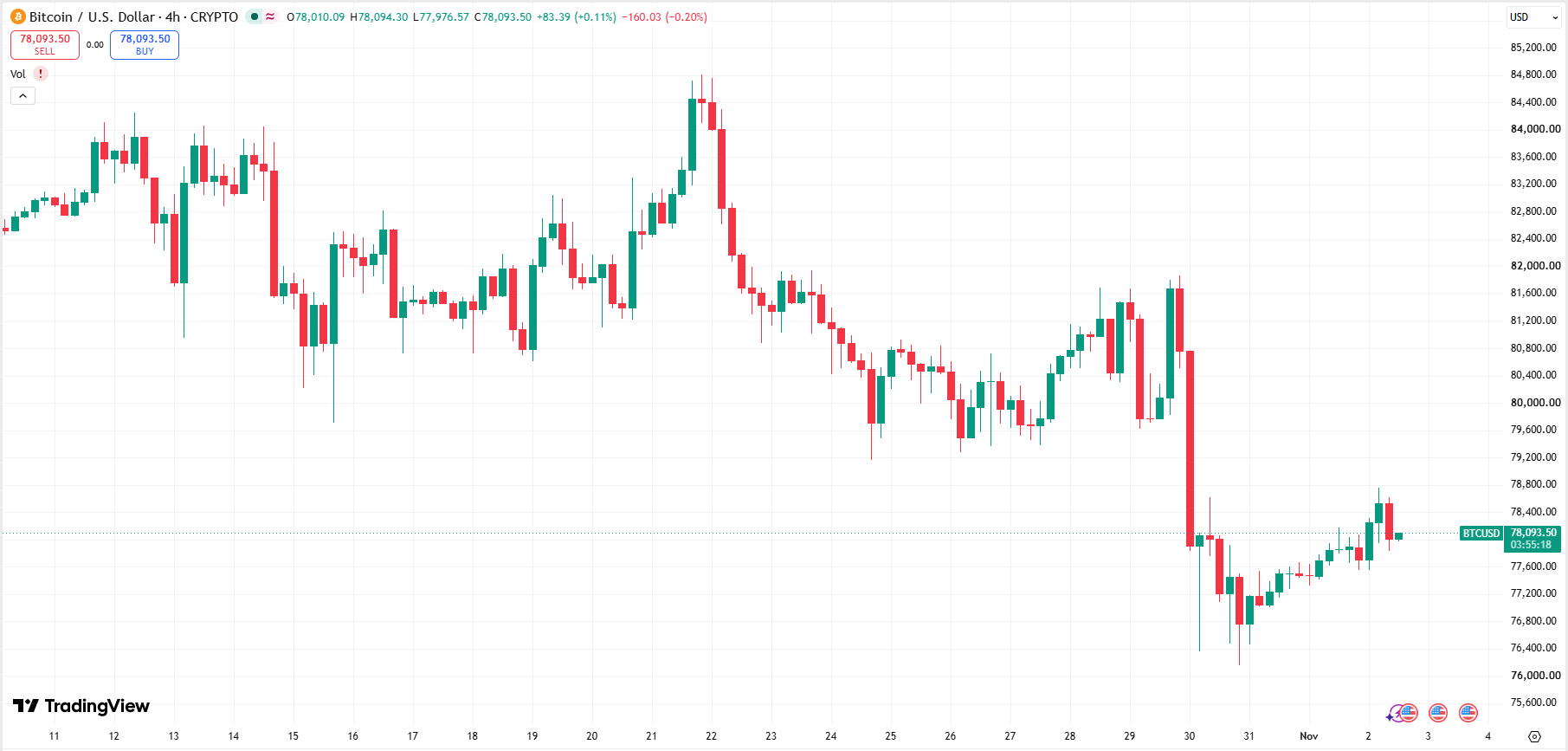
Bitcoin (BTC) traded at $78,164 on Binance on Nov. 2 at the time of writing, 2.4% above its Oct. 30 low of $76,326.
Binance said on Nov. 1 that phase one of withdrawals, starting with BTC, would resume between 06:00 and 09:00 UTC, with about 95% of the stolen assets covered.
US Bitcoin exchange-traded funds (ETFs) sold $643.2 million on Oct. 30, the session after the Binance hack, equal to 146% of the four inflow days before it. BTC now faces resistance between $80,000 and $80,212, where the Nov. 6 options max pain sits, so the rebound needs ETF buyers to reach that zone.
Bitcoin ETF outflows erase four days of inflows
IBIT lost $233.7 million, FBTC $201.0 million, ARKB $129.5 million, GBTC $53.3 million, and BITB $25.7 million on Oct. 30. The outflow exceeds the $440.8 million the funds gathered from Oct. 26 to 29 and trims cumulative net inflows by 1.1% to $57.05 billion as of Oct. 30.
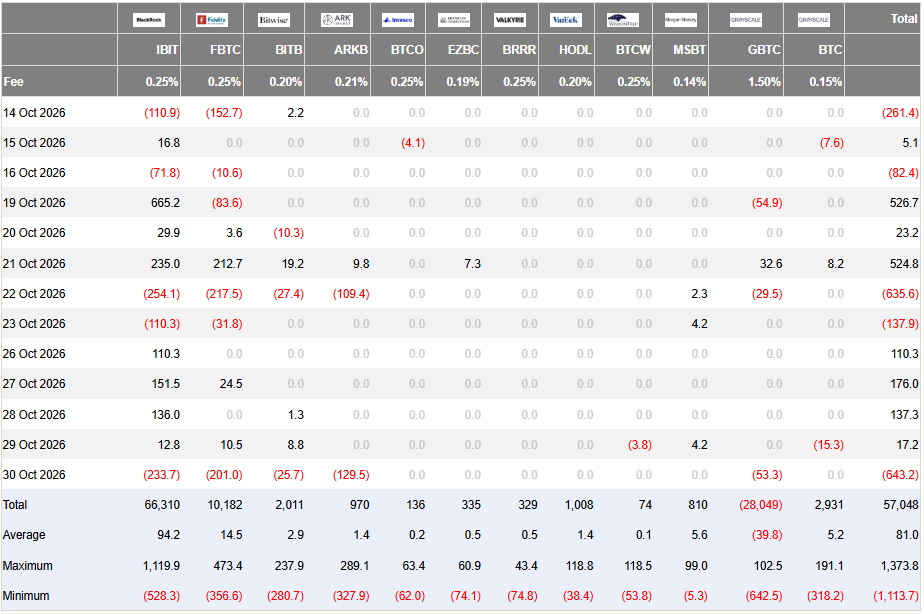
The $643.2-million outflow is 1.3 times the outflow of $484.9 million on Oct. 7 and 3.2 times the $202-million outflow that ended a streak on Aug. 28. US markets were shut on Oct. 31 and Nov. 1, so BTC closed the weekend at $78,354 on Binance, 1.3% above its Oct. 30 close, with no ETF flows and 36% of the Oct. 26 to Oct. 30 average volume.
Bitcoin exchange flows show no run as Binance withdrawals restart
CryptoQuant recorded net exchange inflows of 1,844 BTC across Oct. 30 and 31, then net outflows of 16,660 BTC on Nov. 1. That is 3.5% below the 17,263 BTC outflow on Oct. 27, before the hack, so the restart produced an ordinary heavy outflow day rather than a run.
Binance confirmed on Oct. 31 that it had replenished 90% of the impacted amount from its Secure Asset Fund for Users, futures insurance fund, and corporate treasury, and its Nov. 1 update raised that figure to about 95%. The outstanding 5% sits in tokens outside the top 10, and the full zero-knowledge proof-of-reserves is expected by Nov. 3 UTC.
By Oct. 31, Binance set aside more than $6.34 billion, which equals 15% of its $42.1 billion stablecoin reserves as of Aug. 12.
Bitcoin funding rate and open interest show leverage never reset
Binance BTCUSDT funding held at 0.0100% for eight straight settlements from 16:00 UTC on Oct. 30 to 00:00 UTC on Nov. 2.
Under Binance’s funding formula, the interest component is 0.01% per settlement, and the premium adjustment is clamped at 0.05%, so any premium index between -0.04% and 0.06% prints exactly 0.0100%. The perpetual’s mark price sat at $78,125 against a $78,157 index at 06:44 UTC, a 0.04% discount that approximates the premium index and sits at the lower edge of that band, so a wider discount would pull funding below 0.0100%, as when funding turned negative on Oct. 22.
Open interest stood at 95,303 BTC at 06:00 UTC on Nov. 2, 1.9% above its 20:00 UTC level on Oct. 29 and 2.3% above the open interest of 93,131 BTC on Oct. 19, so the hack did not reset leverage.

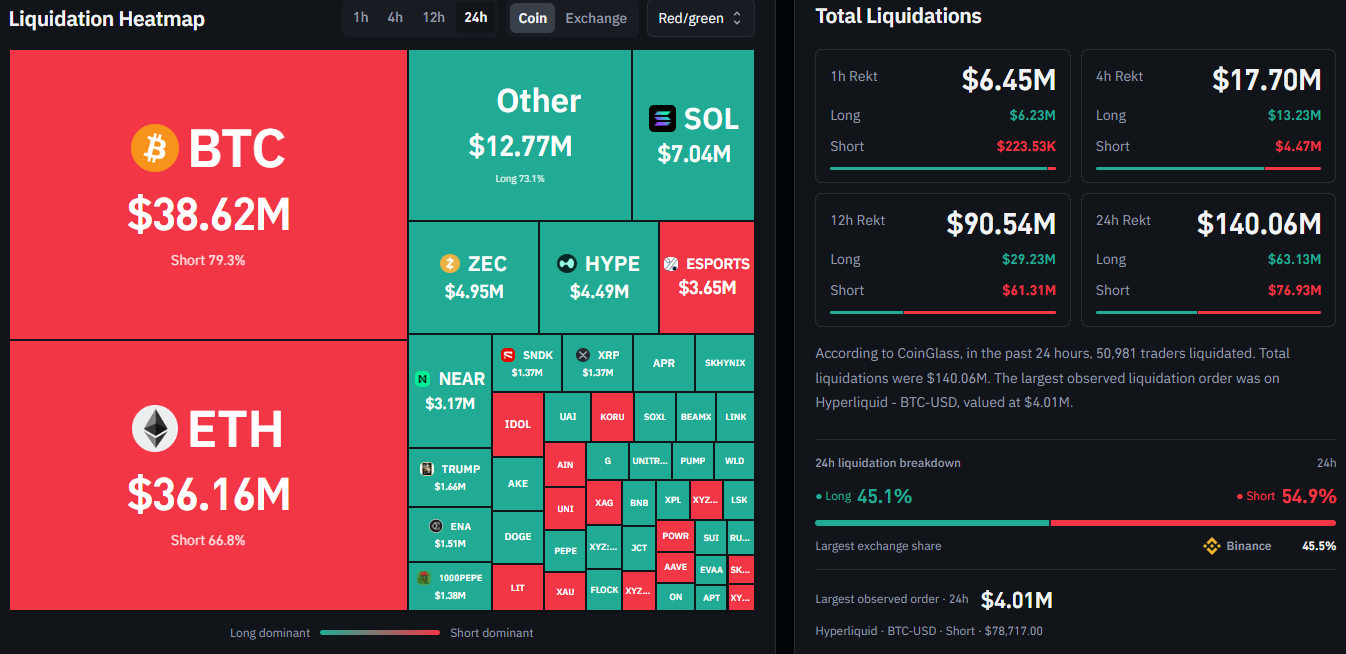
CoinGlass tallied $38.19 million of BTC liquidations over 24 hours at 06:53 UTC, 80.3% of them shorts.
Bitcoin price analysis points to $80,000 resistance
TradingView lists the daily candle with an open of $78,241, a high of $78,750, and a low of $77,929, with BTC at $78,057 at 06:47 UTC on Nov. 2.
BTC sits above the 100-day exponential moving average (EMA) at $77,761 and the 200-day EMA at $76,460, but below the 10-day EMA at $79,054, the 20-day EMA at $80,154, and the 50-day EMA at $80,212.
The relative strength index (RSI) reads 39, the moving average convergence/divergence (MACD) level of -1,157 signals downward momentum, and the average directional index (ADX) at 21 indicates a weak trend.
Deribit’s Nov. 6 expiry has a put-call ratio of 0.34, with max pain at $80,000 (2.3% above the Binance price), and the Nov. 27 expiry has the same max pain. The 20-day EMA, 50-day EMA, and that strike sit within 0.3% of each other, and an $80,000 call wall flagged on April 2 shows the level has drawn options positioning before.
A daily close above $80,212 clears the 20-day and 50-day EMAs, while a close below $77,761 exposes the 100-day simple moving average (SMA) at $76,548 and the 200-day EMA at $76,460. The market-value-to-realized-value (MVRV) recovered to 1.447 on Nov. 1 from 1.427 on Oct. 30, a 45% aggregate gain over realized value, so resistance carries profit-taking risk rather than capitulation.
A second straight day of ETF outflows on Nov. 2 would leave the weekend gain on 36% of weekday volume without confirmation. Deribit settles its Nov. 6 options expiry, which carried 27,179 BTC of open interest on Nov. 2, at 08:00 UTC on Nov. 6.
Disclaimer: This article is for informational purposes only and does not constitute financial or investment advice. Cryptocurrency prices are highly volatile. Always conduct your own research before making investment decisions.