preferred on


Points of Focus
- US Bitcoin ETFs lost $1.04 billion in two sessions, led by IBIT on Nov. 2.
- Binance open interest hit 99,776 BTC, while longs took 93.1% of liquidations.
- BTC sits at the 200-day EMA, which has held for 75 sessions.
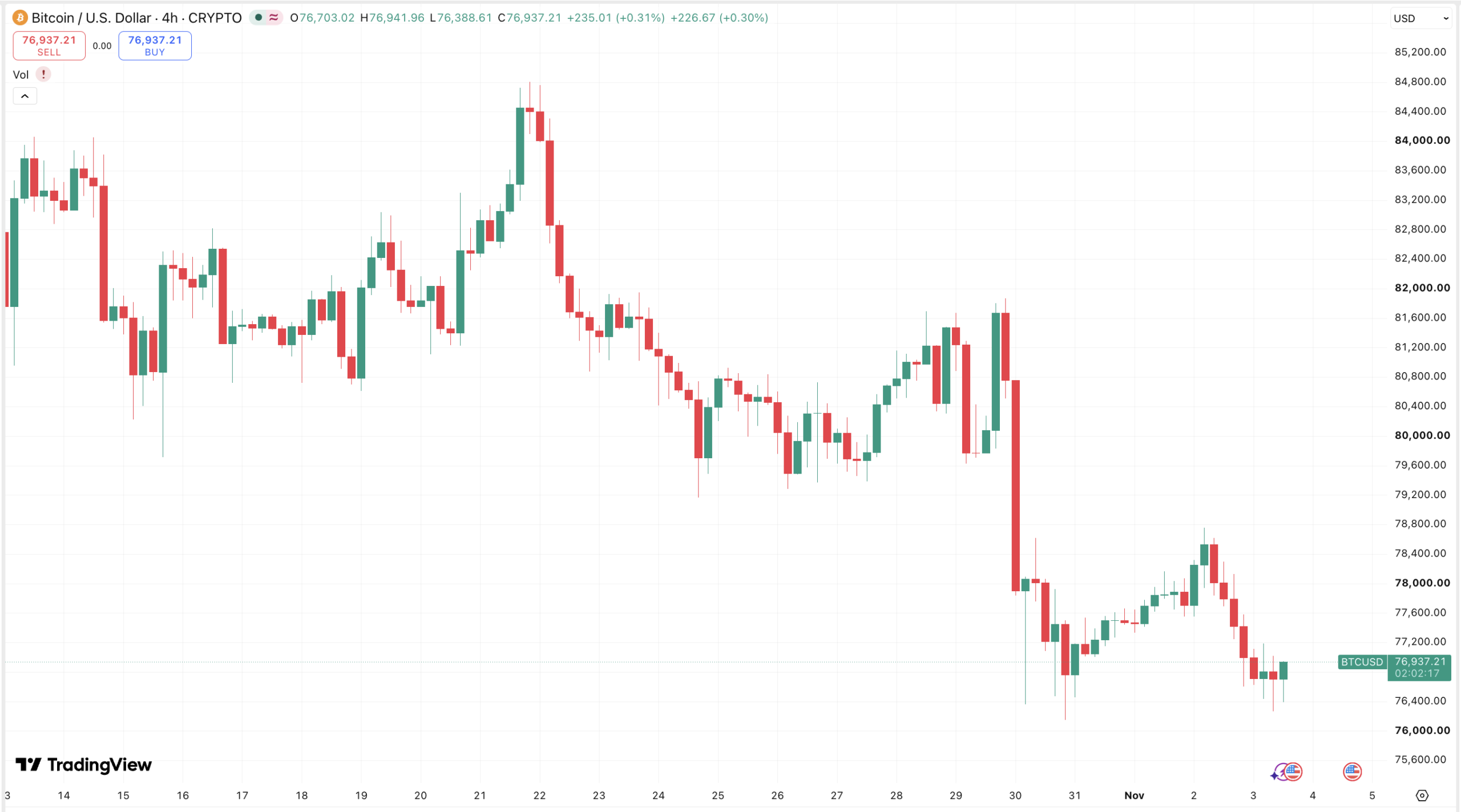
Bitcoin (BTC) traded at $76,573 on Binance on Nov. 3 at the time of writing, 2.9% below its Nov. 2 high of $78,878.
US Bitcoin exchange-traded funds (ETFs) lost $398.6 million on Nov. 2, led by IBIT at negative $405.3 million, taking the outflow since Oct. 30 to $1,041.8 million.
Binance BTCUSDT open interest rose 4.7% to 99,776 BTC on Nov. 3, while CoinGlass tallied $100.00 million in 24-hour liquidations, 93.1% longs. BTC now sits on the 200-day exponential moving average (EMA) at $76,446, a line Binance daily closes have held for 75 sessions.
Bitcoin ETF outflows top $1 billion as IBIT carries the second session
IBIT’s $405.3 million outflow on Nov. 2 was its 10th largest daily outflow since Jan. 11, 2024, after five funds shed $643.2 million on Oct. 30. On Oct. 7 and 8, by contrast, FBTC led a $729-million outflow with IBIT at $213.2 million, so selling has narrowed from a broad exit to one issuer.
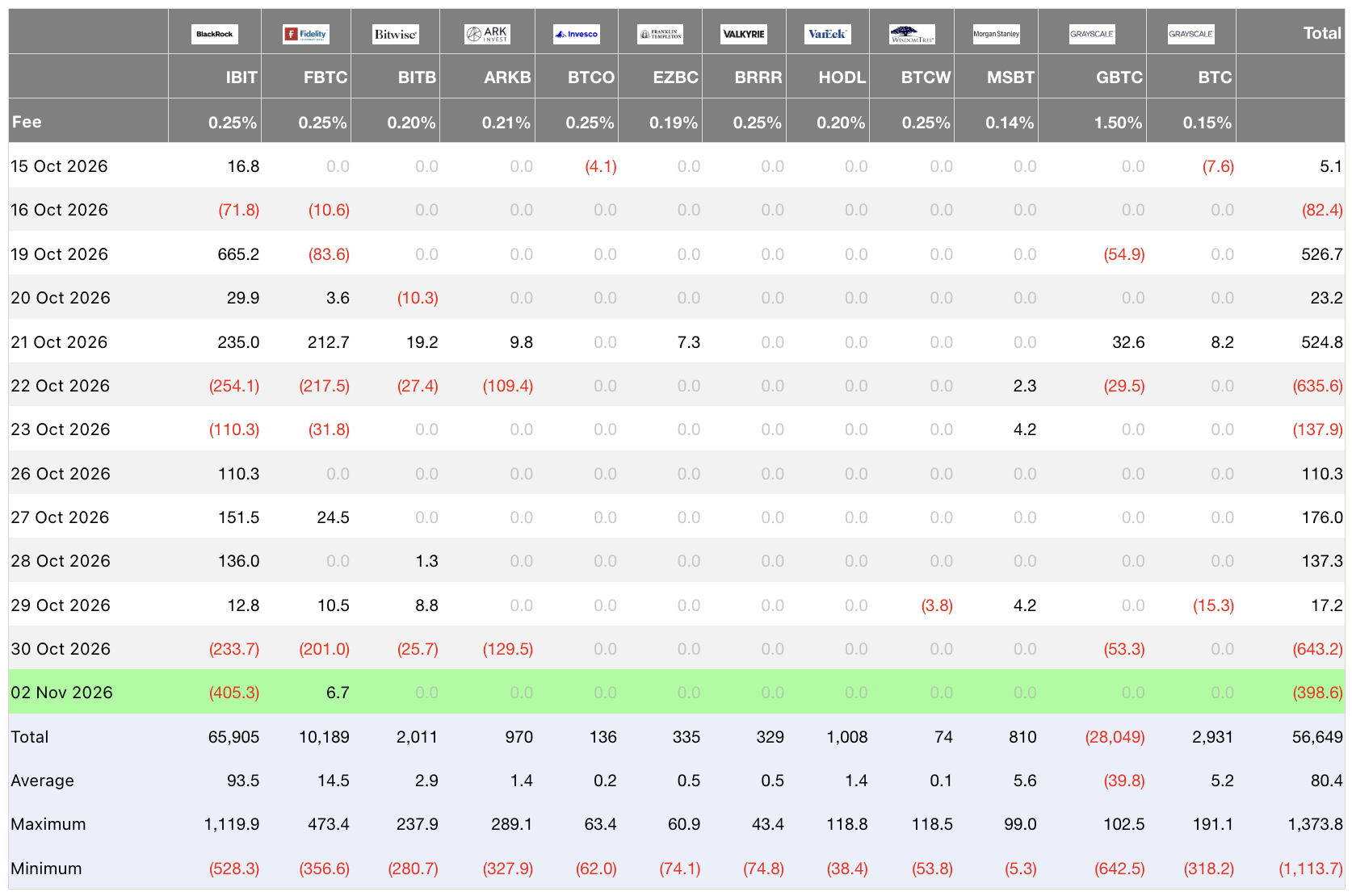
IBIT also supplied $410.6 million of the $440.8 million gathered from Oct. 26 to 29, or 93%, so one fund swung the channel both ways. That fails the breadth test the Nov. 1 outlook set, with the $1.041-billion outflow 2.4 times that inflow and the funds at negative $601.0 million since Oct. 26.
At the $76,816 Binance close, IBIT’s outflow equals about 5,276 BTC, or 42% of the 12,641 BTC that traded on BTCUSDT on Nov. 2, when BTC closed 2.0% lower after a $78,878 high.
Binance said it would reopen withdrawals for more assets, including BTC on the BNB Smart Chain and Ethereum networks, from 04:00 UTC on Nov. 3, so access is returning while one issuer’s holders redeem.
Bitcoin open interest and long accounts rise into the dip
Binance BTCUSDT open interest rose from 95,303 BTC at 06:00 UTC on Nov. 2 to 99,776 BTC, while BTC closed 2.0% lower on Nov. 2.
The reading is 2.3% above the peak of 97,507 BTC after the Binance hack on Oct. 30 and 5.7% above the range of 92,378-94,395 BTC held from Oct. 9 to 19, so positioning exceeds every hourly reading since Oct. 13.
Binance’s account data shows 73.2% of accounts long at 06:00 UTC on Nov. 3, up from 67.6% a day earlier, so the added open interest was most likely long.
CoinGlass liquidations flipped from $38.19 million at 06:53 UTC on Nov. 2, when shorts led liquidations at 80.3%, to $100.00 million with 93.1% longs, no more than 1.3% of Binance open interest.
Binance BTCUSDT funding printed 0.0088% and 0.0091% at the 08:00 and 16:00 UTC settlements on Nov. 2, then 0.0100% at 00:00 UTC on Nov. 3. Binance’s formula prints exactly 0.0100%, while the premium index stays between negative 0.04% and 0.06%, and the mark price of $76,548 sat 0.04% below the $76,577 index at 06:59 UTC.
When funding turned negative on Oct. 22, Binance open interest fell 4.8%, while the Nov. 2 dips came with rising open interest, suggesting positioning rather than de-risking.
Bitcoin options and volatility index price a quiet market with hedges at $74,000
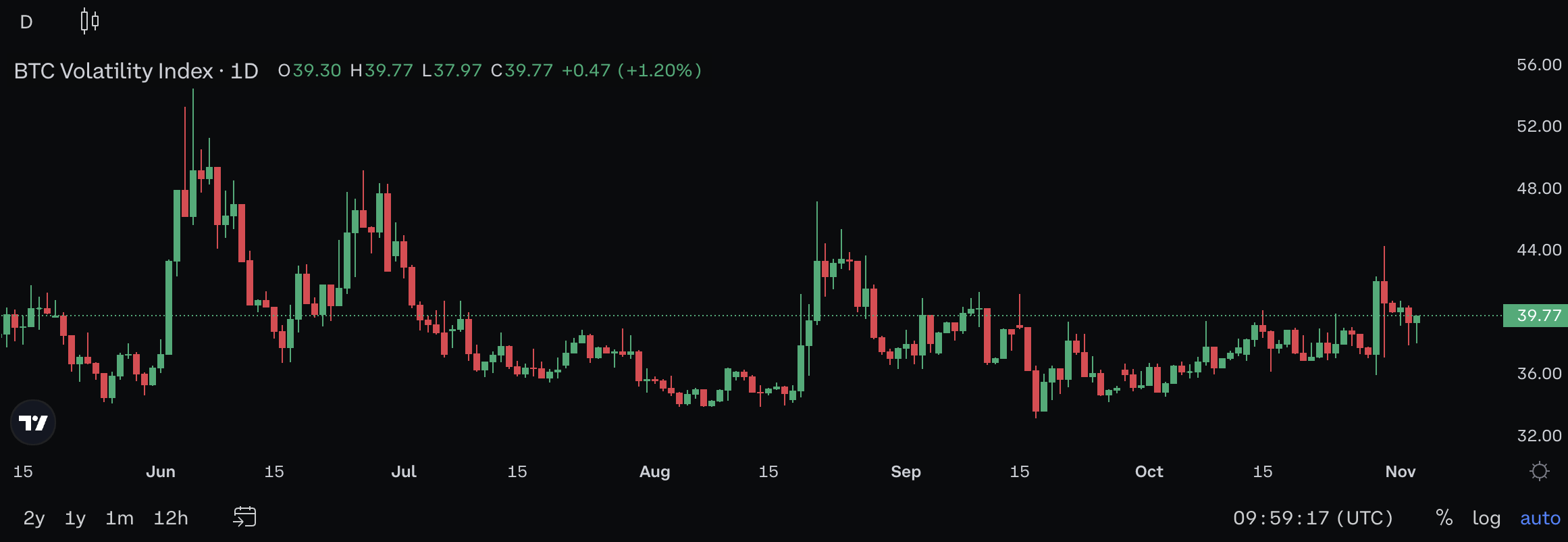
Deribit’s volatility index (DVOL) stands at 39.32 on Nov. 3, the 24th percentile of daily readings since Feb. 8, 2024, which implies a one-day range of $74,997-$78,149 around $76,573. Options price a calm session, while open interest sits at a 500-hour high.
Deribit’s book carries 28,459 BTC of open interest on the Nov. 6 expiry with max pain at $79,000, and its largest call strike of $82,000 holds 5,499 BTC, 7.1% above the Binance price.
The Nov. 13 expiry has 3,945 BTC in puts at $74,000, 30% of its 13,178 BTC open interest, and 3.4% below the Binance price.
Bitcoin price analysis points to $76,446 support and $77,708 resistance
TradingView lists the daily candle at an open of $76,674, a high of $77,183, and a low of $76,268, with BTC at $76,450 at 06:48 UTC on Nov. 3.
BTC sits below the 10-day EMA at $78,370, 20-day EMA at $79,680, 50-day EMA at $80,011, 100-day EMA at $77,708, and 100-day simple moving average (SMA) at $76,645, $4 above the 200-day EMA at $76,446 and above the 200-day SMA at $73,153.
The relative strength index (RSI) reads 34, the moving average convergence/divergence (MACD) level is -1,389, signaling downward momentum, and the average directional index (ADX) at 23 shows a weak trend.
A daily close above $77,708, the 100-day EMA, clears the 100-day SMA at $76,645 and puts the 10-day EMA at $78,370 in range. A close below $76,446 ends the 75-session streak and exposes the $74,000 put strike and the 200-day SMA at $73,153, where crowded longs would add forced selling.
BTC sits above only one of its five EMAs, so the streak is the last EMA signal in its favor. The last Binance close below the 200-day EMA came on Aug. 19 at $69,335, below the average of $71,543 (3.1% under).
Disclaimer: This article is for informational purposes only and does not constitute financial or investment advice. Cryptocurrency prices are highly volatile. Always conduct your own research before making investment decisions.