
Could AI Break Bitcoin’s Cryptography Without Quantum Computers?
Key Takeaways
- Scott Aaronson reports credible rumors of undisclosed AI cryptography breakthroughs.
- Ledger’s CTO warns that attacks on elliptic-curve cryptography could threaten Bitcoin.
- Google’s latest mathematical research shows progress, but no confirmed Bitcoin security breach.
Bitcoin’s cryptographic security is facing renewed scrutiny after prominent computer scientists reported rumors that leading AI laboratories have discovered potentially serious weaknesses in mathematical systems protecting modern financial infrastructure.
The discussion began with theoretical computer scientist Scott Aaronson, who disclosed hearing repeated claims that OpenAI, Anthropic, or both had discovered a polynomial-time algorithm for integer factorization.
In a Nov. 25 blog post, Aaronson said he was “virtually certain, from multiple reliable sources” that AI laboratories were holding undisclosed cryptographic breakthroughs.
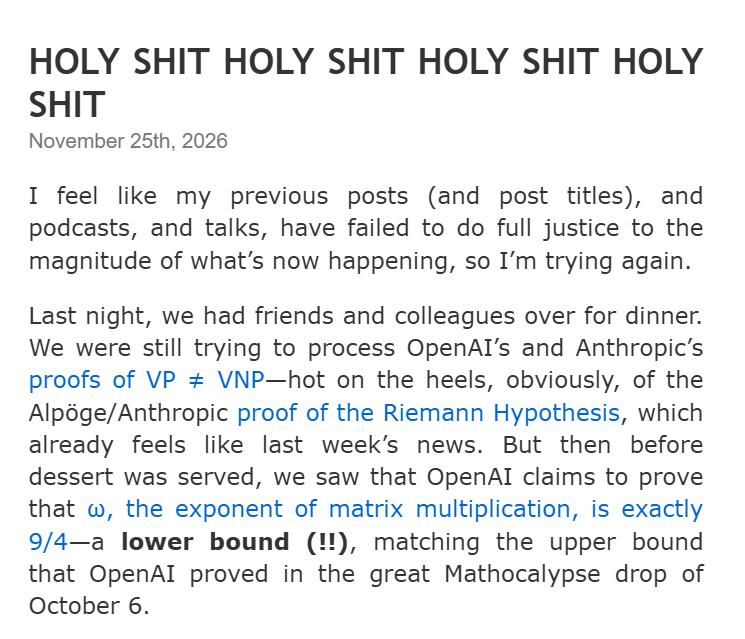
However, he acknowledged substantial uncertainty about their precise nature, warning that technical details could have been distorted as information circulated.
The speculation spread further when Ledger chief technology officer Charles Guillemet reported hearing similar rumors involving Rivest-Shamir-Adleman (RSA), elliptic-curve cryptography, and lattice-based security systems.
Neither researcher confirmed that Bitcoin’s cryptography had been broken.
Scott Aaronson’s warning sparks cryptography debate
Aaronson’s comments followed extraordinary developments in AI-assisted mathematics, including an Anthropic-assisted proof of the Riemann hypothesis and new mathematical results published by OpenAI.
https://twitter.com/solidintel_x/status/2125667764530450693
The Riemann hypothesis concerns the distribution of prime numbers, a subject closely related to number theory and cryptography.
However, proving it does not establish that RSA encryption can be broken or that Bitcoin private keys can be recovered.
One rumor discussed by Aaronson concerns whether integer factorization belongs to the complexity class P, meaning sufficiently large numbers could be factored using an algorithm whose running time grows polynomially with input size.
Such a discovery could fundamentally undermine RSA if the algorithm were efficient enough to work against real-world key sizes.
Bitcoin, however, does not rely on RSA to authorize transactions.
Its digital signatures use elliptic-curve cryptography, which presents a different mathematical challenge.
Ledger’s Charles Guillemet identifies three potential threats
In a Nov. 25 post on X, Guillemet outlined three rumored breakthroughs.
The first involved integer factorization, which could threaten RSA encryption and signatures used throughout internet infrastructure.
The second concerned elliptic-curve cryptography, including the Elliptic Curve Digital Signature Algorithm (ECDSA) and Elliptic-Curve Diffie-Hellman (ECDH). A sufficiently powerful attack could affect cryptocurrency wallets and widely deployed authentication systems.
https://twitter.com/P3b7_/status/2125633815519354949
The third involved Ring Learning With Errors, or Ring-LWE, a mathematical problem underlying some post-quantum cryptographic designs.
If those lattice-based assumptions proved weaker than expected, security systems intended to withstand quantum attacks could also require reassessment.
Guillemet nevertheless questioned whether any of these systems had been completely defeated.
He pointed out that polynomial-time primality testing has been known since 2002, but efficiently identifying the factors of a large composite number remains a separate problem.
He also warned that responsible disclosure would become exceptionally difficult if an AI laboratory discovered a practical attack affecting global financial infrastructure.
Google’s six AI-generated papers add to the uncertainty
On Nov. 25, Google Research published six papers produced by Cogentic, an AI research system using Gemini 4, covering advanced mathematical problems.
Among them were papers titled “Unconditional Integer Factorization in Time L_N[1/3, O(1)]” and “Unconditional Deterministic Subexponential Integer Factoring and Quadratic Nonresidue Construction.”
Another examined discrete logarithms in finite fields of fixed characteristic.
The research is available through Google’s public repository.
One paper claims an unconditional subexponential factoring result, while another investigates deterministic factoring without relying on unproven assumptions.
However, subexponential time is not polynomial time.
The results therefore do not establish the rumored breakthrough that would fundamentally change RSA’s security assumptions.
Similarly, progress on discrete logarithms in small-characteristic finite fields does not demonstrate an attack against Bitcoin’s secp256k1 elliptic curve.
The papers have not undergone peer review, and their promised formal proof certificates were not publicly available alongside the initial release.
What scientific studies reveal about AI cryptanalysis
There is already measurable evidence that AI models can discover cryptographic weaknesses.
A July 2026 study titled “CryptanalysisBench” tested frontier AI models against 191 cryptographic challenges.
Researchers found that the models successfully attacked 65%-86% of schemes with previously known practical weaknesses.
They also identified previously unpublished vulnerabilities, including a key-recovery attack against the SpoC authenticated-encryption design.
Separately, Google DeepMind’s Nov. 5 research on factorization factories described improvements to existing factoring techniques developed with AI assistance.
The researchers explicitly stated that their findings did not threaten currently deployed RSA systems using keys of 2,048 bits or larger.
These studies demonstrate growing capabilities in AI-assisted cryptanalysis, not a practical defeat of Bitcoin’s signature system.
Could attackers steal Bitcoin without quantum computers?
Bitcoin uses ECDSA and Schnorr signatures based on the secp256k1 elliptic curve.
If AI helped discover an efficient classical algorithm for solving the underlying elliptic-curve discrete logarithm problem, attackers could potentially derive private keys from exposed public keys.
Older pay-to-public-key outputs, reused addresses whose public keys have been revealed, and Taproot outputs would present different forms of exposure.
However, a breakthrough in RSA factorization would not automatically compromise these Bitcoin signatures.
Nor would breaking elliptic-curve cryptography automatically defeat SHA-256, which Bitcoin uses in mining.
Security researchers remain divided over how urgently to respond.
Blockstream CEO Adam Back previously dismissed speculative claims of an imminent AI-driven Bitcoin cryptographic failure, while Coinbase cryptography head Yehuda Lindell argued in October that there was no demonstrated evidence of broken elliptic-curve hardness assumptions.
https://twitter.com/lindellyehuda/status/2107999859219587309
Meanwhile, the Ethereum Foundation announced on Nov. 23 that AI had emerged as a more urgent security concern, accelerating its work on hash-based cryptography and formal verification.
For Bitcoin, the immediate question is whether developers should accelerate cryptographic migration before a practical attack emerges.
No publicly demonstrated AI technique can currently recover Bitcoin private keys from properly generated secp256k1 public keys.
But with AI laboratories producing increasingly sophisticated mathematical research, the time available to prepare for a genuine breakthrough has become a subject of serious debate.