preferred on

Points of Focus
- MIM grew to nearly $4.6 billion in market capitalization before market turmoil and repeated security exploits weakened its position.
- MIM’s June 2026 depeg accelerated despite emergency interest-rate increases and liquidity interventions, sending its price sharply below $1.
- By September 2026, Abracadabra estimated approximately $21 million in bad debt, leaving less than four cents of potentially recoverable collateral per outstanding MIM.
In the volatile world of decentralized finance (DeFi), few stories match the rapid and dramatic fall of Magic Internet Money (MIM).
Once a prominent crypto-backed stablecoin issued by Abracadabra Money, MIM was designed to maintain a steadfast $1 peg through overcollateralized lending. However, a severe depeg in June 2026 shattered user confidence, cascading from an initial liquidity slip into a catastrophic 50% crash by late June.
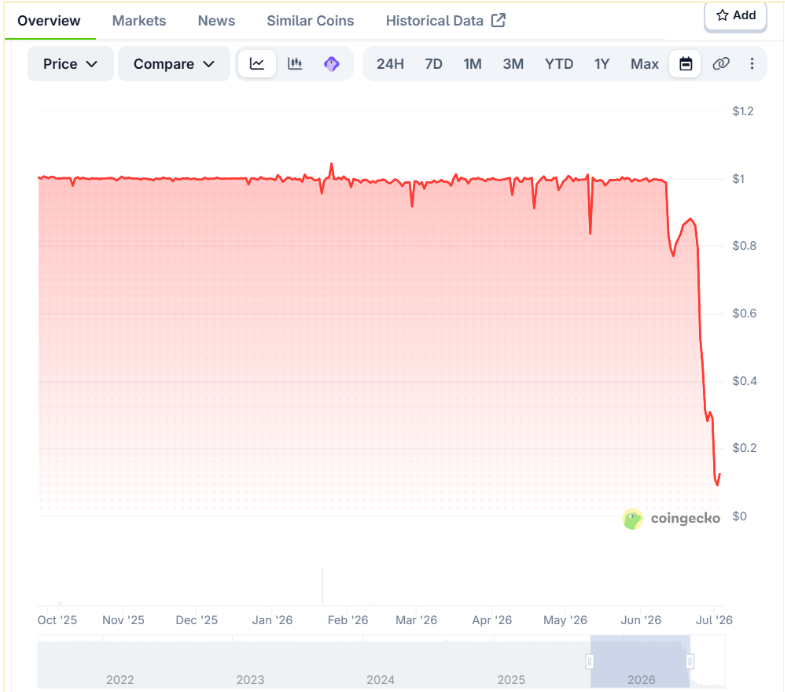
Between June 7, 2026, and July 2, 2026, MIM depegged from $0.99747 to $0.091068.
By September 2026, the stablecoin’s issuer was confronting a very different calculation: About $22 million of MIM remained outside protocol-controlled addresses, while only about $900,000 of collateral appeared realistically executable.
That worked out to less than $0.04 of recoverable value for every MIM supposedly worth $1.
The collapse was not caused by a single bank-run moment. MIM survived earlier depegs, market crashes, and bad debt. But repeated exploits, shrinking liquidity, and mounting liabilities progressively weakened the balance sheet.
MIM’s journey from one of DeFi’s largest stablecoins to a distressed claim on residual assets shows how collateralization can look very different once the question changes from what assets exist onchain to what can actually be recovered.
How MIM grew to $4.6 billion
Abracadabra.money gave DeFi users an unusual proposition.
Instead of requiring users to sell yield-generating positions to access liquidity, the protocol allowed supported interest-bearing tokens to be deposited as collateral in lending markets known as Cauldrons. Users could then borrow MIM against those positions, while the underlying collateral continued generating yield.
The model quickly found demand.
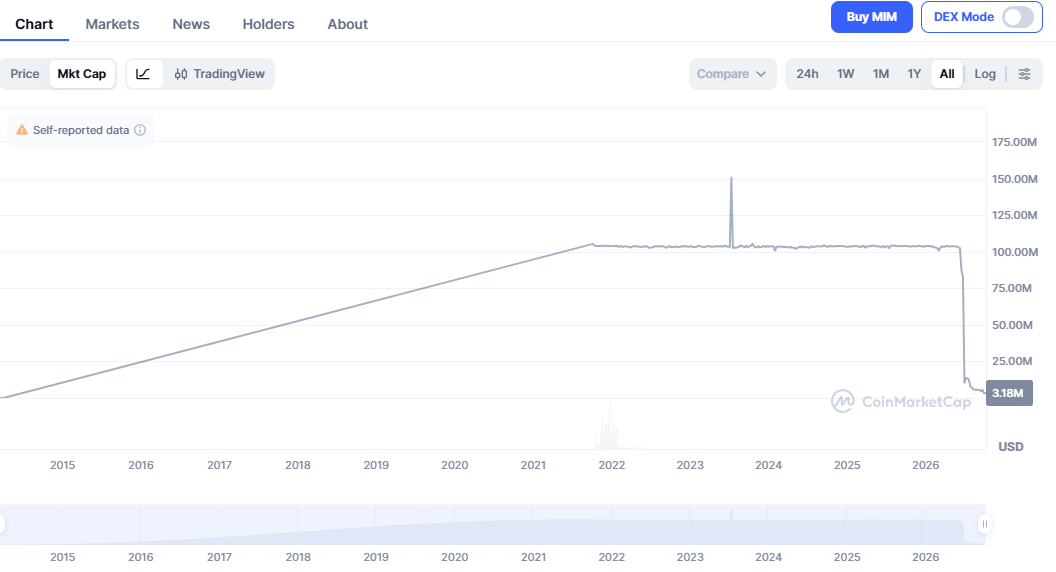
MIM’s market capitalization climbed from $879 million in September 2021 to $4.59 billion by January 2022. Abracadabra’s total value locked also rose above $6 billion around its peak.
But the design introduced another layer of risk. MIM’s stability depended not only on having collateral but also on that collateral retaining sufficient value and liquidity.
Stress would eventually expose vulnerabilities across several of those layers.
Early cracks appeared in 2022
MIM’s first major stress test came during the collapse of Terra’s UST ecosystem.
Abracadabra users had built leveraged positions involving UST and related yield strategies. As Terra unraveled, MIM briefly traded around $0.91, and Abracadabra accumulated approximately $12 million of bad debt.
MIM survived and returned toward its peg, but its scale did not.
MIM survived the Terra collapse and returned toward its dollar peg, but its market capitalization continued shrinking. From $4.59 billion on Jan. 1, 2022, it had fallen to around $300 million by June. By Nov. 8, its market capitalization had declined further to an estimated $153 million.
This distinction matters. The 2022 shock severely reduced MIM’s footprint, but it did not make the stablecoin unrecoverable. What followed was a series of security failures that repeatedly damaged the assets supporting its liabilities.
Exploits kept adding balance-sheet damage
In January 2024, attackers exploited a precision-loss vulnerability affecting Abracadabra’s Cauldron v4 lending contracts. The incident produced losses of $6.49 million and pushed MIM below its peg.
Another exploit followed in March 2025.
Attackers manipulated collateral accounting involving GMX v2 Cauldrons and extracted around $13 million. The vulnerability allowed borrowing against positions that should not have supported the resulting debt.
Then, in October 2025, deprecated Cauldron contracts were exploited again. $1.79 million of unbacked MIM was borrowed before Abracadabra intervened, with the protocol using treasury resources to buy it back.
Taken individually, each incident appeared manageable.
Collectively, they attacked the mechanism at the core of a collateralized stablecoin: the assumption that liabilities created when MIM is borrowed remain matched by sufficient recoverable assets.
June depeg exposed a deeper problem
MIM’s final crisis accelerated in June 2026.
As the token moved sharply below $1, Abracadabra raised borrowing rates across its Cauldrons. The logic was straightforward: Higher borrowing costs should encourage borrowers to purchase discounted MIM, repay their loans, and remove MIM from circulation.
The protocol also reduced incentives for some liquidity pools and injected around $100,000 into Curve liquidity.
But the peg continued deteriorating.
MIM traded around $0.50 by late June and fell toward $0.14 in early July.
According to CoinGecko, MIM traded close to its $1 peg through much of the first five months of 2026 despite several earlier exploits affecting Abracadabra. The apparent stability broke in June, when MIM rapidly fell below $0.80. A brief rebound failed to hold, and the token subsequently plunged toward $0.10-$0.15 by early July. The speed of the collapse illustrated how quickly a stablecoin’s market price could diverge from its intended peg once confidence deteriorated.
The failure demonstrated the limits of monetary incentives once confidence in backing itself deteriorates. Higher interest rates can make outstanding loans expensive and encourage repayments. They cannot manufacture collateral or restore losses already embedded in a protocol’s balance sheet.
Shrinking MIM supply mattered only if the remaining liabilities could ultimately be supported by realizable assets.
Four-cent math changed everything
By September, the calculation had become stark.
Abracadabra estimated that approximately $22 million of MIM remained outside protocol-controlled addresses. Against those liabilities, the protocol identified around $1.2 million of collateral, only $900,000 of which was considered realistically executable. This implied approximately $21 million in bad debt.
The resulting recovery value was less than $0.04 per MIM.
The figure needs an important distinction: Four cents was not another target peg or evidence that MIM had successfully recovered. It represented an estimate of what remaining assets could potentially return to holders if the system were wound down.
At that point, the problem was no longer how to restore MIM to $1; it was how to divide what remained.
Wind-down replaced the $1 peg
Abracadabra consequently proposed liquidating eligible remaining collateral, converting proceeds into ETH and distributing the recovered value among MIM holders.
The proposal effectively acknowledged that attempting further forced liquidations to defend the peg could simply produce a temporary price increase benefiting the quickest sellers without repairing the underlying deficit.
MIM had therefore undergone a fundamental transformation.
A token designed to represent a stable dollar had become economically closer to a distressed claim on a pool of residual assets.
Even the exit proved complicated. An initial governance vote reportedly received 99.48% support among votes cast but failed because participation reached only 3.35% of the required quorum.
It means the four-cent recovery should not be treated as an assured payout until the wind-down mechanism is actually approved and executed.
Recoverable collateral matters more than collateral on paper
MIM’s decline does not demonstrate that every stablecoin backed by yield-bearing crypto assets is destined to fail.
It demonstrates something narrower and more important.
Collateralization works only when the assets supporting liabilities retain sufficient value, can be liquidated when necessary, and remain protected from accounting and smart contract failures. Repeated losses can gradually break that relationship even if a protocol survives each individual crisis.
MIM survived Terra, multiple depegs, and three major exploits. Survival, however, was not the same as balance-sheet recovery.
By 2026, the question was no longer whether Abracadabra could persuade markets that one MIM was worth one dollar. It was how much value remained behind each token when holders eventually asked for their money back.