preferred on


Points of Focus
- Researchers detected 28 million sandwich attacks by 8,631 persistent bots on Solana, generating an estimated $345.2 million in net profit over three years.
- Solana dwarfed Ethereum, Tron, and Base in detected protected-order-flow sandwiching, despite lacking Ethereum’s traditional public mempool.
- Researchers found the exposure changed over time, with evidence shifting from validator-level visibility toward application-level leakage.
Solana’s lack of an Ethereum-style public mempool was supposed to remove one of the easiest hunting grounds for sandwich bots. New research suggests that hiding pending transactions from the public did not eliminate the underlying problem.
A three-year study by Lioba Heimbach, Ozan Solmaz, Burak Öz, and Christof Ferreira Torres detected roughly 28 million sandwich attacks against supposedly protected order flow on Solana between July 2023 and June 2026.
The researchers identified 8,631 persistent Solana bots, estimating $383.4 million in gross profits and $345.2 million after fees. By comparison, they detected just 38,567 protected-order-flow sandwiches on Tron, 30,607 on Ethereum, and 1,889 on Base. No persistent attackers meeting their methodology were detected on Arbitrum or Monad.
🚨 New paper alert 🚨
No Place to Hide: An Analysis on Protected Order Flow Sandwich Attacks
w/ Ozan Solmaz @boez95 @ChristofTorres
Bots watch every pending trade in Ethereum's public mempool and sandwich the ones worth attacking. Hence the nickname: the dark forest. In… pic.twitter.com/giL8PhxSWi
— Lioba Heimbach (@liobaheimbach) September 24, 2026
The findings challenge a simple assumption behind private transaction infrastructure: Keeping an order out of a public mempool does not guarantee that nobody capable of exploiting it can see it.
How can 28 million sandwich attacks happen without a public mempool?
A sandwich attack exploits the price impact of another trader.
If a user submits a sufficiently large token purchase, a bot can buy immediately before it, allow the victim’s purchase to push up the price, and then sell afterward. The victim receives worse execution, while the attacker captures part of the difference.
Jito itself describes sandwiching as a harmful maximal extractable value (MEV) that exploits pending transactions and users’ available slippage. Its infrastructure now includes mechanisms such as “dontfront,” designed to prevent transactions from being preceded within Jito bundles.
But the new research broadens the problem beyond public mempools.
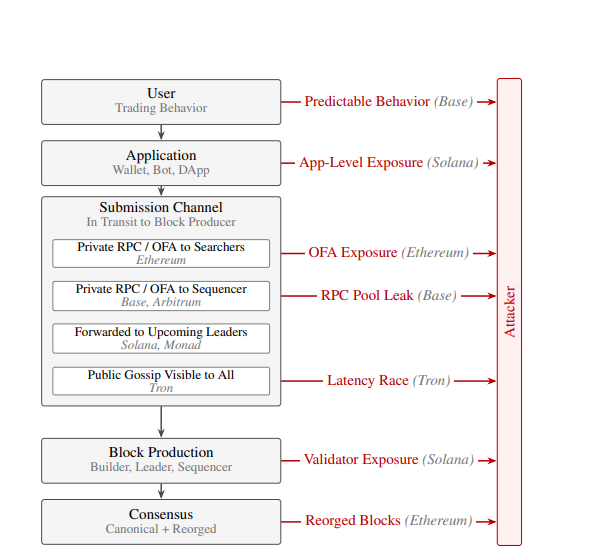
Protected order flow transaction paths and identified exposure points. Source: arxiv
The authors use the term “protected order flow” for transactions routed through mechanisms intended to protect them from front-running. Their central finding is that exposures can still emerge elsewhere in the transaction pipeline.
A user’s swap can pass through an application, remote procedure call (RPC) infrastructure, transaction relays, and validators before execution. Hiding it at one point does not necessarily hide it at all of them.
The researchers found evidence of both validator-level and application-level exposure on Solana. Ethereum showed different weaknesses, including order-flow auctions and reorganized blocks, while Tron was vulnerable to latency-based front-running, and Base showed RPC exposure and predictable victim behavior.
That makes sandwich protection less about whether a blockchain has a public mempool and more about who can observe order flow before settlement.
Solana’s sandwich problem changed rather than disappearing
The longitudinal data provides another important finding: Solana’s attack surface did not remain static.
Earlier in the observation period, sandwich attacks were disproportionately associated with particular validators. The researchers interpret that concentration as evidence consistent with validator-level transaction exposure.
Solana’s MEV infrastructure subsequently changed.
Jito shut down its public mempool in March 2024 amid concerns that it was facilitating sandwich attacks. Solana has also developed transaction-routing protections specifically aimed at reducing MEV exposure. Its current developer documentation explicitly presents Jito transaction routing as a way to keep transactions out of sandwich attacks.
Yet sandwiching continued.
The researchers found that from 2025 onward, validator concentration declined while victims increasingly clustered around particular applications. They argue this pattern points toward application-level exposure becoming increasingly important.
That is potentially more difficult to solve.
Removing a mempool closes a relatively identifiable information source. Removing malicious validators can similarly eliminate particular participants. Application-level exposure widens the security perimeter to wallets, interfaces, RPC providers, aggregators, and other infrastructure through which transactions travel.
The paper’s broader conclusion is not that protected order flow provides no protection; it is that existing mechanisms can provide weaker guarantees than users may expect because exposure can occur at multiple layers.
Why did 8,631 bots make $345 million?
Scale helps explain why sandwiching remains attractive even when individual attacks are relatively small.
Dividing $345.2 million in estimated net profit by approximately 28 million detected attacks produces an average of roughly $12.30 per attack.
That figure should not be interpreted as the average victim loss. The researchers estimate bot profitability across detected sandwiches, and individual attacks vary considerably.
But it illustrates the economics of automation.
A strategy capable of extracting $10 or $20 does not appear particularly significant in isolation. A bot that can repeat profitable variants millions of times is operating under completely different economics.
The researchers also imposed behavioral filters intended to avoid classifying ordinary trades as attacks. Their methodology searches for persistent bots and sandwich-like trading patterns rather than treating every suspicious sequence as malicious.
That methodological choice is important because protected-order-flow sandwiches can look different from the classic three-transaction Ethereum sandwich.
The researchers found these attacks rarely occurred tightly around victims. Their detection approach captures “wide” attacks that can stretch across transactions and blocks.
This also complicates defenses. A system designed primarily to detect an obvious attacker-victim-attacker sequence may miss strategies operating across a wider execution window.
Solana dwarfed other chains in measured sandwich profits
The cross-chain comparison is arguably the paper’s most striking result.
Solana accounted for nearly all the estimated profit from the protected-order-flow sandwiches researchers detected.
Ethereum, despite its long association with MEV and front-running, recorded only 30,607 attacks against protected transactions in the main data set. Reorganized Ethereum blocks exposed another 2,875 victims.
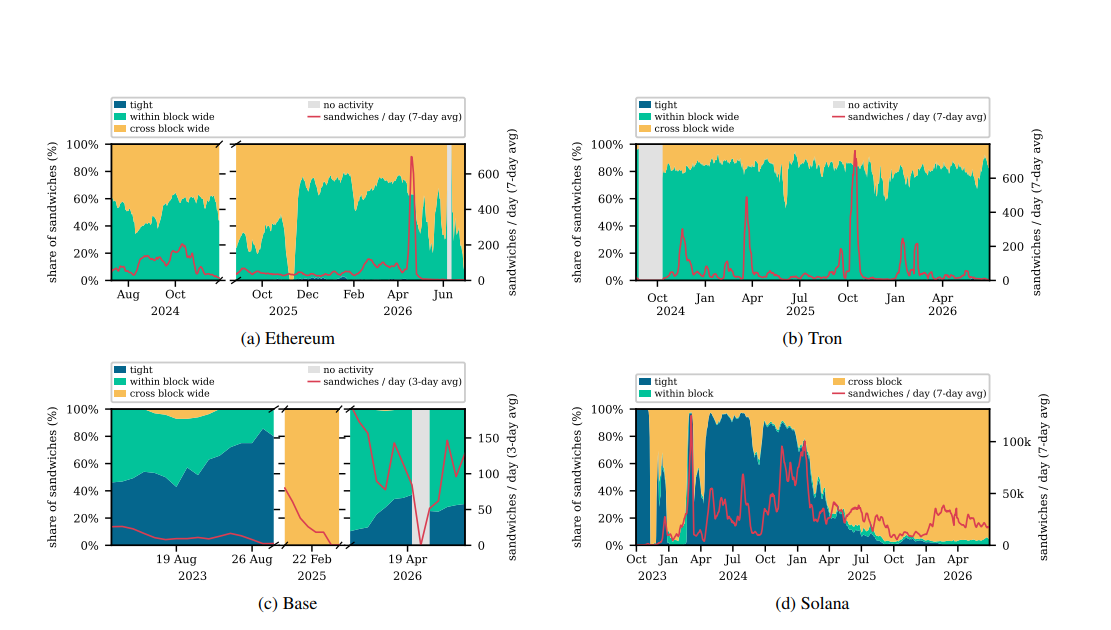
Sandwich attacks per day, per chain. Source: arxiv
Tron recorded 38,567 attacks, while Base recorded just 1,889, compared with 28 million on Solana. The gap is striking, although the researchers caution against treating attack counts as a direct measure of a blockchain’s overall security. The study examines a specific form of sandwiching against protected order flow, while the networks differ significantly in architecture, transaction routing and MEV defenses. That said, zero detected persistent attackers also does not prove attacks are impossible.
Still, the scale makes Solana an important case study in what happens when MEV moves away from a transparent public mempool.
Heimbach’s broader research focuses on blockchain protocol design, decentralized finance (DeFi) measurement and mechanism design, including earlier academic work specifically on preventing transaction-reordering manipulation and eliminating sandwich attacks.
Her latest research with Solmaz, Öz, and Torres argues that the problem is now distributed across the entire transaction lifecycle rather than confined to one visible mempool. The authors call for stronger end-to-end defenses rather than assuming individual privacy mechanisms are sufficient.
Experts are shifting the focus from mempools to information leakage
The findings fit a broader change in how MEV researchers are approaching transaction privacy.
Flashbots’ latest MEV research roundup highlighted the study specifically for showing how information leaks, reorganizations, and predictable trading behavior can undermine front-running protections.
Meanwhile, Jito’s own explanation of harmful MEV recognizes sandwiching as predatory behavior that extracts value from ordinary traders, while its newer protection mechanisms attempt to constrain how transactions can be positioned inside bundles.
Those approaches attack different parts of the same problem.
But the new paper suggests transaction confidentiality behaves more like a chain: Protection is only as strong as the weakest point through which the order passes.
Private RPC infrastructure cannot fully protect a trade if information leaks later. Removing a public mempool cannot solve application-level exposure. Validator controls cannot prevent an application from revealing enough information for an attacker to anticipate a transaction.
And even perfect confidentiality may not eliminate every form of sandwiching if a trader’s behavior becomes sufficiently predictable.
Protected order flow needs end-to-end protection
The headline number — $345 million extracted by 8,631 bots — is dramatic, but the more important finding is how the attacks survived.
Solana changed its MEV environment. Public transaction exposure was reduced. Validators associated with harmful behavior faced pressure. Transaction-protection mechanisms improved.
Yet the researchers still observed sandwiching, with the apparent source of exposure shifting over time.
That suggests MEV defenses can produce a displacement effect: Close one observation point and sophisticated attackers search for another.
The next stage of MEV protection, therefore, cannot simply be “remove the mempool.”
Applications, RPC infrastructure, relays, validators, and ordering mechanisms need to be considered as one transaction pipeline. Users also need clearer guarantees about what private or protected routing actually promises.
Solana’s 28 million detected attacks provide the clearest evidence yet of why.
The public may not be able to see a transaction waiting to execute.
A profitable attacker only needs someone in the pipeline to see enough.