


 preferred on


Points of Focus
- Gnosis Chain plans to become the first general-purpose Ethereum Economic Zone (EEZ) network in spring 2027.
- Ethereum’s rollup expansion has reduced transaction costs but fragmented liquidity, leaving developers dependent on bridges, duplicated infrastructure, and separate DeFi markets.
- Gnosis will retire its roughly 200,000-validator network in favor of a centralized block composer.
Ethereum’s scaling strategy is facing a fundamental test as Gnosis Chain prepares to abandon its independent layer-1 (L1) architecture and become a network that settles directly on Ethereum.
On Nov. 4, Gnosis co-founder Friederike Ernst announced that Gnosis Chain would join the Ethereum Economic Zone (EEZ) in spring 2027, becoming its first general-purpose production network.
We built Gnosis Chain to scale what Ethereum couldn’t yet. Now Ethereum can be the settlement layer for all of it. Next spring Gnosis Chain becomes the first EEZ production network, composing synchronously with L1. It’s been a long road and it ends where it started. https://t.co/otP8fMQmcq
— Friederike Ernst (@tw_tter) November 4, 2026
The announcement follows the launch of Rollup X, an EEZ development network demonstrated at Devcon Mumbai, where applications executed transactions involving Ethereum mainnet and a rollup without conventional bridging delays.
The initiative targets one of Ethereum’s most persistent problems: Although layer-2 (L2) networks have made transactions cheaper, they have also divided users, liquidity, and applications into separate environments.
Gnosis believes synchronous composability — the ability for contracts on different networks to interact within a single transaction — could reconnect those environments.
But the proposal introduces its own trade-offs, particularly around block production, security, and the extent to which Ethereum’s existing rollups will participate.
Ethereum’s L2 expansion has created a liquidity problem
Ethereum’s rollup-centric roadmap was designed to increase transaction capacity without requiring every transaction to execute on mainnet.
Networks such as Base, Arbitrum, and Optimism have helped reduce transaction fees and accommodate applications that would otherwise face higher execution costs on Ethereum L1.
However, moving execution away from the mainnet has also divided Ethereum’s economic activity.
In her Nov. 4 announcement, Ernst argued that Ethereum’s biggest remaining challenge is no longer transaction throughput but fragmentation.
According to figures cited by Gnosis, seven out of every eight Ethereum ecosystem transactions occur on rollups, yet only about one-sixth of decentralized finance (DeFi) capital is held on them.
Ethereum mainnet retains about $46.4 billion in DeFi total value locked (TVL), compared with $6.1 billion on Base and $1.5 billion on Arbitrum One, based on the figures in the announcement.
These figures illustrate a gap between where users transact and where substantial financial liquidity remains concentrated.
That separation creates costs beyond ordinary bridge fees.
A decentralized exchange operating on one rollup cannot automatically access liquidity deposited in a pool on another. Lending markets must attract collateral independently, while applications often deploy separate contracts and infrastructure across networks.
Consequently, Ethereum’s growing number of execution environments can create inefficiencies even as individual transactions become cheaper.
Gnosis estimates that operating its existing independent chain costs its decentralized autonomous organization (DAO) between $7 million and $10 million annually, partly because it must maintain infrastructure and incentives that already exist elsewhere in the Ethereum ecosystem.
The economic question is whether Ethereum needs dozens of separate liquidity environments to achieve scalable execution, or whether those environments can share more of the same financial infrastructure.
Gnosis tests Ethereum mainnet liquidity access without traditional bridges
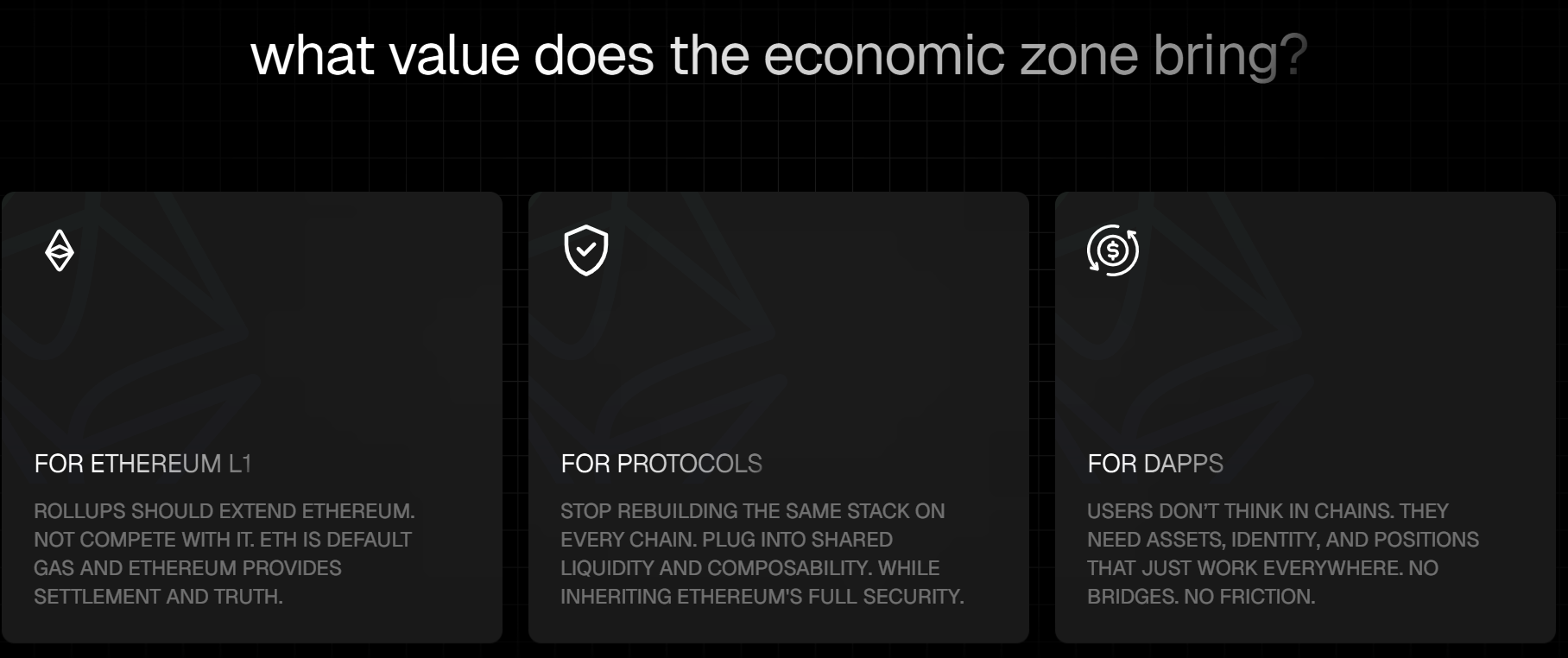
The Ethereum Economic Zone attempts to address that problem by changing how applications communicate across networks.
Under conventional cross-chain arrangements, a user may need to transfer assets through a bridge, wait for settlement, and then execute another transaction on the destination network.
EEZ instead aims to let smart contracts on participating rollups call Ethereum mainnet contracts and use their results within the same transaction.
If one part of the composed operation fails, the intended design allows the entire operation to revert.
At Devcon Mumbai, Gnosis demonstrated three potential applications through Rollup X.
The first involved CoW Swap accessing Ethereum mainnet liquidity to execute a trade initiated on the rollup, with the resulting assets returned within the same composed transaction.
This could reduce the need for decentralized exchanges to maintain deep liquidity pools on every participating network.
A second demonstration involved Safe, the smart account infrastructure originally developed within the Gnosis ecosystem.
The demonstration showed how account ownership changes and spending permissions could be coordinated across Ethereum and Rollup X.
Such functionality could become relevant for institutions managing treasury assets across multiple networks, where inconsistent permissions can create operational and security risks.
The third demonstration focused on post-quantum cryptography.
A Falcon signature was verified on Rollup X and used to authorize an Ethereum mainnet transaction.
According to Gnosis, performing the verification directly on Ethereum would require about 5.5 million gas, compared with 495,000 mainnet gas when using Rollup X, a 91% reduction in L1 gas consumption.
That does not eliminate the computational work. Instead, it moves expensive verification to a lower-cost execution environment while retaining Ethereum settlement.
adoption without surrender pic.twitter.com/rNibi7tUgp
— Gnosis (@gnosis_) March 29, 2026
The broader implication extends beyond cryptocurrency trading.
Applications could eventually combine low-cost computation with Ethereum-based collateral, settlement, and account permissions without treating every network as a separate financial system.
However, these demonstrations remain early-stage technical results, not evidence that the architecture is ready to secure substantial production assets.
Gnosis will retire 200,000 validators to improve Ethereum interoperability
The most controversial element of the transition is what Gnosis must give up.
Today, Gnosis Chain operates as an independent proof-of-stake blockchain supported by approximately 200,000 validators.
Under the EEZ architecture, that validator set will retire, and a Gnosis-operated composer will assume responsibility for producing blocks.
The change will allow Gnosis to target two-second blocks while coordinating execution with Ethereum’s 12-second slots.

Ernst acknowledged that the decision involves sacrificing decentralized sequencing to achieve faster execution and synchronous composability.
The trade-off raises a question that interoperability improvements alone cannot answer: Does making Ethereum’s networks work together justify concentrating control over transaction ordering?
A centralized composer could introduce censorship and availability risks if users depend on one operator to include transactions.
Ethereum settlement and cryptographic proofs can help protect the validity of network state, but they do not automatically eliminate every risk associated with transaction inclusion or sequencing.
The transition also introduces temporary security assumptions.
Gnosis documentation indicates that the initial implementation will likely use trusted execution environment-based proving infrastructure before moving to real-time zero-knowledge proofs.
Its core contracts are still undergoing development, with independent audits required before production activation.
Importantly, the initial EEZ release will not provide unrestricted communication across every participating network.
At launch, Gnosis applications are expected to call Ethereum mainnet contracts synchronously. Ethereum-to-Gnosis calls, nested execution, and direct interoperability between different EEZ networks are planned for later phases.
That means Gnosis could improve access to mainnet liquidity without immediately eliminating fragmentation across Base, Arbitrum, and other existing rollups.
There is also an economic challenge.
The EEZ framework is open-source and co-funded by the Ethereum Foundation, with Gnosis and Zisk helping develop the architecture. But other rollup operators must still decide whether adopting the framework serves their technical and commercial interests.
Networks that have invested heavily in proprietary infrastructure, liquidity incentives, and sequencing revenue may have little immediate incentive to change.
For existing Gnosis users, however, the migration is designed to be relatively straightforward.
Contracts, wallet addresses, balances, and the xDAI gas token will remain unchanged, while GNO will continue functioning as a governance token.
Developers will not need to redeploy existing applications simply because the underlying network changes.
Can Ethereum’s economic zone expand beyond Gnosis in 2027?
GnosisDAO has already approved the transition, although the precise activation block has not been announced.
Ernst is targeting spring 2027, while the project’s technical documentation describes subsequent milestones as dependent on engineering progress, testing, and audits.
The first production deployment will therefore be an important test of whether synchronous interoperability can function securely outside a controlled development environment.
Three outcomes will be particularly revealing:
- First, whether applications can consistently access mainnet liquidity without introducing new execution or settlement failures.
- Second, whether the architecture attracts meaningful financial activity rather than simply shifting existing Gnosis users onto a different settlement system.
- Third, whether additional rollups join the framework, allowing the benefits to extend beyond a single connection between Gnosis and Ethereum.
A successful Gnosis migration would demonstrate that an established blockchain can become more closely integrated with Ethereum without forcing users to abandon existing contracts or balances.
It would not, by itself, resolve Ethereum’s wider interoperability problem.
For that, the EEZ would need participation from multiple networks, reliable cross-network execution, and security guarantees strong enough for applications handling substantial capital.
Gnosis is effectively betting that Ethereum’s next competitive advantage will come not from creating another faster chain, but from allowing applications to use the ecosystem’s existing liquidity and infrastructure as a shared resource.
Whether that approach succeeds will depend less on the speed of the Rollup X demonstrations than on what survives production deployment, security audits, and the economic incentives of competing networks.
Ethereum has already demonstrated that it can scale execution across many chains. Gnosis now wants to establish whether those chains can operate as parts of one financial system without recreating the bottlenecks they were designed to escape.






