preferred on


Points of Focus
- Scammers replicated enough functioning blockchain infrastructure to make the counterfeit Giwa network appear like a legitimate layer 2.
- More than 1,300 wallets made over 2,200 deposits before 766.25 ETH was drained from the fake bridge in a single transaction.
- The attack shows how chain IDs, working RPCs, bridges, and onchain activity can create false signals of legitimacy without proving who actually operates a network.
The wallets connected. The bridge worked. Transactions went through. The network even reported the expected Giwa chain ID.
There was just one problem: Giwa’s mainnet did not exist.
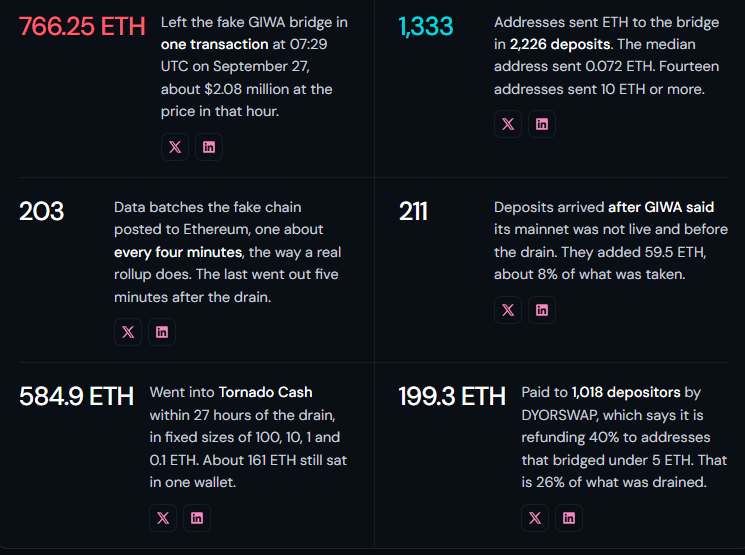
On Sept. 26, scammers began operating a counterfeit version of Giwa, the Ethereum layer 2 being developed by Upbit operator Dunamu. Within 13 hours, 1,333 addresses had sent Ether (ETH) to its bridge across 2,226 deposits, according to Bitquery.
At 07:29 UTC on Sept. 27, 766.25 ETH, worth about $2.08 million at the time, disappeared from the bridge in a single transaction.
This was more than a fake website. The attackers built enough functioning blockchain infrastructure to make the network behave like the product users were expecting.
The incident exposes an emerging authentication problem for crypto: Wallets can verify transactions cryptographically, but users may have much less certainty about who actually operates the network receiving them.
Scammers built a blockchain people could use
Dunamu launched the Sepolia testnet of Giwa in 2025 using Optimism’s OP Stack. However, the Giwa mainnet was yet to be launched.
The counterfeit network filled that gap.
It responded with chain ID 9134, the identifier users expected for the Giwa mainnet, and provided a remote procedure call (RPC) endpoint through which wallets could interact with it. An Ethereum bridge accepted deposits.
More unusually, the operators made the network behave like a rollup.
One wallet posted 203 data batches to Ethereum, approximately one every four minutes, using Ethereum’s blob infrastructure. The first appeared at 18:17 UTC on Sept. 26; the last arrived five minutes after the bridge was emptied the following morning.
This activity mattered because it provided visible evidence of something apparently functioning behind the interface. Users were not merely trusting a logo and website; they could add a network, send transactions, and observe activity resembling a real layer 2.
Open-source blockchain software facilitated much of it. The scammers did not need to invent a new rollup architecture; they needed to deploy existing technology under an identity people already trusted.
Chain ID isn’t proof of identity
The attack exploited a subtle vulnerability in how users identify blockchains.
A chain ID helps wallets distinguish one network from another and prevents transactions intended for one chain from being replayed on another. But it does not authenticate who operates the network.
Anyone configuring a blockchain can choose an identifier.
The fake Giwa network therefore returned 9134 without requiring control over Giwa itself. DYORSwap, a decentralized exchange that interacted with the counterfeit network, later said the matching chain ID contributed to its initial assessment that the network was legitimate.
This distinction is important. The scammers did not compromise Giwa’s blockchain; they copied enough of its expected identity to convince users they had reached it.
DYORSwap itself said its contracts were not hacked. It had mistaken the counterfeit network for the real mainnet.
How 1,333 wallets supplied social proof
The deposits reveal how the deception accelerated.
For about the first eight hours, Bitquery recorded only 21 deposits. Then the supposed mainnet discovery began spreading.
At its peak, 750 deposits arrived within one hour.
In total, 1,333 addresses made 2,226 deposits. The median depositor sent just 0.072 ETH, while 706 addresses sent less than 0.1 ETH. But the money was considerably more concentrated than the wallet count: Just 14 addresses deposited at least 10 ETH each and collectively supplied 214.6 ETH.
Every additional transaction potentially strengthened the appearance that other users had independently verified the network.
It created a feedback loop: A working RPC made the chain appear legitimate, successful bridging reinforced that impression, and growing activity provided social proof for the next group of users.
Fake Giwa also looked plausible by the numbers
A comparison with genuine layer-2 launches demonstrates why wallet count alone offered little warning. Artemis data shows Unichain, Ink, and World Chain attracted between 11,508 and 19,330 active addresses on their first full mainnet day, putting fake Giwa’s 1,333 depositors well below those launches. But small participation alone does not identify a fraudulent network.
More revealing is how genuine launches develop around those users. Artemis found active addresses increased 254% for Unichain and 65% for World Chain over their first 48 hours, while legitimate bridge flows were highly uneven rather than uniform.
Fake Giwa reproduced part of that pattern. Its median deposit was only 0.072 ETH, yet just 14 addresses supplied 214.6 ETH. The scam, therefore, did not necessarily look synthetic from transaction distribution alone — another reason apparently organic onchain activity could reinforce its credibility.
Even Giwa’s warning didn’t immediately stop deposits
At 06:09 UTC on Sept. 27, Giwa publicly stated that its mainnet had not launched and, therefore, could not have suffered the rumored RPC leak.
By then, 706.8 ETH had already reached the fake bridge.
But the official warning did not immediately stop the flow.
Another 211 deposits totaling 59.5 ETH between Giwa’s warning and the drain at 07:29 amounted to about 8% of the amount ultimately stolen.
It is evidence of how convincing the infrastructure had become. Users weren’t weighing an official denial against an obviously fraudulent webpage. They were seeing a functioning network, the expected chain ID, a bridge processing deposits, Ethereum data batches, and other wallets actively participating.
Technical plausibility was competing directly with official information.
766 ETH disappeared in one transaction
The exit was considerably simpler than the setup.
At 07:29 UTC, 766.25 ETH left the bridge in one transaction and landed at a fresh address. The amount matched the deposits accumulated before the drain.
The funds quickly began moving toward Tornado Cash.
By 10:00 UTC on Sept. 28, 584.9 ETH were traced into the mixer through deposits of 100, 10, 1, and 0.1 ETH. Other funds continued moving through newly created addresses.
DYORSwap subsequently began compensating affected users from its own treasury. 199.3 ETH were returned to 1,018 depositors by its Sept. 28 cutoff. DYORSwap’s stated policy offered 40% reimbursement to addresses that had bridged less than 5 ETH, while larger deposits were reviewed individually.
Verification problem goes beyond Giwa
The scam succeeded because several signals users associate with legitimacy were reproducible.
A chain ID could be copied. Open-source layer-2 software could be deployed. An RPC could respond correctly. A bridge could process real ETH. Ethereum itself could contain genuine data posted by the counterfeit rollup.
None proved that Giwa operated the network.
It changes what verification needs to mean when a new blockchain launches. Instead of asking only whether a bridge contract works or whether a chain reports the expected identifier, users and infrastructure providers need to establish whether RPC endpoints, bridge contracts, and canonical deployment addresses were published through the project’s authenticated channels.
The fake Giwa chain did not defeat blockchain cryptography; it exploited the gap between cryptographically valid infrastructure and authentic infrastructure.
More than 1,300 wallets discovered that distinction only after 766 ETH had already crossed it.