preferred on


Points of Focus
- CoinShares estimates AI infrastructure can generate about $1.5 million in annualized profit per MW, roughly three times the $500,000 it estimates for Bitcoin mining under current conditions.
- Core Scientific, IREN, and TeraWulf show why the shift is becoming harder to reverse as miners cancel equipment, decommission ASICs, and commit power to long-term AI contracts.
- Bitcoin mining is not disappearing. The deeper divide is between megawatts already committed to AI and flexible capacity that can still respond when BTC mining economics improve.
Bitcoin miners spent years chasing cheaper electricity and more efficient ASICs. In 2026, some discovered that the most valuable part of their business may no longer be the machines producing Bitcoin, but the energized sites behind them.
AlphaWire reported in March that the hash price fell to $28-$30 per PH/s/day and an estimated 15%-20% of the global mining fleet was unprofitable. By Q2, the CoinShares Bitcoin Mining Report calculated a weighted average ex-tax cash cost of about $75,500 to produce one bitcoin among listed miners, while BTC ended the quarter at $58,400. June’s monthly hash price reached an all-time low of $27.70 per PH/s/day.
The alternative looked better. CoinShares estimates AI infrastructure can generate around $1.5 million in annualized profit per MW for the miners it analyzes, versus roughly $500,000 from Bitcoin mining. Bitcoin later recovered to around $77,000 and the hash price to roughly $38, putting most operators back above cash breakeven. Yet the September 15 mining report covered by The Block still concluded that miners already committed to AI were unlikely to reverse course.
The reason is structural. Once a megawatt is tied to a long-term compute lease, mining equipment is canceled, and a site is rebuilt around another workload; Bitcoin’s next price rally is no longer the only variable that matters.
How AI changed the economics of a megawatt
Core Scientific’s Q2 results show how sharply those economics can diverge inside one company. In Q2 2026, it generated $136.7 million from colocation services, compared with $21.5 million from self-mining. CoinShares calculated a 59% colocation gross margin while self-mining posted a negative 56% margin.
The company has gone much further than simply diversifying revenue. Core said in July that 437 MW was already billing, representing approximately $635 million in average annualized colocation GAAP revenue. Its AMD-linked agreements cover roughly 530 MW for 15 years and more than $14 billion of potential base contracted revenue.
That changes what an energized mining site is worth. Bitcoin mining monetizes power through ASICs and volatile block rewards. AI customers pay for access to scarce grid connections, cooling, and data center infrastructure under contracts that can last for years.
Some miners are paying to stop mining
The clearest evidence that this shift is more than temporary comes from what miners are willing to abandon.
Core Scientific recorded a $41.9 million contract-termination loss in Q2 2026 after ending its agreement with Block and Proto, eliminating future mining-equipment delivery obligations. CoinShares says the canceled hardware represented about 15 EH/s of next-generation mining capacity.
Paying tens of millions of dollars to eliminate planned mining capacity is fundamentally different from switching ASICs off during a weak market and waiting for BTC to recover.
IREN is making a larger physical transition. Its June 30, 2026, annual report showed about 23.2 EH/s of installed Bitcoin-mining capacity consuming roughly 380 MW, but the company had begun decommissioning mining hardware and reallocating power and data center capacity to AI Cloud Services. It expects the transition to be substantially complete by December 31, 2026.
The accounting impact is substantial. IREN reported $638.8 million of FY2026 impairment expense, primarily related to mining hardware affected by the AI conversion. In the June quarter, AI Cloud revenue reached $70.5 million, edging above Bitcoin-mining revenue of $66.7 million for the first time.
Turning ASICs off is reversible. Canceling equipment, recognizing impairments, and rebuilding a site around another workload is far less so.
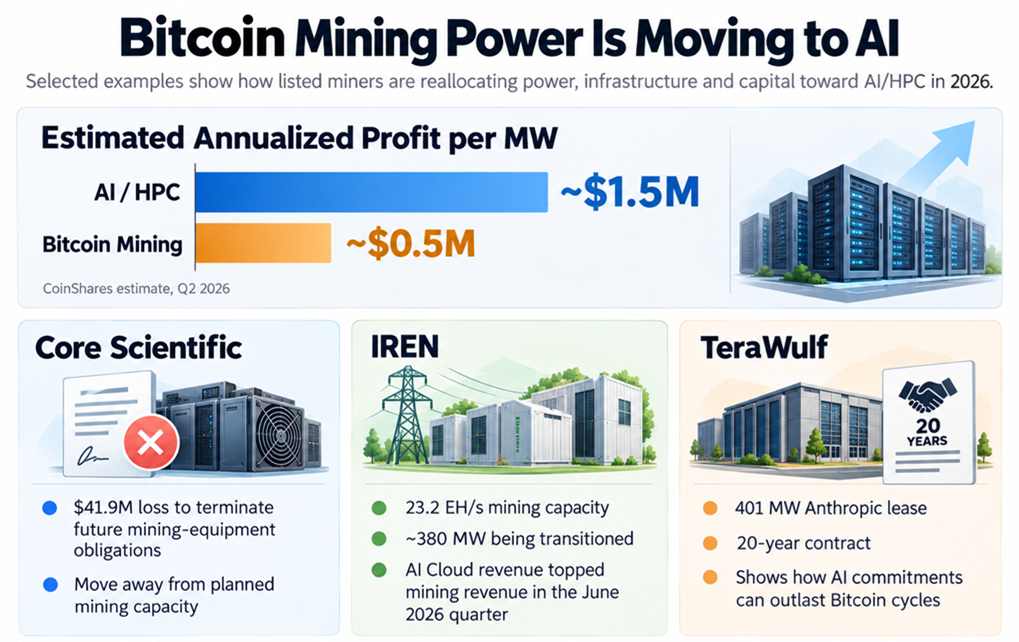
Figure 1: Bitcoin mining power is moving to AI. Visualization based on CoinShares and company disclosures. Source: CoinShares Q2 2026 report | Core Scientific Q2 filing | IREN FY2026 results | TeraWulf 8-K
AI contracts can outlast Bitcoin cycles
AlphaWire highlighted the same shift at Hyperscale Data in September, when the company shut off every Bitcoin miner at its Michigan facility to convert the site for a 10-year AI data center agreement expected by the company to generate more than $1.2 billion.
TeraWulf provides an even stronger example of contractual lock-in. On July 6, 2026, it signed a lease with Anthropic covering about 401 MW of critical IT load at its Kentucky campus. The initial term is 20 years, with two additional five-year extension options.
The shift is already visible in TeraWulf’s revenue mix. In Q2, HPC leasing generated $31.9 million, or about 71% of total revenue. That matters because a 20-year customer commitment can outlast several Bitcoin market cycles.
CleanSpark shows the trend reaching miners that are still heavily exposed to Bitcoin. In July, it signed a 20-year lease covering 175 MW at its Sandersville, Georgia campus. Its filing says Bitcoin mining will continue there until the lease begins, after which power will be diverted to the AI campus and mining will cease.
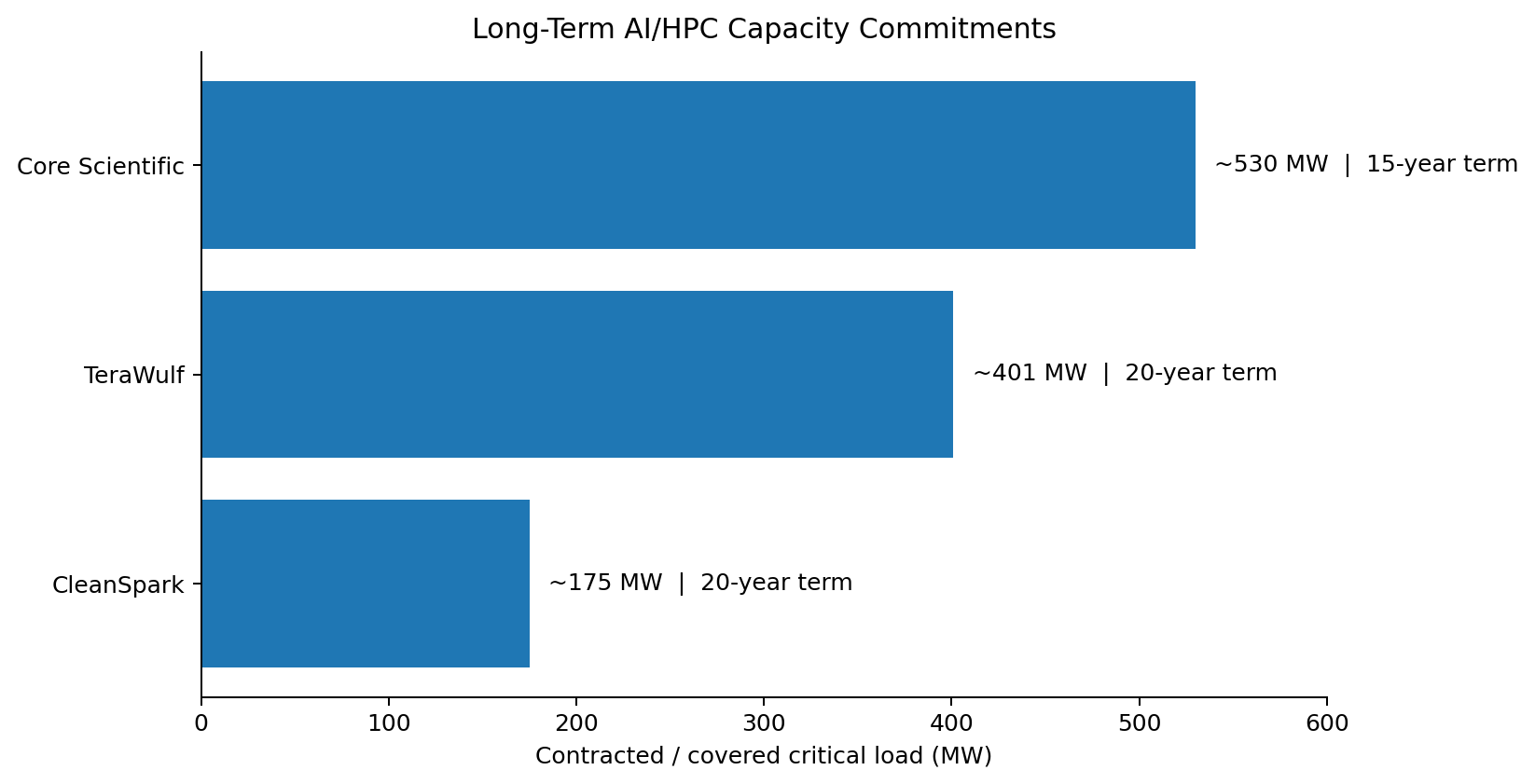
Figure 2: Long-term AI/HPC capacity commitments cited in the article. Source: Core Scientific | TeraWulf | CleanSpark
AI boom still has an execution problem
The AI narrative has a major caveat. CoinShares says more than $100 billion of disclosed AI/HPC backlog across covered miners supports only around $1.1 billion of annualized AI/HPC revenue. Roughly 550 MW is being billed against more than 4 GW contracted.
Contracted capacity is not operating capacity, and contracted revenue is not realized revenue. AI projects still require financing, construction, cooling, networking equipment, and successful delivery. CleanSpark’s agreement, for example, includes milestones whose failure can trigger rent abatements or termination.
That gap is important. AI may offer better economics per MW on paper, but miners still have to turn contracts into working data centers and cash flow.
Bitcoin mining is not disappearing
The opposite mistake would be treating AI as the end of Bitcoin mining.
Riot’s deployed mining capacity increased from 38.5 EH/s at the end of 2025 to 44.4 EH/s on June 30, 2026, a 15.3% increase. MARA ended the same period with 70.3 EH/s of energized hashrate and mined 4,669 BTC during the first half of the year.
HIVE also demonstrates that mining and AI can grow together. In the quarter ended June 30, it generated $72.1 million from digital-currency mining and $7.1 million from HPC, while receiving 1,004 BTC as mining rewards.
Bitdeer moved even more aggressively in mining. Its self-mining hashrate reached 73.0 EH/s in June, while Q2 AI Cloud revenue was only $14 million. These operators show why a higher Bitcoin price still matters to capacity that remains uncommitted.
The industry therefore cannot be divided neatly into “Bitcoin miners” and “AI companies.” The more useful distinction is between flexible megawatts and committed megawatts.
CoinShares estimates at least 35 EH/s is scheduled to leave the publicly listed mining cohort. Keel has already shut down US Bitcoin mining while converting sites toward HPC. Machines can be resold or redeployed elsewhere, so that capacity does not necessarily disappear from Bitcoin forever.
What changes is who controls the option.
A higher Bitcoin price can make mining attractive again. But it cannot instantly reclaim a megawatt already rebuilt, financed, and leased to another customer for the next 15 or 20 years.