preferred on


Points of Focus
- Bitcoin’s 90-day correlation with gold was the highest in almost six years at the end of August 2026.
- Spot Bitcoin ETFs have altered the way traditional investors access Bitcoin, shifting it further into conventional portfolios.
- Bitcoin and gold can have more in common as they start to have a macro investor base; however, Bitcoin’s volatility suggests that this is not necessarily forever.
Over the years, Bitcoin (BTC) has been referred to as digital gold but has operated in many aspects like a high-beta technology asset. In August 2026, it made that distinction more difficult to justify.
According to Bitwise research, Bitcoin’s 90-day rolling correlation with gold climbed to its highest level in almost six years. The shift occurred amid stress in US government long-dated bonds. The move occurred when the US government bonds that date in the long term became stressed. Bitcoin increased by 22.4% in the week after the shift at the deep end of the Treasury market, whereas gold increased about 5% and equities decreased.
The headline interpretation is simple: Bitcoin is trading like gold again. More significant is what changed enough for that to happen.
Bitcoin’s fixed supply has not changed. The position of gold as a reserve asset has not been transformed either. What has altered far more radically is the investor base of Bitcoin, access infrastructure, and place within portfolios of traditional types.

Bitcoin’s 90-day correlation with gold reached its highest level in nearly six years in August 2026. Source: Bitwise
Bitcoin’s gold correlation is no longer a marginal signal
The most recent relationship is important since Bitcoin has already failed significantly to pass the bare test of the digital-gold argument.
In the previous market shocks, Bitcoin tended to drop with equities as investors derisked. It is also sensitive to price, liquidity, leverage, regulation, and crypto-specific events. Gold, on the other hand, is well established in institutional holdings and central bank reserves.
The recent regime of the market was different. Bitwise cross-asset data revealed that the 90-day correlation between Bitcoin and gold was as strong as it was in circa 2020. Bitcoin was also negatively correlated with the U.S. Dollar Index (DXY), and the connection with the Nasdaq-100 was no longer as strong as it had been previously.
The shorter-term picture reinforced that shift. Glassnode indicators reportedly showed that the 30-day correlation of Bitcoin with the S&P 500 declined toward zero at the time of the rally in August.
It does not give evidence that Bitcoin has become a gold equivalent; it demonstrates that investors have recently priced the two assets in a more macro prism than they had over the years.
Bitcoin’s investor base no longer looks purely crypto-native
The biggest structural change may therefore be access.
Before US spot Bitcoin exchange-traded funds (ETFs), conventional investors typically had to have direct crypto custody, access to exchanges, futures, or crypto-linked equities to gain exposure. Those paths brought about custody, compliance, and barriers in terms of operation.
Spot Bitcoin ETF altered that design. Bitcoin would now be allowed to reside within the same brokerage and portfolio-management system with stocks, bonds, and gold ETFs.
During the climax of the August rally, the US spot Bitcoin ETFs had been absorbing some $290 million per day on average, with daily ETF trading volume approaching $3 billion. The following day, the funds had a net inflow of approximately $731 million, the biggest daily conduit in since January, per The Block.
The shift is supported by regulatory filings. An SEC Form 13F filing includes reported positions in products such as the iShares Bitcoin Trust ETF, Fidelity Wise Origin Bitcoin Fund, and Bitwise Bitcoin ETF.
It is not just greater demand that is important. The marginal Bitcoin user is more and more like a traditional asset allocator as opposed to a crypto-native trader.

U.S. spot Bitcoin ETFs saw stronger inflows during August 2026. Source: SoSoValue
Bitcoin and gold are entering the same macro trade
There is a change in access that explains who will be able to purchase Bitcoin. The second issue is why these investors can simultaneously purchase Bitcoin and gold.
In its currency debasement argument, Bitwise claims that as fiscal or monetary intervention becomes prominent, investors will respond to it by gradually moving toward treating Bitcoin and gold as having similar macro risks.
The August episode fits that reading. Longer-term bond yields came under pressure, Bitcoin and gold rallied together, and equities weakened.
This does not imply that Bitcoin and gold are the same to institutions. A more powerful explanation is that they can be used more and more as various expedients of the same macro perspective.
The sheer demand to invest in gold by itself was great. The World Gold Council report in August 2026 indicates that worldwide physically backed gold ETFs are drawing $18 billion, the second-greatest monthly inflow ever. There was a 16% month-on-month increase in assets under management (AUM) to $615 billion, and holdings were at a record high of 4,189 tons.
Bitcoin will thus not necessarily be the alternative to gold. Increasingly, the same type of portfolio can hold both.
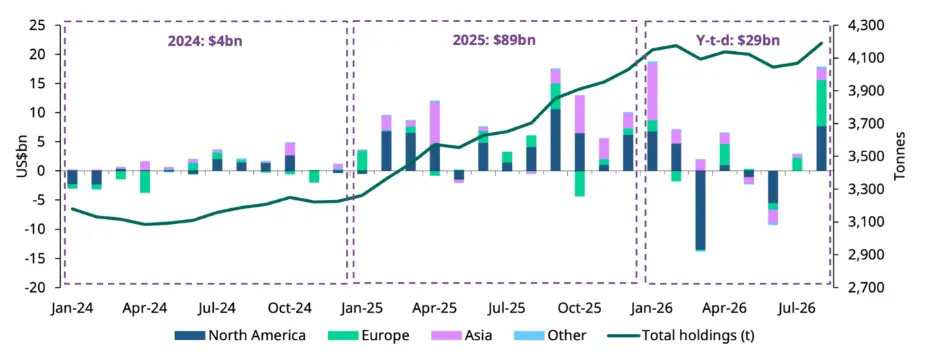
Global physically backed gold ETFs. Source: World Gold Council
Market structure now makes convergence easier
The ETF story matters beyond simple demand.
The relationships between financial assets can be tightened with overlapping categories of investors holding and rebalancing them. Bitcoin is now traded via hosted ETFs, derivatives, institutional execution pathways, and crypto-native exchanges. The connection of Bitcoin to traditional finance is then far stronger than in the past relative to the correlation peak of 2020.
Financial products have also made it easier to trade in gold. According to World Gold Council market statistics, the global activities of the gold market average approximately $430 billion daily in August. Gold ETF trading volumes jumped 83% month-on-month to $8.7 billion per day.
The assets remain fundamentally different — but an investor reacting to a weak dollar, rising inflation expectations, or worries about sovereign debt can now express that same view through overlapping infrastructure, buying both through the same brokerage account or ETF wrapper rather than through entirely separate access paths.
That explains the fact that even in cases where underlying assets are yet to become the same, correlation may intensify.
But Bitcoin has not stopped trading like a risk asset
There is a serious counterargument.
A high 90-day correlation does not prove a permanent regime change.
As reported by Glassnode, its evaluation cautioned that previous times when Bitcoin decoupled from equities on sovereign-bond selloffs were typically short-lived rather than lasting.
Bitcoin also remains much more volatile than gold. The macro positioning can still be overcome by leverage, liquidations, regulation, ETF redemptions, or selling to large holders.
In the same rally, Glassnode data showed a significant cluster of long-term-holder supply concentrated between $83,000 and $86,000 — a resistance zone where holders would return to breakeven, a reminder that crypto-specific, onchain dynamics were still shaping price action alongside the macro story.

Bitcoin’s 30-day correlations with the S&P 500 and DXY. Source: Glassnode
Correlation has a reliance on the measurement window, too. The macro regime can be trapped in a strong 30-day or 90-day relationship only to fade away when circumstances shift.
The difference is vital: The institutionalization of Bitcoin seems to be structural; forever gold-like behavior is not yet.
What has really changed?
Bitcoin has not suddenly transformed into gold.
The thing that remained different is its financial system. The barriers to access and custody were lowered by spot ETFs. The institutional involvement further ventured Bitcoin into traditional portfolios. Meanwhile, the issues of government debt, weak currency, and government intervention generated a state of affairs where Bitcoin and gold might play an analogous role in a portfolio.
The outcome is the creation of an even more overlapping base of investors who are better served by more similar investment infrastructure.
That offers a better explanation for the six-year-high correlation than just saying that Bitcoin has finally become digital gold.
It is endurance that counts. As long as Bitcoin remains correlated with gold as bond-market stress subsides, equities will be strengthened, and crypto-specific speculation will reappear; the argument in favor of structural convergence will become considerably more solid.
Assuming that the relationship will deteriorate when the current macro regime dies, the recent relationship will appear less like Bitcoin will become permanently gold and more like two entirely different types of assets engaging in temporary interim trade.
Disclaimer: This article is for informational purposes only and does not constitute financial or investment advice. Cryptocurrency prices are highly volatile. Always conduct your own research before making investment decisions.